 How-to
8 Steps to Inspect a Used Center Console Before Buying
Last Updated: November 19, 2026
Quick Summary
To inspect a used center console, check the paperwork, hull, deck, and transom on land first, then test the engine, electrical and bilge systems, and finish with a sea trial and independent marine survey. Inspecting in this fixed order means each problem you find becomes a negotiation point before you sign, not your bill afterward.
- Walk the hull on land with a low-angle light and tap it in a grid to find delamination or wet core.
- Push the tilted engine's lower unit side to side; any flex at the bracket bolts is a stop-and-investigate finding.
- Ask the seller to leave the engine cold so you can see how it actually starts.
- High hours with full service records beats low hours with no history every time.
- Run the sea trial at cruise for at least 20 minutes and note every fault for your offer.
Table of Contents
- Start With a Used Center Console Boat Inspection Checklist
- Hull, Deck, and Transom Checks That Reveal Hidden Damage
- How to Test an Outboard Motor Before Buying
- Interpreting Engine Hours and Service Records
- Bilge, Wiring, and Systems: What a Pre-Purchase Inspection Should Cover
- Why a Used Boat Marine Survey Pays for Itself
- Your Used Boat Sea Trial Checklist
- Schedule Your Center Console Inspection With Primo Yachts
- Frequently Asked Questions
Start With a Used Center Console Boat Inspection Checklist
A used center console is one of the most versatile boats you can own, and a used center console inspection follows a fixed order so nothing gets missed. At Primo Yachts, we've been serving the South Florida market since 2009, and buyers who inspect in sequence catch problems that wanderers miss.
Check the boat on land first, then the running gear, then the systems, then the water.
- Paperwork: title, liens, and service records
- Hull and deck: on the hard, out of the water
- Transom and engine: static checks before any start
- Electrical and bilge: pumps, wiring, and instruments
- Sea trial: everything under load
- Survey: independent verification before you sign
That sequence isn't arbitrary. A problem found on land is a negotiation point. The same problem found after closing is your bill.
The Right Order to Check a Boat
Start with documents, then the hull, then systems, then the water. Each step can kill the deal before you spend money on the next one.
A common mistake is starting with the engine. It's the most expensive part, so buyers rush to it. But a strong motor on a wet transom is still a bad boat. Check the structure first.
For the full picture of what separates a solid hull from a tired one, our guide on what to look for in center consoles covers the model-level differences worth knowing before you commit.
Hull, Deck, and Transom Checks That Reveal Hidden Damage
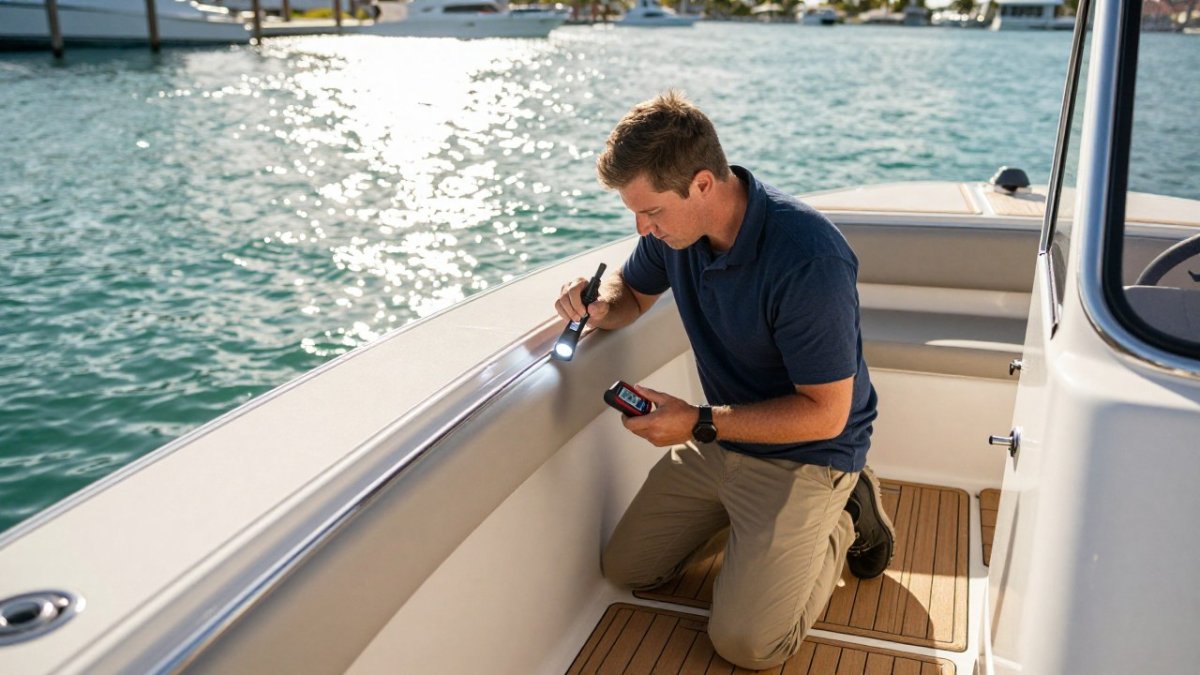
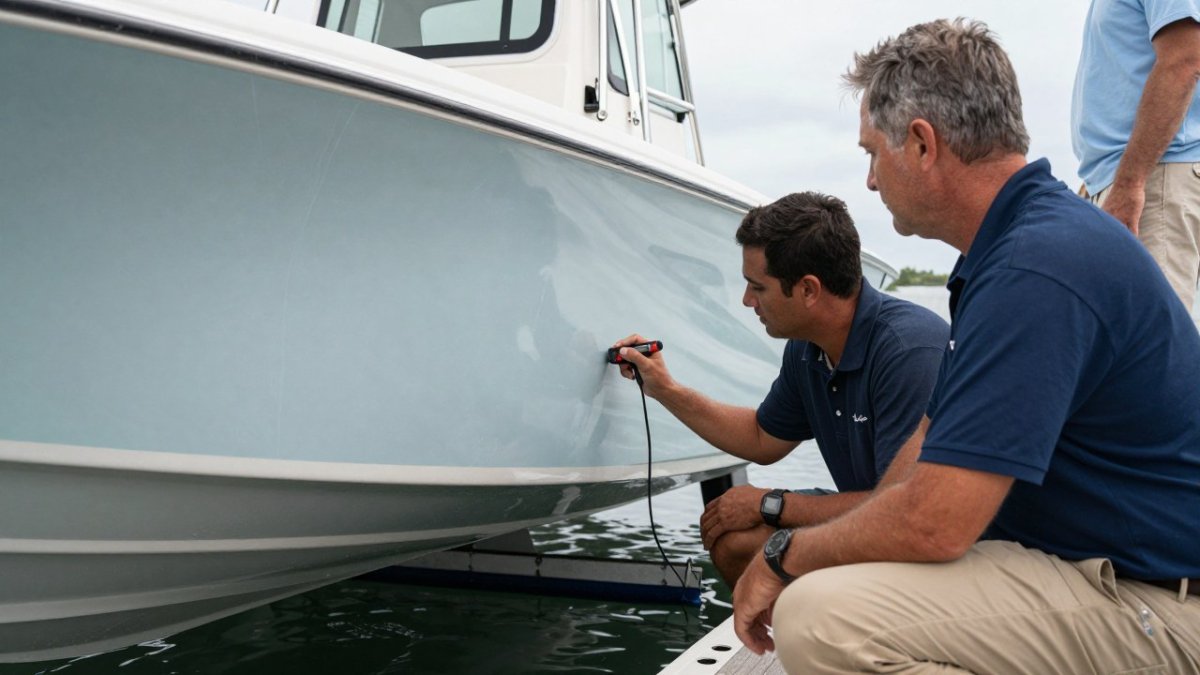
Hull damage hides in three places: the keel line, the chines, and around every fastener. Walk the hull on land with a bright light held at a low angle. Shadows reveal what straight-on light hides. Work bow to stern on one side, then return on the other, so you do not skip a section when the seller starts talking.
Bring a few basic tools: a bright LED flashlight, a plastic tapping hammer, a moisture meter, and a pocket screwdriver. The hammer and meter turn opinions into readings you can put in an offer.
Reading the Hull Like a Surveyor
Look for impact damage, stress cracks, and repairs that don't match the surrounding gelcoat. A crack radiating from a hard point is structural until proven otherwise.
Tap the hull in a grid: along the keel, both chines, the strakes, and around every through-hull and fastener.
A moisture meter gives you a number, and numbers start negotiations.
Deck, Flooring, and Water Intrusion
On deck, walk every square foot. Soft spots under your heel mean wet core.
Open every hatch and look at the underside of the deck. Staining, delamination, and rust trails on fasteners tell you water has been there.
Transom: The Highest-Stakes Check
The transom carries the engine, so treat it as the highest-stakes area on the boat.
With the engine tilted up, stand behind the boat and push the lower unit side to side and fore and aft.
Tap the transom in a grid around the bracket and along the hull sides. Compare readings port and starboard.
For the full picture of what separates a solid hull from a tired one, our guide on what to look for in center consoles covers the model-level differences worth knowing before you commit.
How to Test an Outboard Motor Before Buying
Test an outboard in three stages: cold start, idle quality, and compression. Never accept a warm engine on arrival. Ask the seller to leave it cold so you see how it actually starts.
- Cold start: should fire within a few turns, no long cranking
- Idle: steady, no hunting or stalling
- Tell-tale: strong, steady water stream
- Compression: all cylinders within a narrow band of each other
- Lower unit: check the gear lube for water or metal
Compression testing is the single most useful check you can do without a mechanic. A cylinder that reads far below the others signals a rebuild. If you're unsure whether to test it yourself or bring in help, read our guidance on when to hire a professional marine engine technician.
Watch out: a seller who won't allow a compression test is telling you something. Treat that as a red flag, not a scheduling problem.
Interpreting Engine Hours and Service Records
Engine hours mean nothing without service records. A motor with high hours and documented maintenance beats a low-hour motor with no history every time.
Ask for the full maintenance history in writing. Look for oil changes, water pump service, and lower unit lube intervals. Gaps in the record are gaps in care.
Putting Hours in Context
Engine hours should be read against how the boat was actually used and maintained. Neither number is good or bad on its own; the question is whether the maintenance matches the use.
- High hours, full records: used regularly and maintained. Proceed with confidence, but confirm compression and lower unit condition.
- Low hours, no records: sat unused, unknown care. Budget for service before your first trip.
- Hours reset or mismatched: possible meter replacement or repower. Verify with the mechanic and check the engine serial number against the paperwork.
- Recent major service: seller addressed known issues. Ask what prompted it and get the invoice.
A boat that sat is not a bargain. Seals dry out, fuel goes stale, and pumps seize.
Reading the Records Like a Mechanic
Ask for invoices, not just a verbal summary. Look for the engine serial number on the service records and confirm it matches the engine on the boat.
Check the intervals. Oil changes should appear at the manufacturer's recommended hours or annually, whichever comes first. Check the manufacturer's recommended service intervals for water pump and lower unit maintenance.
Pair the records with a compression test and, where available, a diagnostic download from the engine's ECU, which can show run time and fault history.
The Document Checklist That Protects the Deal
Hours and service records are only half the paperwork.
Here is the framework we use with buyers:
| What You See | What It Usually Means | What To Do |
|---|---|---|
| High hours, full records | Used regularly and maintained | Proceed with confidence |
| Low hours, no records | Sat unused, unknown care | Budget for service |
| Hours reset or mismatched | Possible meter replacement | Verify with the mechanic |
| Recent major service | Seller addressed known issues | Ask what prompted it |
| Serial number mismatch | Paperwork or repower issue | Resolve before deposit |
A boat that sat is not a bargain. Seals dry out, fuel goes stale, and pumps seize.
Bilge, Wiring, and Systems: What a Pre-Purchase Inspection Should Cover
The bilge tells you the boat's real story. A clean, dry bilge suggests a cared-for vessel. Standing water, rust trails, and oil sheen tell you where to look next.
Test every bilge pump by hand, not just the float switch. Check wiring for corrosion, chafe, and amateur splices. Electrical systems and instruments should all power up, including the chartplotter, radar, VHF, livewell pumps, and lights.
Inspect the fuel system for hoses, clamps, and tank access. Old fuel lines crack. Check steering through its full lock-to-lock range for binding, and cycle the trim and tilt through the complete arc. Both should move smoothly and hold position.
Corrosion is the quiet killer of outboard systems. Our article on preventing corrosion on outboard engine components explains what to look for at the terminals and connections.
Why a Used Boat Marine Survey Pays for Itself
A marine survey is an independent, written assessment of the vessel's condition, and it is the best money you will spend in the buying process. It gives you a document you can negotiate with and a record you can insure against.
A full pre-purchase survey usually takes most of a working day and includes an out-of-water inspection, as Little Yacht Sales describes in its buying walkthrough. The surveyor works for you, not the seller.
If you're still weighing whether a preowned boat is the right move at all, our piece on whether buying a preowned center console is worth it walks through the ownership math.
Your Used Boat Sea Trial Checklist
A sea trial proves the boat under load, which no dock inspection can do. Run it long enough to reach operating temperature and open water.
- Cold start, then run at cruise for at least 20 minutes
- Full throttle check: does it reach rated RPM?
- Steering through turns at speed, no binding or wander
- Trim and tilt under load
- All electronics on and reading correctly
- Bilge pumps cycling, no new water
- Fuel consumption noted against the gauge
- Listen for vibration, rattles, or unusual noise
Bring a notebook. Write down every fault you find, because each one becomes a line in your offer.
Schedule Your Center Console Inspection With Primo Yachts
The gap between a good used center console and an expensive mistake comes down to process. Inspect in order, test under load, and get an independent survey before you sign anything.
At Primo Yachts, we've specialized in center consoles since 2009, and we help buyers work through exactly this sequence. Our team specializes in center consoles, and we can walk you through the buying process from first look to closing.
If you're ready to see what's available, our comparison of used center console yachts for sale is the place to start. Reach out now to see how we can help with your boating needs.
A thorough inspection is the difference between a boat you trust offshore and one you worry about. Primo Yachts brings specialist center console expertise to every transaction, with brokerage guidance built around how these boats are actually used and maintained. Get started with Primo Yachts and inspect your next vessel with confidence.
Frequently Asked Questions
What should you inspect before buying a used center console boat?
Work through the hull, deck, and transom first, then the outboard, electrical systems, and bilge. Check for stress cracks, soft spots, water intrusion, and corrosion. Pull engine hours and service records, and confirm the fuel system and steering operate correctly. Finish with a sea trial and a professional marine survey, which should catalogue everything attached to the boat. A used center console boat inspection checklist keeps the order consistent so nothing gets skipped.
Should you get a marine survey for a used center console?
Yes. A prepurchase survey gives you an independent, documented assessment of the hull, systems, and equipment, and it typically takes most of a working day with the boat out of the water. Use the findings to price repairs and negotiate. A used boat marine survey also creates a record of condition at purchase, which matters when you resell a premium center console.
How can you tell if a used boat has hull damage?
Look for spiderweb stress cracks, gouges below the waterline, and any area that sounds dull when tapped. Moisture readings above surrounding readings suggest water intrusion in cored construction. Check the transom for cracks around the bracket and engine mounting bolts, and inspect the keel and chines for impact damage. Any finding should be confirmed by a surveyor before you commit.
What should you check during a sea trial on a used boat?
Run the engine through its full rpm range and note top speed and fuel consumption against the spec. Test steering lock-to-lock, trim and tilt, and check for vibration or unusual noise. Confirm instruments and electronics work, the bilge pump cycles, and no water enters the hull. Bring a used boat sea trial checklist so you test every system under load, not just at the dock.