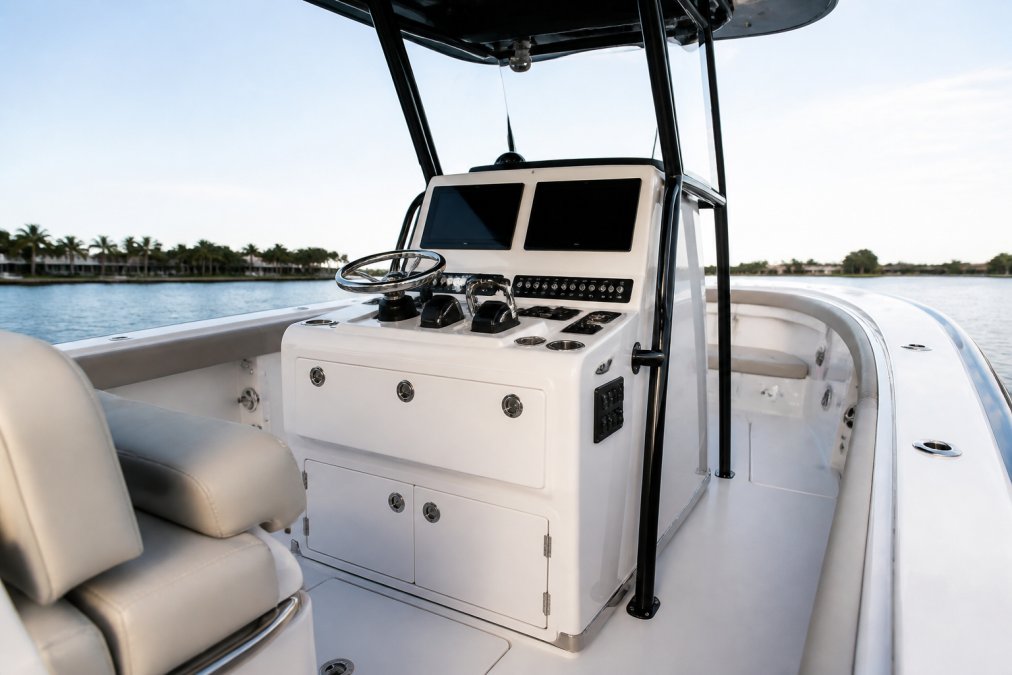
 ultimate-guide
What to Look for in Center Consoles: A Buyer's Guide
Table of Contents
- Hull Design and Performance Fundamentals
- Engine and Propulsion: What Matters Most
- Best Center Console Boats for Fishing
- Center Console Boat Features for Families
- Storage Capacity and Deck Organization
- Canopy Options: T-Top and Bimini Top Choices
- Used Center Console Inspection Tips
- Total Cost of Ownership and Resale Value
Last Updated: August 14, 2026
Hull Design and Performance Fundamentals
A well-designed hull determines how the boat performs in various water conditions, fuel efficiency, and overall ride quality. Understanding deadrise, beam, and draft becomes your first critical checkpoint when evaluating center consoles.
Deadrise, Beam, and Draft Considerations
Deadrise is the angle at which the hull bottom rises from the center toward the sides. Center consoles typically feature deadrise angles between 18 and 25 degrees. Higher deadrise (20-25 degrees) provides a softer ride in rough seas but sacrifices fuel efficiency and speed. Lower deadrise (18-20 degrees) delivers better fuel economy and speed but produces a harder, wetter ride in choppy conditions.
Beam refers to the maximum width of the boat. Wider beams provide greater stability and more usable deck space, but reduce fuel efficiency and complicate tight maneuvering. Most center consoles range from 8 to 10 feet in beam.
Draft is the depth of water the boat requires to float. Shallow-draft center consoles (under 18 inches) excel in skinny water and coastal flats. Deeper-draft models (20+ inches) offer better offshore stability but limit access to shallow fishing grounds. For versatility, look for boats with adjustable trim tabs that allow you to modify effective draft during operation.
When inspecting a center console, run your hand along the hull below the waterline to check for impact damage, stress cracks, or previous repairs that might indicate the boat has been pushed beyond its design limits.
Fiberglass Construction and Gelcoat Quality
Fiberglass construction quality separates boats that last decades from those requiring constant repairs. Examine the gelcoat, the outer resin layer protecting the fiberglass underneath. Quality gelcoat should be uniformly thick, glossy, and free from crazing (fine cracks in the surface). Run your fingernail gently across the hull, crazing suggests the gelcoat has begun breaking down, accelerating water infiltration.
Check for hull integrity by inspecting the interior fiberglass layup. Quality construction shows consistent fiber orientation with no visible voids or delamination. Delamination, where layers separate, indicates manufacturing defects or water damage that compromises structural strength.
Press on the hull in several locations. A solid hull resists pressure; a soft or flexing hull suggests inadequate fiberglass thickness or core material breakdown. This is especially critical around the transom, where outboard engines mount. Transom deterioration is one of the most expensive repairs on used center consoles.
Engine and Propulsion: What Matters Most
The engine is the second-largest investment after the hull itself. Most center consoles use outboard engines, which offer advantages in space efficiency and serviceability.
Outboard Engine Selection and Hours
Engine hours are your primary health indicator. A well-maintained outboard can run 1,500-2,000 hours before major service becomes necessary. However, hours alone don't tell the whole story, a boat run at high RPM for short bursts accumulates stress faster than one operated at moderate speeds.
Request complete service records from any used boat you're considering. You're looking for evidence of regular oil changes, impeller replacements, and scheduled maintenance. Boats with spotty service histories may have hidden damage.
Modern outboard engines come in two-stroke and four-stroke configurations. Four-stroke engines are quieter, more fuel-efficient, and produce fewer emissions. Two-stroke engines, found on older center consoles, deliver more power per displacement but consume more fuel and require more frequent maintenance.
Horsepower selection depends on your intended use. For fishing in protected waters, a single outboard rated at 200-250 horsepower provides adequate performance. For offshore conditions or water sports, dual engines or a single high-horsepower outboard (300+ HP) becomes necessary.
Fuel Capacity and Efficiency
Fuel capacity determines your operational range. Most center consoles carry 150-300 gallons of fuel. Calculate your boat's fuel consumption at your typical cruising speed. A boat burning 15 gallons per hour at 25 knots can travel roughly 200 nautical miles on a full 300-gallon tank.
Modern four-stroke outboards deliver 1.5-2.5 nautical miles per gallon at cruise speed. Older two-stroke engines typically achieve 0.8-1.5 nautical miles per gallon. When comparing used boats, factor fuel costs into your total cost of ownership calculation.
Best Center Console Boats for Fishing
Fishing-specific features separate a general-purpose center console from a dedicated fishing platform.
Live Well and Bait System Specifications
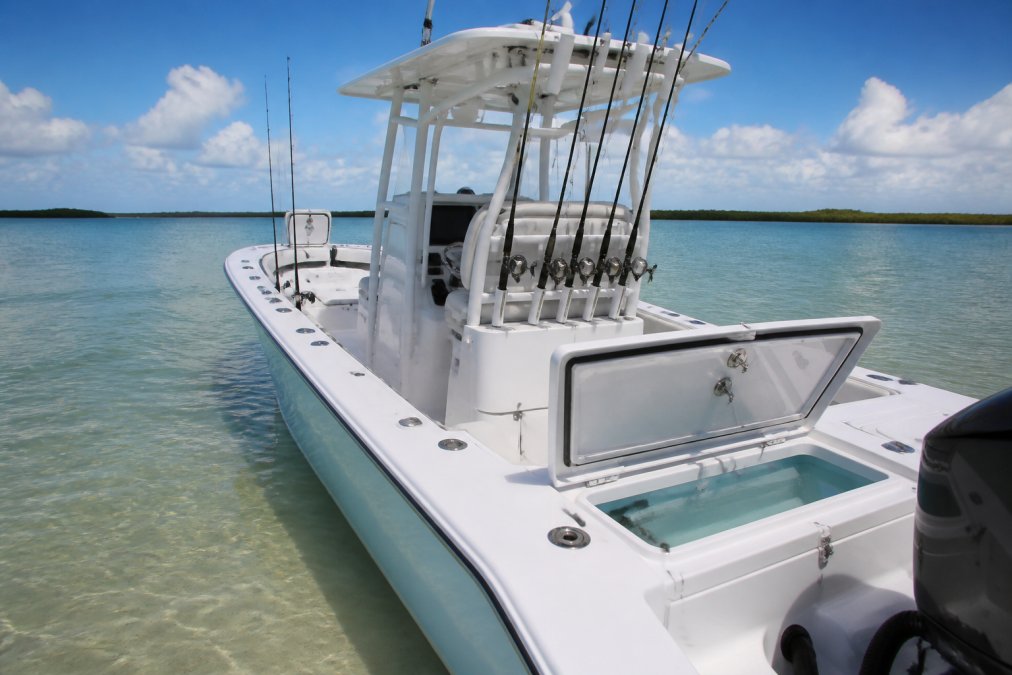
A quality live well maintains bait and catch in optimal condition throughout your fishing day. Modern live wells feature recirculating systems with raw water intake and overflow drains. The well should hold at least 40-60 gallons for effective bait management. Check the circulation system for a functional aerator with separate intake and discharge lines. Inspect through-hull fittings for corrosion or leaks.
Bait system integration includes dedicated bait storage with chilled or ambient conditions. For serious fishing operations, a dedicated bait station with cutting boards and storage prevents contamination of the main cabin.
Rod Storage and Tackle Station Layout
Proper rod storage prevents expensive tackle damage. Dedicated rod holders should accommodate your typical rod count with protection from impact and UV damage. Horizontal rod storage systems minimize stress on rod blanks during rough seas.
A well-designed tackle station includes organized storage for lures, hooks, line, and tools. Verify that storage compartments have adequate drainage and ventilation to prevent rust and mold growth.
Fish Finder and Chartplotter Integration
A quality fish finder with transducers mounted on the transom or through-hull provides real-time bottom structure and fish location data. Look for units with GPS integration, side-imaging capability, and mapping functions.
A chartplotter with integrated navigation allows you to return to productive areas with precision and provides safety features like man-overboard marking. Verify that any electronics package includes backup power systems and weatherproof connections.
Center Console Boat Features for Families
If your center console will serve both fishing and family recreation, comfort and safety features become equally important.
Seating Comfort and Cushion Configuration
Extended time on the water demands comfortable seating. Quality cushion sets use marine-grade foam and UV-resistant fabrics that withstand saltwater exposure and sun damage.
Evaluate seating ergonomics during a sea trial. The helm position should provide clear visibility forward and to both sides. Passenger seating should accommodate your typical crew size without crowding. Verify that cushions are removable for cleaning and that underlying storage remains accessible.
Bolster design matters for safety during rough seas. High bolsters on helm seats prevent the operator from being thrown during aggressive maneuvering.
Safety Features and Self-Bailing Cockpit Design
A self-bailing cockpit automatically drains water that enters the boat during operation or rough conditions. Verify that drain scuppers are unobstructed and functional.
Safety equipment should include properly mounted fire extinguishers, first aid kits, and throwable flotation devices. Check that the boat's bilge pump operates automatically and has sufficient capacity to handle water ingress.
Handholds and railings prevent crew injuries during rough water operation. Verify that all safety railings are securely mounted with no cracks or corrosion.
Storage Capacity and Deck Organization
Practical storage separates a functional fishing boat from one that becomes cluttered. Evaluate storage compartment locations, sizes, and accessibility. Verify that compartment lids have positive latches that prevent accidental opening during rough seas.
Below-deck storage should feature adequate ventilation to prevent mold and mildew growth. Deck space organization determines how efficiently you can fish or operate the boat. Verify that rod holders and tackle storage don't obstruct walkways or interfere with helm visibility.
Canopy Options: T-Top and Bimini Top Choices
A T-top is a permanent hardtop structure that provides weather protection and mounting points for electronics and additional rod holders. T-tops add weight and affect the boat's center of gravity, but provide superior protection in heavy rain or extended sun exposure.
A Bimini top is a canvas canopy supported by aluminum frames. Bimini tops offer excellent sun protection with less weight and structural impact than T-tops. They're easier to remove or adjust for trailering, but provide less weather protection during heavy rain.
Evaluate the structural integrity of any existing canopy. Check for rust or corrosion on aluminum frames and inspect canvas for UV damage, tears, or water pooling.
Used Center Console Inspection Tips
Purchasing a used center console requires systematic evaluation of structural condition, maintenance history, and operational integrity.
Hull Integrity and Transom Condition
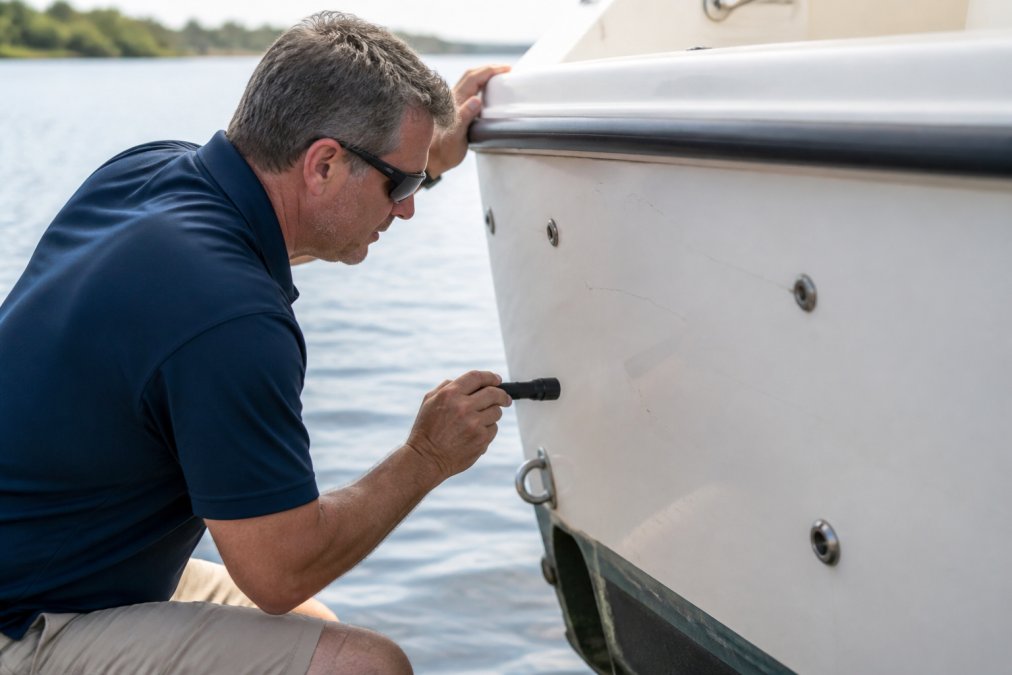
Begin your inspection with a complete visual survey of the hull exterior. Look for impact damage, previous repairs, or stress cracks that indicate the boat has experienced trauma.
The transom, the reinforced panel where outboard engines mount, endures tremendous stress. Inspect the transom from both sides. On the exterior, look for cracks, separation from the hull, or soft spots indicating water intrusion. Press firmly on the transom with your palm, a soft or flexing transom indicates core material deterioration.
Check the gunwale (the upper edge of the hull) for cracks or separation. Cracks in the gunwale often indicate the boat has experienced impacts that may have compromised structural integrity.
Inspect the hull bottom for evidence of grounding damage. While minor grounding damage doesn't necessarily indicate structural problems, it suggests the boat may have been operated aggressively or carelessly.
Service Records and Engine Maintenance History
Request complete service records for the engine and boat systems. You're looking for evidence of regular maintenance performed by qualified technicians. Boats with sporadic or incomplete service histories may have hidden damage.
Engine oil analysis provides critical insight into internal engine condition. If available, request copies of oil analysis reports from the last few services.
Verify that the boat has been winterized in regions with cold seasons. Check for evidence of recent major repairs or replacements, which suggest the previous owner was maintaining the boat proactively.
Sea Trial Evaluation and Trim Tab Performance
A comprehensive sea trial reveals operational condition that static inspection cannot. Observe how the boat accelerates, handles turns, and maintains course in various sea conditions.
Trim tabs adjust the boat's running angle for optimal performance and fuel efficiency. Verify that trim tabs operate smoothly and respond immediately to control inputs.
Listen for unusual engine sounds, knocking, grinding, or excessive vibration suggests internal engine problems. The engine should accelerate smoothly without hesitation. Test the steering system for responsiveness and smooth operation. Examine the boat's handling in various sea conditions. A well-designed center console should maintain stability and control even in moderate seas.
Total Cost of Ownership and Resale Value
The purchase price represents only the beginning of your center console ownership costs. Annual operating costs include fuel, maintenance, insurance, storage, and registration. A boat burning 20 gallons per hour at current fuel prices costs roughly $1,500-2,000 per 100 operating hours.
Maintenance costs typically run 5-10 percent of the boat's purchase price annually. A $200,000 center console might incur $10,000-20,000 in annual maintenance.
Resale value depends on hull condition, engine hours, maintenance history, and market demand. Center consoles typically retain 50-70 percent of their original value over five years. Well-maintained boats with complete service records command premium resale prices.
When evaluating a used center console, research comparable sales for similar models, age, and condition. This provides context for pricing and helps you identify genuine opportunities.
At Primo Yachts of Palm Beach, we've guided countless buyers through the process of evaluating center consoles. Our specialized expertise in center console brokerage means we understand the nuances of hull design, engine condition, and market value that casual buyers often overlook. Whether you're purchasing your first center console or upgrading to a larger platform, working with specialists who focus exclusively on center consoles ensures you make informed decisions backed by deep market knowledge and technical understanding.
Evaluating what to look for in center consoles requires balancing technical knowledge with practical experience. The hull design determines how your boat performs across different conditions. Engine condition and maintenance history reveal whether you're inheriting a well-cared-for asset or a money pit. Fishing-specific features transform a general boat into a specialized platform. Understanding total ownership costs prevents surprise expenses that undermine your enjoyment. By systematically evaluating each element, from deadrise and fiberglass quality to service records and sea trial performance, you'll identify center consoles that deliver genuine value and reliable performance for years to come. Primo Yachts of Palm Beach specializes in matching buyers with center consoles that fit their specific needs, backed by comprehensive pre-purchase evaluation and ongoing support throughout your ownership experience.
Frequently Asked Questions
What should you have in your center console?
A well-equipped center console includes a functional live well with adequate water circulation, rod holders for tackle storage, marine electronics like a fish finder and chartplotter, comfortable seating with quality cushions, proper drainage and bilge pump systems, and secure storage compartments. For fishing, add a tackle station and organized bait system. For families, prioritize safety railings, a self-bailing cockpit design, and a T-top or Bimini for sun protection. The specific features depend on your primary use, offshore fishing demands different equipment than family cruising.
How do I inspect a used center console for hull damage?
Start with a visual inspection of the hull exterior and transom for cracks, soft spots, or delamination in the fiberglass and gelcoat. Check the gunwale for separation from the hull. Press firmly on suspect areas; soft spots indicate water intrusion or structural damage. Examine the bilge pump operation and look for signs of water accumulation. Have a marine surveyor perform a detailed sea trial to test trim tabs, steering response, and overall hull integrity under load. Review service records to confirm regular maintenance and identify any previous repairs that could indicate deeper issues.
What are the primary advantages of a center console boat?
Center consoles offer 360-degree fishing access, making them ideal for anglers who need to move around the deck freely. The open layout provides excellent visibility and safety for families. They're highly maneuverable in tight spaces and generally more fuel-efficient than larger cabin boats. Many models are trailerable, reducing storage and docking costs. The unobstructed deck space allows for customization of rod holders, tackle stations, and other fishing-specific features. Their popularity means strong resale value and readily available parts and service support.
What size center console is best for a first-time buyer?
Most first-time buyers benefit from a 21- to 28-foot center console. This size offers manageable handling for solo operators, reasonable fuel costs, and enough beam and draft for stable offshore performance in moderate conditions. It provides adequate seating and storage without overwhelming complexity. Verify the boat's draft for your intended waters, check the fuel capacity relative to your cruising range, and ensure the engine hours and service records reflect proper maintenance. Consider whether you'll fish primarily inshore or offshore, as this affects the hull design and electronics you'll need.
This article was written using GrandRanker