 Comparison
7 Used Center Console Yachts for Sale: Buyer's Comparison
Last Updated: November 16, 2026
Quick Summary
Used center console yachts for sale are listed on high-volume marketplaces like Boat Trader, which showed 9,472 used center console boats, and through specialist brokerages that curate fewer, vetted listings. Asking prices across YachtWorld's center console listings run from roughly $15,105 to $1,789,199, tracking length, power, age, and use.
- Marketplaces offer volume and filters, but no one flags a mispriced listing or a soft transom.
- A specialist brokerage offers fewer boats with more context and daily model expertise.
- Compare three to five listings in the same length band, normalized on year, hours, power, and equipment.
- A pre-purchase marine survey is the single highest-return expense in the entire purchase.
- The sub-$50,000 tier usually means older, smaller boats with outboards near or past service life.
Table of Contents
- Where Used Center Console Yachts for Sale Are Listed
- Used Center Console Boat Prices: What the Listings Show
- Used Center Console Boats Under $50,000
- 32-Foot Center Console Boats for Sale: Size and Capability
- Used Center Console Yachts for Sale by Owner
- Inspecting a Used Center Console Before You Commit
- Total Cost of Ownership Beyond the Asking Price
- Start Your Search With a Specialist Brokerage
- Frequently Asked Questions
Where Used Center Console Yachts for Sale Are Listed
Used center console yachts for sale sit in two very different pools: high-volume public marketplaces and specialist brokerages that curate a smaller, vetted set of listings. According to Boat Trader's center console inventory, 20,543 center console boats were listed on the platform, split between 11,071 new and 9,472 used. YachtWorld's broader center console category showed 13,933 boats. At Primo Yachts, we watch both pools daily, and the gap between them shapes nearly every buying decision.
Marketplace Listings vs. Specialist Brokerage
Marketplaces win on volume. You get search filters, boat photos, specifications, model year, engine hours, and asking price in one scrollable grid. What you do not get is anyone telling you which listing is mispriced or which hull has a soft transom.
A specialist brokerage inverts that. Fewer boats, more context. A broker who handles center consoles daily can read a listing sheet and flag the boat that has been repowered, the one with mismatched engine hours, and the one priced for a seller who is not serious.
Used Center Console Boat Prices: What the Listings Show
Asking prices across the market run from roughly $15,105 to $1,789,199, according to YachtWorld's center console listings. That spread is not noise. It tracks length, power, age, and how the boat was used.
| Price Band | Typical Boat | What It Buys |
|---|---|---|
| Under $50,000 | Older 20-24 ft hulls | Entry fishing, near-shore use |
| $50,000-$150,000 | 24-30 ft, moderate hours | Serious inshore and light offshore |
| $150,000-$400,000 | 30-35 ft, recent power | Offshore capable, family use |
| $400,000+ | 35 ft+, premium builds | Tournament and long-range fishing |
Reading Asking Price Against Condition and Hours
A low asking price on a high-hour boat is not a bargain; it is a forecast. Engine hours, maintenance history, and electronics age tell you more than the number on the listing. Compare model year against hours: a five-year-old boat with 900 hours has worked, and the price should reflect it.
A Fair-Value Framework Buyers Can Apply
Most listings show an asking price and little else. To judge whether that number is fair, work through four variables in order.
Model year and depreciation. Center consoles hold value differently across model years, and the depreciation curve is not flat.
Engine hours and configuration. Hours matter most when they are compared against the manufacturer's service intervals and the owner's records. A large gap in hours between engines can signal a replacement, a repair, or simply a captain who ran on one engine.
Power and performance. Two boats of the same length can carry very different horsepower. A 32-footer with twin 300s and one with twin 400s are not the same boat at resale, and the higher-power version usually commands a premium that is only worth paying if your use case needs the speed and range. Ask for fuel burn at cruise, not the top-speed claim.
Equipment and refit history. Electronics, autopilot, radar, trolling motor, livewell capacity, and trailer inclusion all move value.
Comparing Asking Prices Across Listings
A practical method is to build a small comparison set of three to five listings in the same length band and model family, then normalize them on year, hours, power, and equipment. The boat that looks cheapest on the listing page often loses that position once hours and electronics are accounted for.
A seller who will not provide engine hour reports, service records, or a survey history leaves a gap in the boat's documentation that buyers should weigh carefully.
Where the Bands Break Down
Asking prices are a starting point, not an appraisal. Use length, age, hours, and equipment to narrow the search, then use the four variables below to rank what you find.
Used Center Console Boats Under $50,000
The sub-$50,000 tier is where first-time buyers get hurt. Boats in this band are usually older, smaller, and powered by outboards nearing or past their service life. That does not make them bad purchases. It makes the pre-purchase inspection non-negotiable.
Saltwater use shows up in the hardware, the wiring, and the trailer. Budget for immediate maintenance: impellers, fuel lines, batteries, and lower-unit service add up fast on a boat that sat.
Best for: first-time owners and near-shore anglers. Skip if: you plan to run offshore regularly.
32-Foot Center Console Boats for Sale: Size and Capability
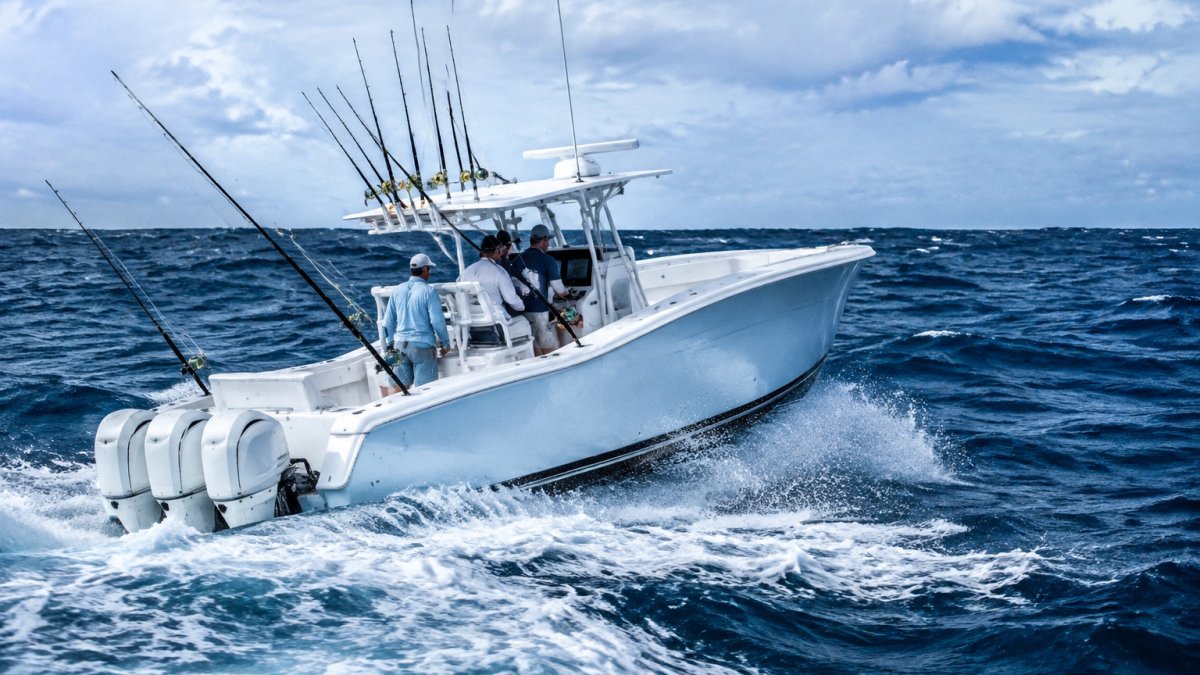
A 32-foot center console is the practical dividing line between a bay boat and an offshore boat. At this length you get twin outboard power, meaningful fuel capacity, and a ride that handles a chop without beating up the crew.
What Changes at 32 Feet
Below roughly 30 feet, most center consoles are built around single or twin mid-range outboards and near-shore range. At 32 feet, the hull gains beam, fuel capacity, and the deck space to carry a full offshore crew. The step up is not just length; it is the systems that come with it: larger fuel tanks, twin-engine redundancy, more robust wiring, and often a head and berth that make longer days practical.
Power, Fuel, and Range
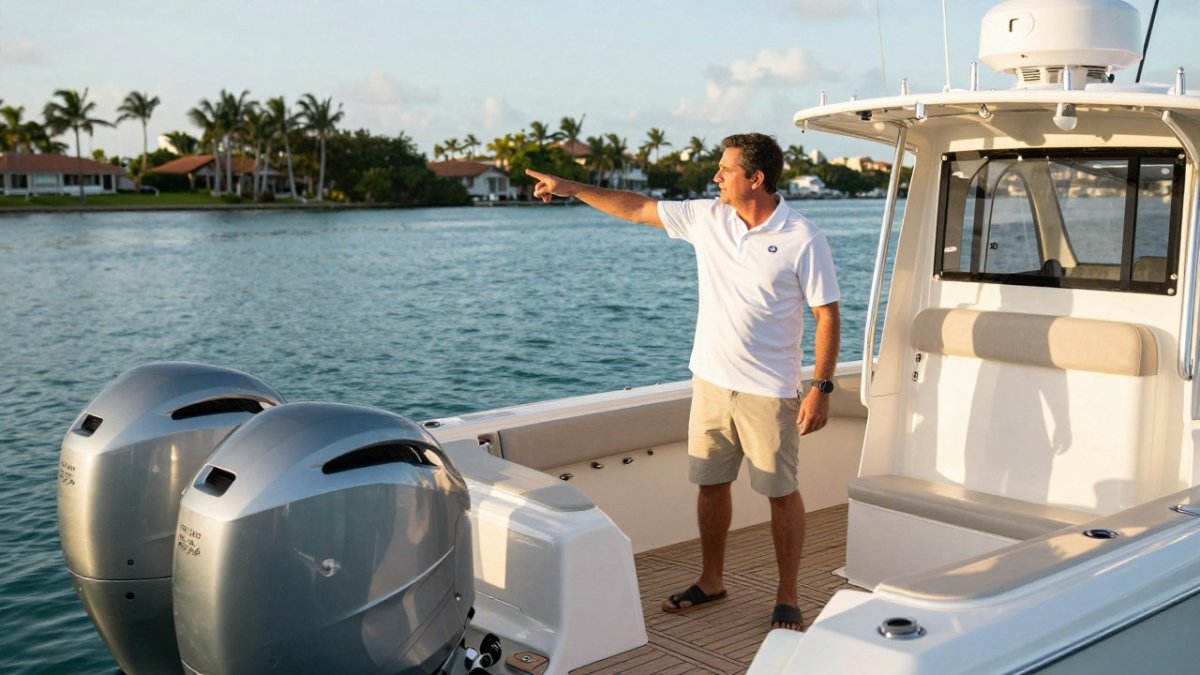
Horsepower and fuel capacity decide cruising range, and range decides how far offshore you can fish safely. Twin 300s on a 32 is a common configuration; twin 350s and twin 400s appear on higher-performance builds. Rather than trusting a top-speed claim, ask for fuel burn at a realistic cruise speed and multiply against usable fuel capacity, remembering that most operators plan to keep a reserve rather than run tanks dry.
A useful way to compare listings is to request the same three numbers for each boat: cruise speed, fuel burn at that speed, and usable fuel capacity. Those three numbers turn a range estimate into something you can check against your actual fishing plans.
What Makes a Center Console a Yacht
The market mixes ordinary center consoles with yacht-class models, and the distinction matters at resale and at the dock. Yacht-class center consoles typically carry a cabin or enclosed head, shore power and a battery management system, finished hardtops and seating, and a build quality aimed at overnight and long-range use. They also tend to sit at the top of the length and price bands, which is why a 35-foot-plus premium build can be priced well above a same-length fishing-focused hull.
Matching Size to Intended Use
A 32-foot center console suits anglers who run offshore when conditions allow and want the option of a family day on the water. A 35-foot-plus yacht-class model adds comfort and range but also adds fuel burn, storage demands, and maintenance cost.
For a deeper look at matching hull size to offshore conditions, read our guide on choosing an offshore center console.
Watch out: a 32-foot listing with twin engines at the low end of the horsepower range may be priced attractively but can feel underpowered with a full crew and fuel load, so confirm performance on a sea trial rather than assuming the hull handles it.
Used Center Console Yachts for Sale by Owner
For-sale-by-owner listings cut out the broker commission and sometimes surface boats that never hit the public market. They also cut out the vetting. No one has verified the title, the lien status, or the engine history.
What a Private Sale Skips
A private sale typically skips the marine survey coordination, the sea trial logistics, and the escrow handling a brokerage provides. That is fine if you know what you are doing. It is expensive if you do not. Buyers comparing private listings against brokered inventory can view our center console listings to see how a represented boat is presented.
Inspecting a Used Center Console Before You Commit
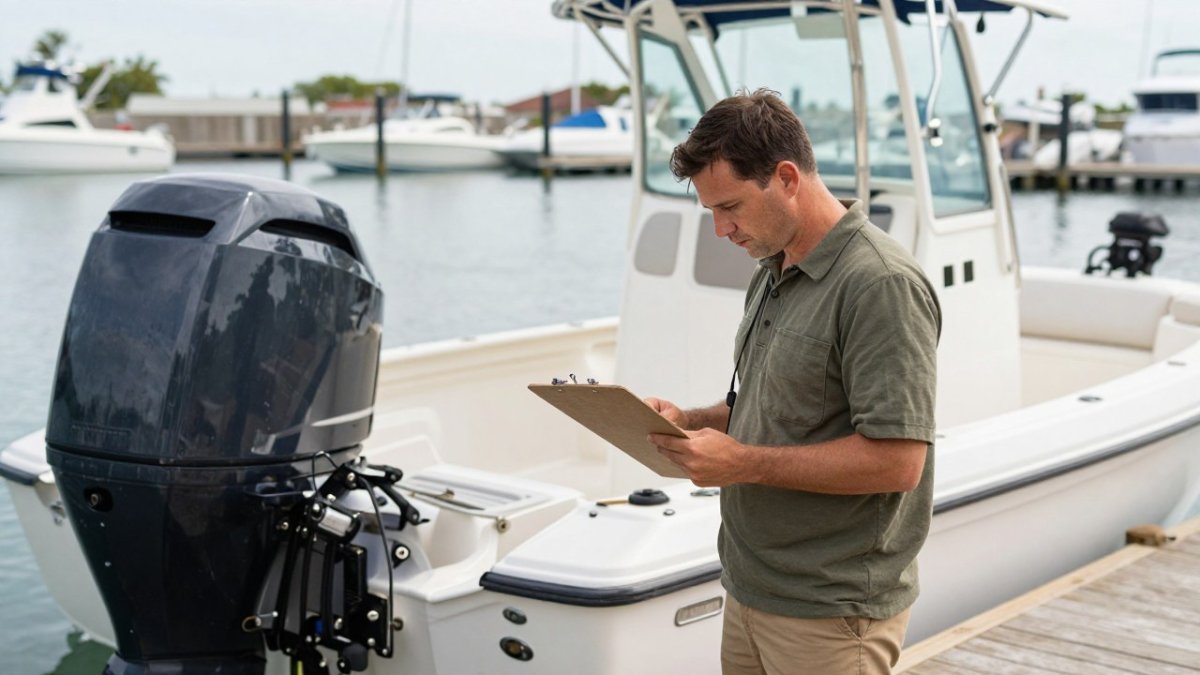
A pre-purchase marine survey is the single highest-return expense in the entire purchase. A surveyor checks the hull for moisture, the transom for flex, the deck for soft spots, and the wiring for corrosion. Engine compression and lower-unit inspection come next.
- Hull moisture reading and transom tap test
- Deck and hatch soft-spot check
- Engine compression and hour verification
- Lower unit pressure test
- Wiring and electronics function test
- Fuel tank and line inspection
- Sea trial at cruise and wide-open throttle
Total Cost of Ownership Beyond the Asking Price
The asking price is the entry fee, not the cost. Insurance, storage, maintenance, and fuel compound annually, and in saltwater use the maintenance line grows faster than most buyers expect. Financing changes the math too, and whether it is worth it depends on how long you keep the boat; our breakdown of financing a used center console covers that trade-off. Insurance discounts vary widely by owner and vessel, and our guide to Florida boat insurance discounts explains where the savings actually sit.
Start Your Search With a Specialist Brokerage
Primo Yachts has focused on the center console since 2009, working with buyers and sellers across South Florida on premium vessels. Before you engage any broker, understand what you are paying for with our guide to yacht broker commission and fees.
The hardest part of buying a used center console is not finding listings. It is knowing which listing deserves your money. Primo Yachts brings specialist center console expertise, discreet brokerage for high-value transactions, and buyer guidance from first search through survey and closing. Get started with Primo Yachts and buy with the confidence that comes from a brokerage that knows these boats.
Frequently Asked Questions
How much is a used center console boat worth?
It depends on length, model year, engine hours, and condition. Listing data shows wide spreads: A 32-foot boat with low engine hours and recent electronics sits well above an older, higher-hour hull. Compare asking prices for the same make, model, and year, then adjust for hours and survey findings before you make an offer.
Is it better to buy a used center console from a dealer or a private seller?
Private sellers can offer lower asking prices because there is no brokerage layer, but you carry the full burden of inspection, paperwork, and title checks. A specialist brokerage typically provides listing details, maintenance history, and survey coordination. For a premium used center console, the inspection and documentation matter more than the small price gap. Whichever route you take, insist on an independent marine survey and a sea trial before money changes hands.
What should I inspect before buying a used center console yacht?
Start with engine hours and service records for the outboards, then check the hull for moisture and stress cracks, the fuel system for contamination, and all electronics for function. Verify the model year against the hull identification number, confirm trailer or storage arrangements, and review the maintenance history. A pre-purchase marine survey covers structure, systems, and running gear. Budget for a sea trial in the conditions you actually fish, since performance and range only show up underway.
How many engine hours are too many on a used center console?
There is no fixed cutoff, but context matters more than the number. Four-stroke outboards run well past 1,000 hours with proper service, so a 900-hour engine with full records can be a better buy than a 300-hour engine with no history. Look at hours per season, compression and leak-down results, and whether the engines have been serviced on schedule. On a 32-foot center console, factor in the cost of a repower if hours are high and records are thin.
Where can I find a 32-foot center console boat for sale?
Large marketplaces list many 32-foot center consoles. Search filters by length, price, and location narrow the field quickly. Ask for photos, specifications, and engine hours before traveling to see any boat.