 How-to
What Does It Cost to Sell a Yacht Through a Broker?
Last Updated: November 20, 2026
Quick Summary
The cost to sell a yacht through a broker is typically 8-10% commission for midsize yachts of 40-80 feet and 5-8% for superyachts over 120 feet, paid by the seller at closing out of the sale proceeds. Total closing costs usually run 10-15% of the final price once documentation, survey, and repair credits are added.
- Commission is calculated on the final sale price, not the asking price, so it falls when a deal closes lower.
- A private sale avoids broker commission entirely but moves marketing, negotiation, and paperwork onto the seller.
- An exclusive listing typically owes commission even if the owner finds the buyer during the listing term.
- A protection period can keep the vessel exposed to the broker's commission claim after the listing expires.
- Estimate net proceeds before listing by subtracting commission, closing costs, loan payoff, and repair credits.
Table of Contents
- Yacht Broker Commission: What Sellers Actually Pay
- Who Pays Boat Broker Fees, and When
- Other Closing Costs Beyond Commission
- Selling a Boat Privately vs. Using a Broker
- What a Yacht Brokerage Agreement Should Spell Out
- Calculating Your Net Proceeds Before You List
- Choosing a Broker: Questions to Ask Before You Sign
- Frequently Asked Questions
Yacht Broker Commission: What Sellers Actually Pay
The cost to sell a yacht through a broker is not a single number. For a deeper breakdown of yacht broker commission structures, see our dedicated article.
A 2026 fee guide from Boat Tomorrow's yacht broker fee analysis reports 8-10% commission for midsize yachts of 40-80 feet and 5-8% for superyachts over 120 feet.
Rates can differ by vessel, so confirm the exact percentage with any broker before budgeting.
How Commission Is Calculated From the Sale Price
Commission is a percentage of the final sale price, not the asking price. If a vessel lists high and closes lower after survey findings or negotiation, the commission falls with the price.
The formula is simple: final sale price × commission rate = broker fee. A brokerage agreement should state the rate, the calculation basis, and whether the fee applies to gross or net.
Worked Examples at Three Price Points
The math is straightforward once you have a rate. Here is how it looks across three vessel values, using the published ranges above.
| Vessel Size | Sale Price | Commission Rate | Broker Fee |
|---|---|---|---|
| 45-foot center console | $850,000 | 10% | $85,000 |
| 65-foot sportfish | $2,400,000 | 9% | $216,000 |
| 130-foot superyacht | $14,000,000 | 6% | $840,000 |
Sale Price
These illustrate the formula, not quotes. Your rate depends on the vessel, the market, and the agreement you sign. We at Primo Yachts walk sellers through this math before anything goes on the market, because a seller who understands the fee structure negotiates from a stronger position.
Who Pays Boat Broker Fees, and When
In a typical brokered sale, the seller pays the broker fee out of the sale proceeds at closing.
How Commission Is Paid at Closing
At closing, the closing agent or title company typically disburses funds and deducts the broker's commission before the seller receives net proceeds.
You pay commission when the transaction funds, not when you list. A deal that collapses costs you nothing in commission, though it may cost you in time and marketing.
Insurance is a detail sellers forget at this stage. Coverage typically needs to stay active through closing, and managing yacht insurance during closing covers how to handle that handoff without a gap.
Other Closing Costs Beyond Commission
Commission is the biggest cost, but it is not the only one. YachtWay's breakdown of seller closing costs notes that total closing costs typically fall between 10% and 15% of the final price, shaped by sale location, ownership structure, vessel value, and transaction complexity.
That gap between the commission rate and the total cost is where budgets break.
Common additional costs include:
- Documentation and closing agent fees for title work and transfer paperwork
- Survey and haul-out costs when a buyer's survey requires the vessel out of the water
- Minor repair credits negotiated after survey findings
For a full tally of what these line items look like together, our complete guide to yacht broker commission and fees lays out the structure.
Selling a Boat Privately vs. Using a Broker
A private sale avoids the broker commission entirely. That is the whole appeal, and it is real money on a high-value vessel.
It also moves the work onto the seller.
Here is the honest comparison.
| Factor | Broker Sale | Private Sale |
|---|---|---|
| Commission cost | 8-10% typical | None |
| Buyer reach | Established buyer network | Seller's own network and listings |
| Negotiation | Broker handles offers | Seller negotiates directly |
| Paperwork and closing | Broker coordinates | Seller manages |
| Time to close | Often faster with qualified buyers | Varies widely |
A private sale suits a seller with a known buyer, deep market knowledge, and patience for paperwork. If you are weighing the private route, our breakdown of alternatives to selling a yacht privately shows what the other side looks like.
What a Yacht Brokerage Agreement Should Spell Out
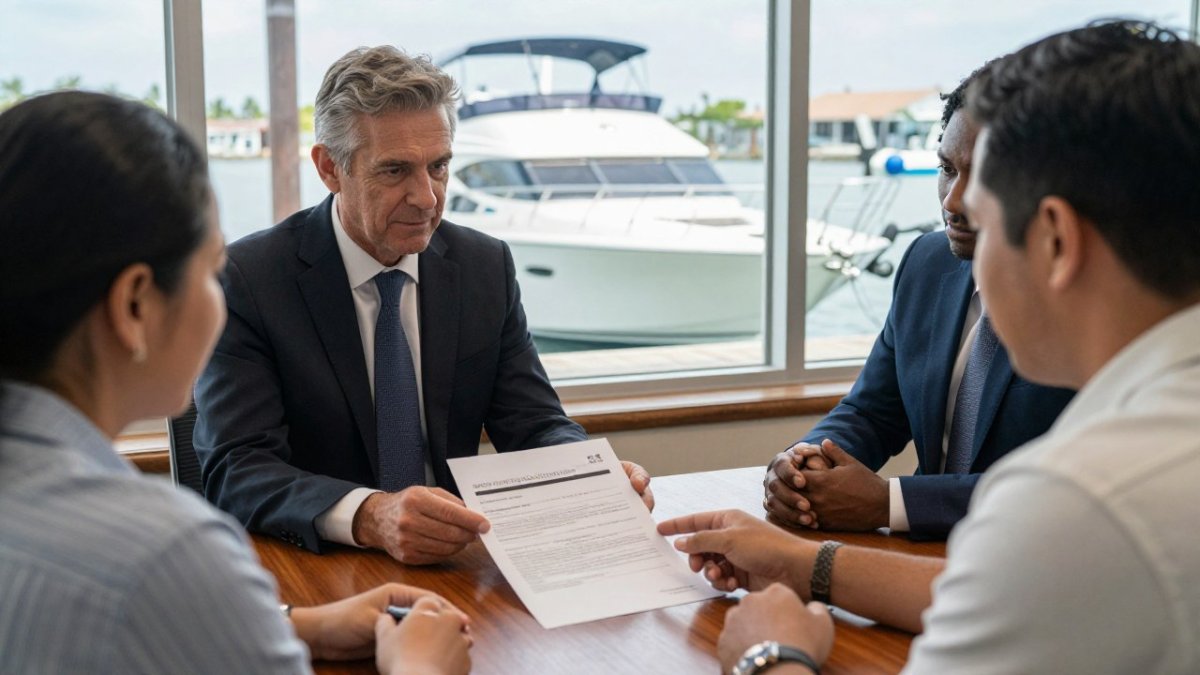
A yacht brokerage agreement authorizes a broker to market your vessel and sets the terms of payment. Read it before you sign. The commission rate gets all the attention, but the clauses around the rate decide whether you actually owe it. The same care with contractual terms matters when buying a yacht in South Florida, where the purchase agreement also shapes each party’s obligations.
Exclusive vs. open listing
An exclusive listing gives one brokerage the sole right to sell the vessel for the listing term.
An open listing lets the owner list with multiple brokerages and pay only the broker who produces the buyer.
A middle structure is the exclusive agency listing, where one brokerage is named but the owner retains the right to sell to a buyer they find themselves without paying commission.
Listing term, renewal, and cancellation
Listing terms vary by vessel and market, and agreements should state the term explicitly. Two clauses matter more than the length itself:
- Automatic renewal. Some agreements roll over automatically unless the seller gives written notice. Calendar the notice date the day you sign.
- Cancellation. A seller who wants out early may owe marketing costs already incurred, or a flat termination fee, even if no sale occurs. Get the cancellation terms in writing before signing.
The protection period
A protection period (sometimes called a tail or holdover clause) keeps the vessel exposed to the brokerage's commission claim for a set number of days after the listing expires. If the broker introduced a buyer during the term and that buyer closes after expiration, the commission can still be owed. Protection period lengths vary by agreement. A long protection period paired with a short listing term effectively extends the exclusive without the seller realizing it.
Commission triggers, the clauses that cost sellers money
The rate is one number; the trigger is the set of events that make the rate payable. Read these carefully:
- Ready, willing, and able buyer. Many agreements state that commission is earned when the broker produces a buyer ready, willing, and able to purchase on the listed terms, even if the seller later declines to close. Know whether your agreement uses this standard or requires an actual closing.
- Owner-found buyer. Under a straight exclusive, the seller may owe full commission on a buyer the seller finds personally during the term. If you have a prospect, negotiate an exclusion by name before signing.
- Net listing prohibition. Confirm the agreement uses a straight percentage of the gross sale price rather than a net-listing arrangement.
Services and pass-through costs
Confirm which services are included and which are billed separately, photography, drone video, print advertising, boat-show entry fees, and haul-out for showings are common pass-through items. Ask for the marketing budget in dollars, not adjectives.
What to get in writing before signing
- Commission rate and the exact calculation basis (gross sale price, not net)
- Listing type (exclusive, exclusive agency, or open) and term length
- Cancellation terms and any early-termination fee
- Protection period length and start date
A brokerage agreement is negotiable. Sellers who treat the first draft as final leave money and flexibility on the table.
Calculating Your Net Proceeds Before You List
Net proceeds are what you keep after commission, closing costs, loan payoff, and repair credits come out of the sale price. Estimate this before you list, not after you accept an offer.
The full formula
Net proceeds = Sale price − Broker commission − Closing and transaction costs − Loan payoff − Repair credits − Owner-side prep costs
Worked example at three price points
45-foot center console, $850,000 sale price, 10% commission
| Line item | Amount |
|---|---|
| Sale price | $850,000 |
| Broker commission (10%) | −$85,000 |
| Closing, documentation, and escrow (approx. 3%) | −$25,500 |
| Survey haul-out and minor repair credit | −$12,000 |
| Loan payoff | −$300,000 |
| Estimated net to seller | $427,500 |
65-foot sportfish, $2,400,000 sale price, 9% commission
| Line item | Amount |
|---|---|
| Sale price | $2,400,000 |
| Broker commission (9%) | −$216,000 |
| Closing, documentation, and escrow (approx. 3%) | −$72,000 |
| Survey haul-out and repair credit | −$35,000 |
| Loan payoff | −$900,000 |
| Estimated net to seller | $1,177,000 |
130-foot superyacht, $14,000,000 sale price, 6% commission
| Line item | Amount |
|---|---|
| Sale price | $14,000,000 |
| Broker commission (6%) | −$840,000 |
| Closing, documentation, and escrow (approx. 3%) | −$420,000 |
| Survey haul-out and repair credit | −$150,000 |
| Loan payoff | −$5,000,000 |
| Estimated net to seller | $7,590,000 |
Run the same table at three prices: your asking price, a realistic negotiated price, and a worst-case number. If the worst case does not work for you, the listing price is too low or the cost structure needs renegotiation.
The line items sellers forget
- Loan payoff and prepayment penalties. If the vessel is financed, the lender's payoff quote, not your statement balance, governs. Ask for a payoff letter with a per-diem figure so the closing date does not create a surprise.
- Escrow and closing agent fees. A neutral escrow or title agent holds funds and handles disbursement. Fees vary by transaction size and ownership structure.
- Documentation and title work. Documentation, lien releases, and transfer paperwork can carry their own fees.
- Sales tax and registration. Treatment varies by state and by how the sale is structured. Confirm this with a qualified tax professional before you list.
How to use the estimate
Build the table before you sign a listing agreement. It tells you the minimum acceptable offer, the price at which net proceeds still clear your loan and your target, and gives you a defensible floor in negotiation.
Choosing a Broker: Questions to Ask Before You Sign
The right broker changes the outcome more than a fraction of a percentage point on commission. Ask direct questions before you commit.
- How will you reach qualified buyers for this specific vessel type?
- Who handles showings, and how are buyer qualifications verified?
- What is your commission rate, and what exactly does it cover?
- Which marketing costs are included, and which are extra?
A broker who answers these clearly has done this before. Sellers who skip the questions learn the answers the hard way, and our list of costly mistakes when selling a yacht covers the patterns we see most often.
Primo Yachts has served the South Florida market since 2009, with a specialized focus on center console and premium vessels.
Selling a premium vessel is a financial decision before it is a transaction. The commission, the closing costs, and the net proceeds all need to be clear before the listing goes live.
Frequently Asked Questions
How much does a boat broker charge to sell your boat?
Broker commission is typically a percentage of the sale price, paid by the seller at closing, and the rate can vary with vessel value. Ask for the exact percentage in writing before you sign, and confirm whether it applies to the final sale price or the asking price.
Is a yacht broker commission negotiable?
Yes. Commission is a contractual term, not a fixed industry mandate, and it varies by vessel size, type, and market conditions. Larger or higher-value yachts often carry lower percentage rates. Negotiate before signing the listing agreement, and ask what the rate includes: photography, marketing, showings, and buyer qualification. A broker who cannot explain what the percentage covers is worth questioning.
Is it cheaper to sell a yacht without a broker?
A private sale avoids the broker commission. The tradeoff is that you handle marketing, showings, buyer qualification, sea trials, survey coordination, and paperwork yourself, and you lose access to a broker's buyer network and comparable sales data. Compare the full picture of costs, not just the commission line.
What should I look for in a yacht brokerage agreement?
Check the commission percentage and what triggers it, the listing term and any renewal clause, whether it is exclusive or open, who pays for photography and advertising, and how a buyer introduced by another broker is handled. Confirm the commission split between the central listing agent and any buyer's broker, and ask what happens if you find the buyer yourself during the term. Get every fee in writing before signing.