 How-to
What Paperwork You Need to Sell a Boat
Last Updated: November 8, 2026
Quick Summary
To sell a boat, you need the original certificate of title signed over to the buyer, a boat bill of sale itemized for boat, motor, and trailer, and a written lien release if a loan exists. The buyer then files the title transfer and pays state fees.
- The certificate of title is the single most important document when you sell a boat.
- Break the bill of sale price out by boat, motor, and trailer for cleaner tax and title work.
- Never sign a blank title; fill in the buyer's name and sale date first.
- Payoff quotes from lenders expire, so request yours close to closing.
- Notify your state agency and insurer after the sale to cancel registration and coverage.
Table of Contents
- Start With the Title: The Core Document to Sell a Boat
- Boat Bill of Sale for Boat, Motor, and Trailer
- Boat Title Transfer Paperwork: Transferring Ownership Correctly
- Selling a Boat With a Loan: Lien Releases and Payoff Steps
- Boat Paperwork for an Online Sale: Remote Transactions and Digital Signatures
- State-by-State Requirements and How to Find Local Rules
- What to Do When the Title Is Missing, Lost, or Has a Lien
- Your Complete Handoff Checklist and Next Steps With Primo Yachts
- Frequently Asked Questions
Start With the Title: The Core Document to Sell a Boat
The certificate of title is the single most important document when you sell a boat. It proves who owns the vessel and lets the state record the ownership transfer.
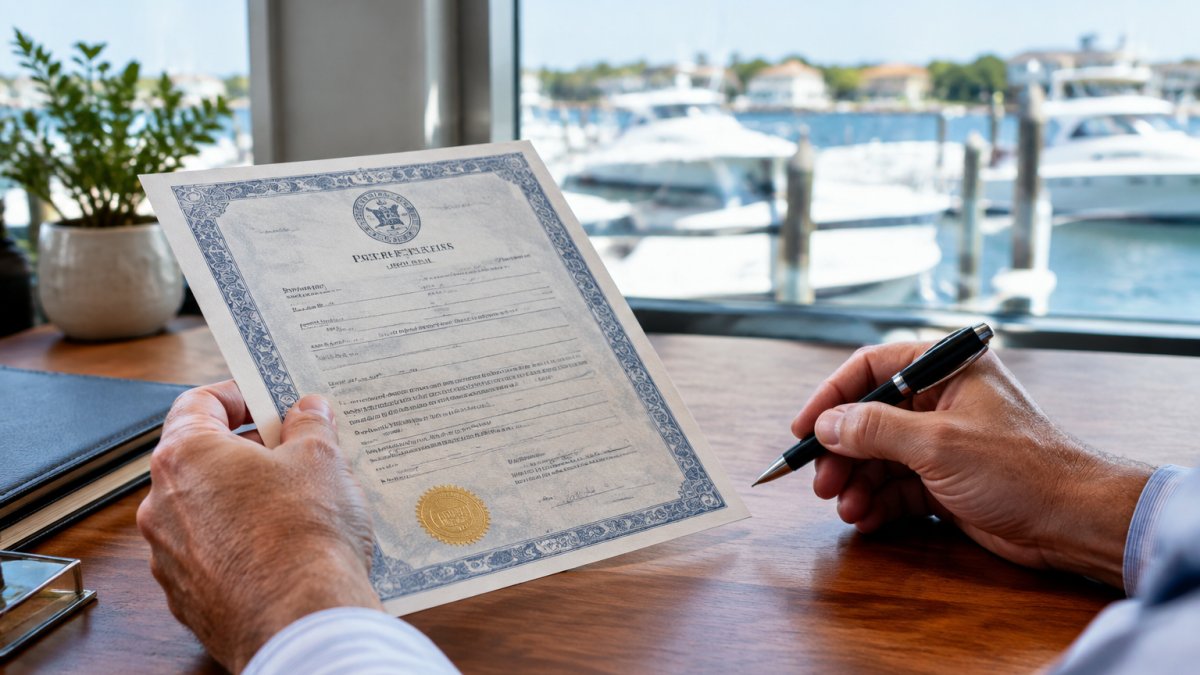
The first question to ask any seller is simple: do you have the title in hand? If the answer is yes, the process moves fast. If not, expect extra steps.
A boat title is a state-issued legal document that names the owner of a vessel and records any liens against it.
Here is what the title must show before you sell:
- The seller's name, matching a valid photo ID
- The hull identification number (HIN)
- The boat manufacturer, model, and length
- Any lienholder listed on the front
- No erasures or altered entries
Florida vessel title and registration guidance explains how titles are issued and transferred in the state.
Boat Bill of Sale for Boat, Motor, and Trailer
A boat bill of sale is a written record of the sale. It names the buyer and seller, the sale price, the sale date, and the form of payment. Most states require it to register or title the vessel in the buyer's name.
Here is what most guides miss: the boat, the motor, and the trailer are often three separate items on paper. Treat them that way.
- Boat: hull identification number, make, model, length, and year
- Motor: outboard motor serial number, horsepower, and make
- Trailer: vehicle identification number (VIN) and whether a trailer title exists
A common mistake is listing one lump price for everything. Break the price out by item. It makes the tax and title work cleaner in most states.
The bill of sale should include:
- Buyer and seller names and contact information
- Full boat description, including HIN
- Purchase price and how it was paid
- Sale date
- Both signatures, signed and dated
Boat Title Transfer Paperwork: Transferring Ownership Correctly
The title transfer happens on the back of the original title, not on a separate sheet. The seller signs the title over to the buyer, and the buyer files a transfer application with the state.
Do this in the right order:
- Locate the original title.
- Complete the seller section on the back.
- Sign and date in the presence of a notary if your state requires it.
- Hand the signed title to the buyer at closing.
- Keep a copy for your records.
The buyer then submits the title transfer and pays the state fees. In many states, the buyer must also register the vessel and pay sales tax at the same time. state-by-state boat title and registration rules tracks how requirements differ across the country.
Watch out: never sign a blank title. Fill in the buyer's name and the sale date before you sign. A blank title is how sellers lose control of a transaction.
Selling a Boat With a Loan: Lien Releases and Payoff Steps
If you still owe money on the boat, the lender holds the title or appears as a lienholder. You cannot transfer clean ownership until that lien is released.
The steps are straightforward:
- Call the lender and request a payoff quote, good through your closing date.
- Confirm how the lender sends the lien release and the title.
- Coordinate with the buyer so the payoff and the sale happen together.
- Get the lien release in writing before you hand over the boat.
A common approach is to close at the lender or through an escrow service. The buyer's funds pay off the loan, the lender releases the lien, and the remaining balance goes to you.
The thing nobody tells you: payoff quotes expire. Request yours close to closing, not weeks before.
Boat Paperwork for an Online Sale: Remote Transactions and Digital Signatures
Remote boat sales are common now, and the paperwork still has to be right. Most states accept electronic signatures on a bill of sale, but title transfer rules are stricter.
Here is what to check before you go remote:
- Does your state accept an electronic signature on the title itself?
- Will a notary be required, and can it be done remotely?
- How will the signed original title physically reach the buyer?
For the money side, use a wire transfer or a licensed escrow service. Keep a written record of the payment, the date, and the account it came from. Never release the title until funds clear.
If you are weighing a private online sale against other routes, the alternatives to selling a yacht privately are worth reviewing before you commit.
State-by-State Requirements and How to Find Local Rules
Boat paperwork is state law, not federal law. The forms, fees, notary rules, and even whether a boat gets a title at all change when you cross a state line.
Start by identifying which agency regulates vessels in your state.
Three requirements vary most and cause the most failed transfers:
| Requirement | What Varies | Why It Matters |
|---|---|---|
| Title vs. registration-only | Some states title all boats, some title only above a length or horsepower threshold, and some issue registration only | If your state does not title your boat, the transfer may run through a registration card and bill of sale instead of a title |
| Notary and witness rules | Some states require a notary on the title or bill of sale, some require a witness, some require neither | A missing notary or witness can void the transfer and force the buyer to redo it |
| Trailer treatment | Trailers may be titled, registered, or exempt depending on weight and state | A trailer that needs its own title will stall the deal if you only prepared boat paperwork |
A practical pattern many sellers use is to call the agency's customer service line with three questions before listing: Does my boat require a title in this state? Does the title transfer require a notary? Does the trailer need a separate title or registration? Once those requirements are clear, completing the bill of sale accurately helps document the agreed terms, and TAJ NOTARY & TAGS can help keep that paperwork aligned with the transfer.
Documented vessels add another layer. If your boat has federal documentation through the U.S.
Watch out: a form that worked for a neighbor's boat may not fit yours if the length, propulsion type, or trailer weight falls on the other side of a state threshold.
state-by-state boat title and registration rules
What to Do When the Title Is Missing, Lost, or Has a Lien
A missing title is not a dead end. It is a delay, and how long depends on your state and the specific problem.
Work through the problem in this order:
- Confirm whether a title ever existed. Check your state agency's records or the previous owner's paperwork. Some states do not title boats below a certain length or horsepower, which means a registration card and bill of sale may be the correct transfer documents.
- Apply for a duplicate title if the title was lost. Submit the state's duplicate-title application and pay the required fee. Do this before you list so the buyer is not waiting on you.
- Resolve any lien before transferring. If a lender appears on the title, request a payoff quote good through your closing date and confirm how the lender sends the lien release. The lien release must be in writing before you hand over the boat.
- Use a bonded title only when the state allows it. Some states issue a bonded title when ownership documentation is incomplete. Confirm the steps with your state before promising a buyer a clean title.
- Verify ownership before closing. Match the seller name on the title or registration to a valid photo ID, confirm the hull identification number on the boat matches the paperwork, and check that no undisclosed lien appears on the title.
Special ownership situations change the paperwork:
- Inherited boat: The estate or heirs must transfer the title first, often with probate or estate documents, before the boat can be sold to a third party.
- Jointly owned boat: Every owner named on the title must sign the transfer, and a missing signature will stall the buyer's registration.
- Business-owned boat: A company officer signs, with proof of authority such as a corporate resolution or operating agreement.
A common pattern is to close through an escrow service when a lien is involved. The buyer's funds pay off the loan, the lender releases the lien, and the remaining balance goes to the seller.
Watch out: payoff quotes expire, so request yours close to closing rather than weeks in advance, and never sign a blank title or hand over the boat before the lien release is in writing.
Florida vessel title and registration guidance
Your Complete Handoff Checklist and Next Steps With Primo Yachts
Use this checklist at closing so nothing gets missed:
- Original certificate of title, signed and dated
- Bill of sale, itemized for boat, motor, and trailer
- Lien release, if a loan existed
- Current registration certificate
- Hull identification number verified against the boat
- Trailer title or registration, if applicable
- Photo ID copies for both parties
- Payment record and funds cleared
- Copies of everything for your files
After the sale, notify your state agency and your insurer. Cancel the registration and the policy so you are not liable for a boat you no longer own.
If you would rather hand the paperwork to a specialist, that is what we do. Our team has guided South Florida sellers since 2009, with a focus on premium center consoles.
Before you list, review the costly mistakes sellers make in Palm Beach and how broker commission works. If you are still choosing a partner, here is how to find a trustworthy yacht broker, and how long a broker-assisted sale takes so you can plan your timeline.
Selling a boat should not stall on a missing signature or an unreleased lien. Primo Yachts brings specialized brokerage experience to every sale, from title transfer to closing.
Frequently Asked Questions
What documentation do I need to sell my boat?
You need the original certificate of title (if your state requires one), a completed boat bill of sale, the current vessel registration, and a hull identification number (HIN) verification. If a trailer or outboard motor is included, prepare separate bills of sale and titles for each. Lien releases are required if money is still owed. Check your state agency's website for any additional transfer application forms before you list the boat.
Do I need separate paperwork for the boat motor and trailer?
Yes, in most states. Outboard motors often have their own title or registration requirements, and trailers typically need a separate title and bill of sale. Treat the boat, motor, and trailer as three distinct items on the bill of sale, listing each serial number and price. This prevents title transfer delays and protects both buyer and seller if one component has a lien or missing documentation.
How do I sell a boat if I still owe money on it?
You will need a lien release from the lender before you can transfer a clean title. Request a payoff quote, arrange for the buyer's payment to satisfy the loan, and have the lender issue a release of lien. Some lenders handle the paperwork directly with the state. Do not hand over the title until the lien is officially cleared, or the buyer cannot register the boat in their name.
What should I do if I lost my boat title?
Apply for a duplicate title through your state's motor vehicle or boat registration agency. You will typically need to submit an application, pay a fee, and provide proof of identity and ownership. If the boat is financed, the lender may hold the title and must request the duplicate. Start this process before listing the boat, because selling without a title is difficult and, in some states, not allowed.