 Comparison
Deep-V vs Modified-V Hulls for Choppy Coastal Waters
Last Updated: November 7, 2026
Quick Summary
For choppy coastal waters, a deep-V or modified-V planing hull with enough deadrise, length and beam is the best match, since a sharp entry cuts wave faces instead of slapping them. A deep-V wins on dynamic and directional stability at speed, while a modified-V trades some ride softness for steadier drift and a common compromise.
- Deep-V hulls knife through chop at speed but roll at rest and need more power.
- More deadrise means a softer entry and more roll at anchor; less deadrise rides harsher but steadier.
- A 22- to 24-degree transom earns its roll at rest for long-distance running and trolling.
- Match the hull to wave period you actually see, not the height on the forecast.
- Changing heading by 10 to 15 degrees often does more for comfort than any trim adjustment.
Table of Contents
- Side-by-Side Hull Comparison for Choppy Coastal Waters
- What Makes the Best Boat Hull Design for Rough Water
- Deep-V and V-Shaped Hull Boat Behavior in Coastal Chop
- Which Is the Most Stable Boat Hull Design When the Water Turns
- Fishing Boat Hull Types and How They Match Coastal Conditions
- Trim, Speed, and Loading: What Hull Specs Don't Tell You
- Matching a Hull to Your Boating Program at Primo Yachts
- Frequently Asked Questions
Side-by-Side Hull Comparison for Choppy Coastal Waters
Comparing boat hull designs for choppy coastal waters starts with one hard truth: there is no single best hull, only the best match between a hull's geometry and the water you actually run. A sharp deep-V can look perfect at the dock and still pound when slowed in a beam sea, while flatter-bottomed boats can feel rock-solid drifting and punish everyone aboard on the ride home.
A 2024 review of planing-hull hydrodynamics published through ScienceDirect's survey of planing hull research makes the same point in academic terms: hull performance is a system of interacting variables, not a single number. Deadrise, length, beam, weight and speed all pull on each other.
Below is the comparison framework we use when a client asks which hull belongs on their dock.
The Four Hull Families at a Glance
Hull designs split into four practical families, and each one trades something to get something.
| Hull Type | Rough-Water Behavior | Best For | Main Trade-Off |
|---|---|---|---|
| Deep-V | Knifes through chop at speed | Offshore fishing, open water | Rolls at rest, needs power |
| Modified-V | Softer ride than flat, steadier drift | Coastal bay and nearshore | Compromise in both directions |
| Displacement | Pushes through waves, stable and slow | Long-range cruising | Limited top speed |
| Flat-bottom | Stable stopped, harsh in chop | Shallows and protected water | Pounding in wind chop |
The deep-V hull is a planing design with a sharp, steep entry and high deadrise carried toward the transom. That sharpness cuts wave faces instead of slapping them. The cost shows up at anchor, where the same geometry lets the boat roll.
What Makes the Best Boat Hull Design for Rough Water
The best boat hull design for rough water is a deep-V or modified-V planing hull with enough deadrise, length and beam to match the sea state you run in most often. Deadrise is the angle between the hull bottom and horizontal, measured at the transom. More deadrise means a softer entry and more roll at rest. Less deadrise means a flatter, steadier platform and a harsher ride.
Length matters just as much. Forum boaters on iboats' rough-water handling discussion argue that a longer hull of any shape can handle chop better than a short one, because it bridges wave crests instead of falling between them. That is an opinion, not a measured result, but it matches what most experienced captains report.
Deadrise, Length, and the Limits of Hull Shape Alone
Hull shape sets the ceiling on comfort, not the outcome. A 24-foot deep-V and a 38-foot deep-V share geometry but not behavior, because waterline length changes how the boat meets a wave train. Weight distribution, engine trim and speed decide whether that geometry works for you on a given afternoon.
Buying on deadrise numbers alone can lead to mismatched choices. A steep deadrise hull that is underpowered will struggle to plane, and an overpowered light hull can porpoise.
Deep-V and V-Shaped Hull Boat Behavior in Coastal Chop
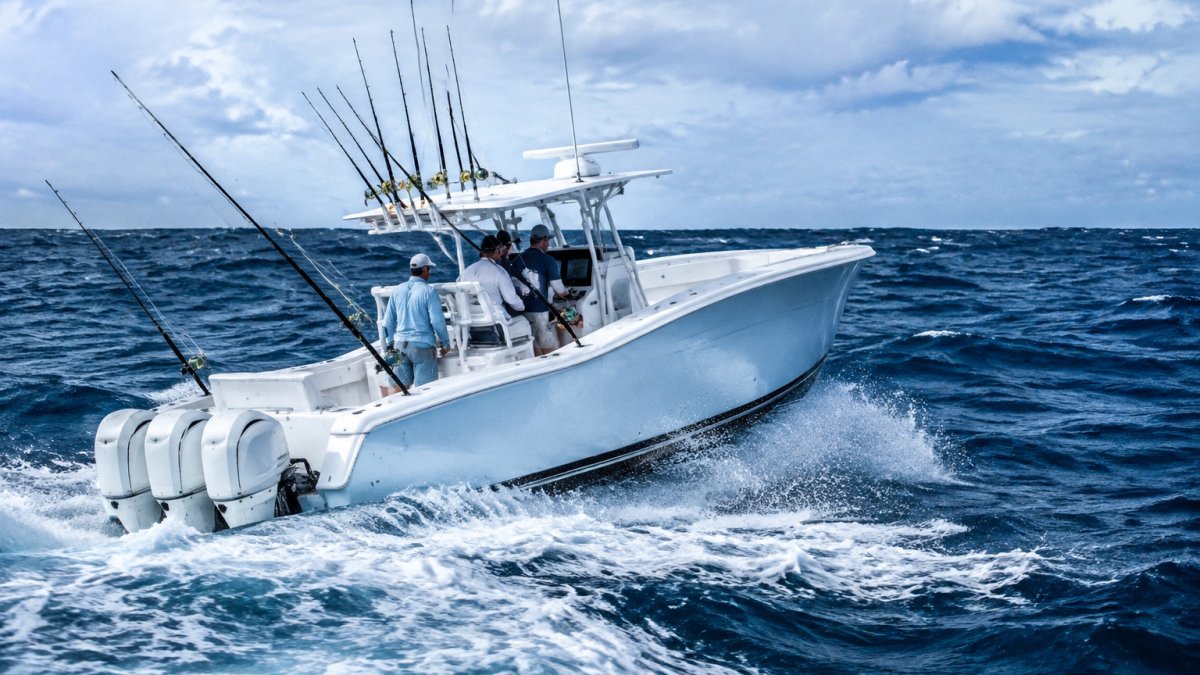
A V-shaped hull boat behaves best in coastal chop when it is kept on plane at a moderate cruise, with the bow trimmed just high enough to lift the entry. In short, steep wind chop, the sharp V splits the wave and throws spray outward instead of upward. Passengers feel a firm but controlled impact rather than a slam.
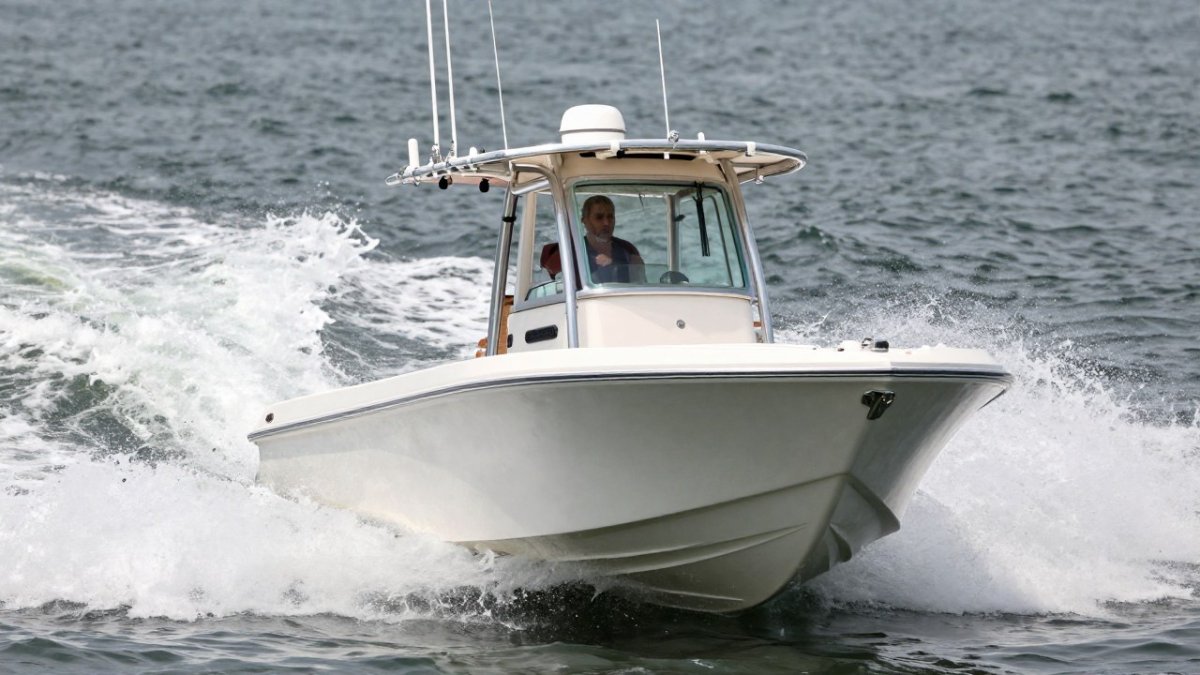
The behavior changes with wave period. Closely spaced chop rewards a sharp entry and light weight. Long, rolling swell rewards length and buoyancy forward. Confused seas, where direction shifts, expose the deep-V's tendency to roll and make trim adjustments constant.
Which Is the Most Stable Boat Hull Design When the Water Turns
The most stable boat hull design in turning water depends on which stability you mean, because the word covers at least four different behaviors that pull against each other. Buyers who conflate them end up with a boat that is stable in the showroom and unsettling on the water.
- Static stability is resistance to roll while stopped or drifting. It comes from beam, buoyancy low and wide, and a flatter bottom. A modified-V or flat-bottom hull wins here.
- Dynamic stability is resistance to tripping, spinning out or bow-steering in a turn at speed. It comes from a sharp entry, deadrise carried aft, and a keel or strake that bites. A deep-V wins here.
- Directional stability is the tendency to track straight without constant correction. A deep-V with a fine entry and adequate running surface tracks well in a quartering sea; a flat-bottom hull can wander and skid.
- Roll stability in a beam sea is the hardest to buy. A deep-V at displacement speed in a beam sea rolls through a wide arc because the same sharp geometry that cuts a head-sea wave offers little resistance to sideways roll. Either keep it on plane or change heading.
Lippert's guide to boat hull types describes V-shaped planing hulls as suited to fast boating in choppy water, which is the speed-and-tracking side of the trade. Tracker Boats' hull comparison makes the opposite trade explicit, noting that flatter bottoms are more stable when stopped but rougher in chop. Neither source resolves the beam-sea roll problem, which is where most coastal discomfort actually comes from.
A practical way to think about it: match the stability mode to your dominant activity. If you drift and cast more than you run, static stability and a moderate deadrise in the high teens to low 20s serve you. If you run long distances in open water and troll, dynamic and directional stability matter more, and a 22- to 24-degree transom earns its roll at rest. For a center console buyer who does both, a modified-V hull is a common compromise.
A sea trial on flat water tells you little about roll stability, so testing the boat beam-to in available chop at displacement speed is worthwhile before deciding on comfort.
Fishing Boat Hull Types and How They Match Coastal Conditions
Fishing boat hull types map cleanly onto coastal conditions once you separate inshore from offshore. Bay boats with modified-V hulls suit protected water and light chop. Deep-V center consoles suit open water and afternoon seabreezes. Flats skiffs handle skinny water but not a building swell.
If you are shopping this category, browsing a deep-V express fishing boat listing shows how the geometry looks on a real offshore hull. The difference between a 20-degree and a 24-degree transom is visible once you know where to look.
Wind chop is the great equalizer. A hull that feels fine in a two-foot swell can feel harsh in a two-foot chop of half the period, because the boat meets more crests per minute. Match the hull to the wave period you actually see, not the height on the forecast.
Trim, Speed, and Loading: What Hull Specs Don't Tell You
Hull shape sets the ceiling on rough-water comfort, but trim, speed and loading decide how close to that ceiling you actually run on a given afternoon. This is the part of the comparison most buyers never test, and it is where two identical hulls can feel like different boats.
Speed and the plane transition. A deep-V is most comfortable on plane at a moderate cruise, where the sharp entry is doing the cutting and the hull is riding on its aft running surface.
Trim and heading. Trim tabs are not a comfort accessory; they are how you correct the list that a beam sea or an uneven load imposes. In a beam sea, tab down on the windward side to level the boat and reduce roll. In a quartering head sea, a touch of tab can keep the bow from climbing too high and losing the entry.
Loading and weight distribution. Payload changes the hull's running attitude, and attitude changes how the entry meets the water. Weight forward buries the bow and makes a head sea wet and harsh; weight aft lifts the bow and can make the boat porpoise or squat.
The loaded sea trial. A common pattern is to sea-trial with two people and a half tank, then run the boat with six friends, full fuel and a full cooler. The ride you bought is not the ride you get. Test the boat loaded, or at least ask what the builder expects the running attitude to do at rated capacity.
No amount of trim or technique makes an unsafe sea state safe. If the forecast is building beyond the boat's and the crew's capability, the correct adjustment is to stay in or turn back, not to trim around it. For how layout and storage affect real-world loading, our guide to comparing offshore boat deck layouts covers the details.
Matching a Hull to Your Boating Program at Primo Yachts
Matching a hull to your boating program means matching the boat to how you actually use it, not to the brochure. Primo Yachts of Palm Beach has specialized in center consoles since 2009.
A center-console model built for coastal chop shows what a deep-V looks like set up for real fishing, and a center console with stability in turning water lets you compare a modified-V against it in person.
If you fish the shallows as well, the shallow-water fishing gear guide pairs well with hull selection. And when you are ready to talk through options, our team can walk you through inventory that fits your program.
The gap between a hull that works and one that fights you usually comes down to matching geometry to your real sea state, not to a spec sheet. Primo Yachts specializes in center consoles, offers discreet brokerage support for buyers and sellers, and can guide you through hull selection with the fishing market in mind. Get started with Primo Yachts and find a center console that handles your water the way you need it to.
Frequently Asked Questions
What is the most stable hull design for rough water?
No single hull wins everywhere. A deep-V planing hull tracks well and cuts chop at speed, while a displacement or semi-displacement hull is steadier when you slow down or stop. Stability also depends on beam, draft, and where weight sits in the boat. For choppy coastal waters, the practical answer is a hull with enough deadrise to soften impacts, matched to the speed you actually run and the loads you carry.
What type of hull provides the smoothest ride in choppy water?
Deep-V planing hulls are widely associated with smoother rides in chop because the sharp entry splits waves and the deadrise absorbs impact. The tradeoff is more draft and less efficiency at low speed. Modified-V hulls soften that tradeoff for mixed use. Ride comfort also depends on trim, speed, and weight distribution, so the same hull can feel very different depending on how it is driven and loaded.
Are catamaran hulls better than V-hulls in rough water?
Catamarans offer wide beam, shallow draft, and stable footing, which suits many coastal fishing programs. V-hulls generally track better and handle head seas with less slamming at speed. The right choice depends on wave direction, wave period, and how you use the boat. A matched-conditions comparison matters more than a blanket verdict.
Does boat length or hull shape matter more in rough water?
Both matter, and they interact. Greater length generally improves handling across designs because a longer waterline bridges short wave sets, while hull shape governs how the boat meets and absorbs each wave. A well-designed shorter hull can outperform a poorly designed longer one in specific conditions. When comparing boat hull designs for choppy coastal waters, look at length, deadrise, and loading together rather than treating any one spec as decisive.