 Comparison
7 Ocean Fishing Boats That Handle Rough Water Best
Last Updated: November 21, 2026
Quick Summary
Ocean fishing boats handle rough water best when they combine deep deadrise, high freeboard, self-bailing decks, and enough fuel capacity for the run. Center consoles from 30 to 45 feet dominate offshore work, while cabin boats add shelter for long runs. Match length and range to the sea state you actually fish.
- Ocean fishing boats typically run 24-45 ft with 20-24+ degrees of transom deadrise.
- Use the one-third rule: one-third of fuel out, one-third back, one-third in reserve.
- A 29-35 ft boat typically carries 200-300 gal and reaches a 60-100 mi offshore radius.
- Cabin boats trade weight and windage for shelter and overnight capability.
- Asking prices reflect seller hopes, so condition, engine hours, and electronics drive real value.
Table of Contents
- What Separates an Ocean Fishing Boat From a Bay Boat
- Center Console Fishing Boats: The Offshore Workhorse
- Saltwater Fishing Boats With Cabin: Shelter for Long Runs
- Offshore Fishing Boat Size: Matching Length to Range and Sea State
- Hull Design, Rough-Water Performance, and Seaworthiness
- Ocean Fishing Boats for Sale: What Asking Prices Actually Tell You
- Total Cost of Ownership Beyond the Asking Price
- Narrowing Your Shortlist With a Center Console Specialist
- Frequently Asked Questions
What Separates an Ocean Fishing Boat From a Bay Boat
U.S. anglers took nearly 194 million recreational fishing trips in 2024, caught an estimated 1 billion fish, and released 68% of their catch, according to NOAA Fisheries recreational fishing data. That volume of offshore fishing puts real demands on hulls, and it explains why ocean fishing boats are built differently from the bay boats that dominate inshore water.
An ocean fishing boat is a vessel designed to run well offshore, handle open-water swells, and keep a crew safe and functional through a long day. A bay boat is shallower, lighter, and built for protected water. The difference is not cosmetic.
Buyers often compare the two categories, and the mismatch usually shows up on the first rough day. Below, we break down the main categories of ocean fishing boats and what separates the ones that handle rough water from the ones that only look like they will.
The core distinction: freeboard, deadrise, fuel capacity, and self-bailing decks. Bay boats trade those for draft and shallow-water access. Ocean boats trade draft for range and seaworthiness.
| Feature | Bay Boat | Ocean Fishing Boat |
|---|---|---|
| Typical length | 18-24 ft | 24-45 ft |
| Deadrise at transom | 12-18 degrees | 20-24+ degrees |
| Draft | Shallow, 12-18 in | Deeper, 18-30 in |
| Fuel capacity | 40-80 gal | 150-400+ gal |
| Best water | Bays, flats, nearshore | Open ocean, offshore runs |
| Weather protection | Minimal | Console glass, T-top, cabins |
Center Console Fishing Boats: The Offshore Workhorse
Center console fishing boats dominate the offshore market for one reason: they put the driver in the middle of the action. A walkaround cockpit surrounds the helm, so an angler can fight a fish from any angle while the captain keeps eyes on the water.
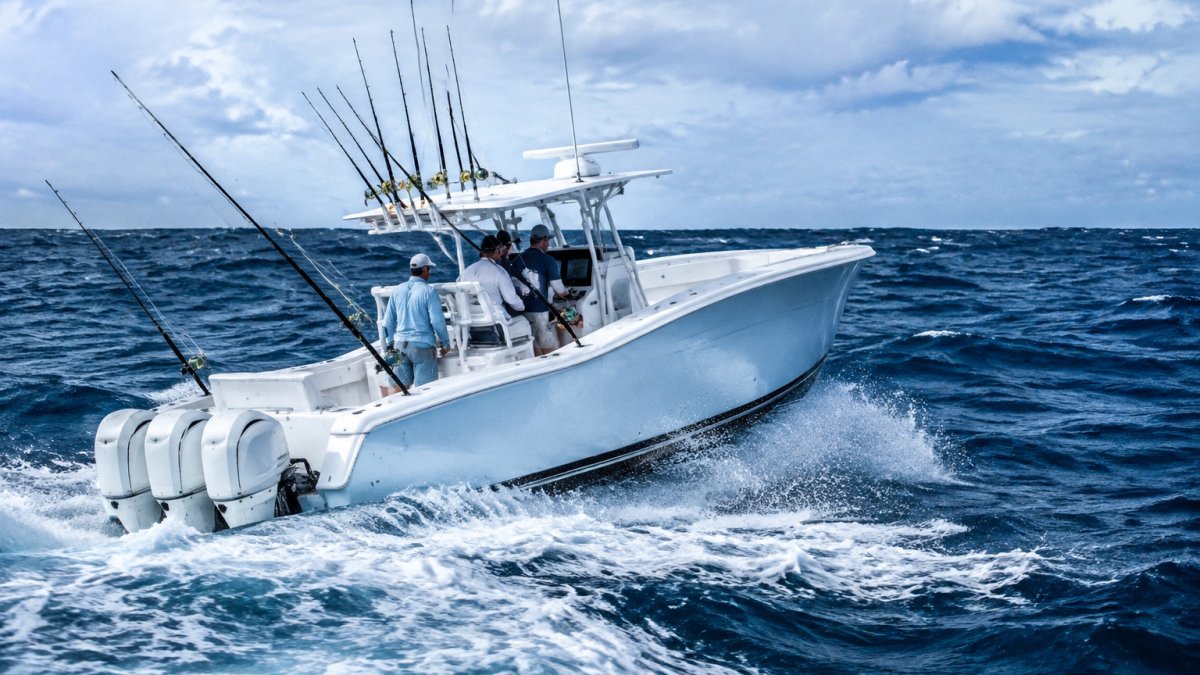
The open layout gives room for multiple anglers, coolers, and tackle stations. Most modern center consoles in the offshore class run 30 to 45 feet and carry twin or triple outboards.
The console itself matters a great deal. Details such as a head compartment, a hardtop with glass, and room for electronics often decide whether a long offshore run is usable or exhausting.
For buyers moving up from a smaller boat, expect a learning curve on rough-water handling. Our guide on how to handle rough seas in a center console covers the practical side of that transition.
Saltwater Fishing Boats With Cabin: Shelter for Long Runs
Saltwater fishing boats with cabin configurations solve the problem center consoles cannot: shelter. A cabin gives the crew a place to get out of spray, weather, and sun on a long run, and it adds overnight capability for trips that stretch past a single day.
Cabin boats split into a few practical types:
- Walkaround cabins: fishable fore and aft, with a small enclosed berth
- Express boats: larger helm deck, more climate control, deeper cabin
- Sportfish convertibles: flybridge, full galley, live-aboard amenities
- Pilothouse boats: enclosed helm, popular in colder or wetter conditions
The trade-off is weight and windage. A cabin boat carries more mass, which helps in a head sea but costs fuel and top-end speed. For families and crews running long offshore legs, the comfort usually wins.
Offshore Fishing Boat Size: Matching Length to Range and Sea State
Offshore fishing boat size should match the range and sea state you actually fish, not the biggest number you can afford.
A practical rule many offshore anglers use is the one-third rule: plan to burn one-third of your fuel running out, one-third running back, and keep one-third in reserve.
A general breakdown of typical planning figures by length looks like this:
| Length | Typical usable fuel | Cruise burn (approx.) | Realistic offshore radius | Best for |
|---|---|---|---|---|
| 24-28 ft | 100-150 gal | 8-12 gph at 25-30 mph | 30-50 mi | Nearshore reefs, day trips, single or twin outboards |
| 29-35 ft | 200-300 gal | 14-22 gph at 28-32 mph | 60-100 mi | Offshore day runs, twin outboards |
| 36-45 ft | 350-500 gal | 24-40 gph at 28-32 mph | 100-160 mi | Long offshore runs, overnight capability |
| 45+ ft | 500-800+ gal | 35-60 gph at 25-30 mph | 150-250+ mi | Extended trips, inboard or quad outboard power |
Actual fuel consumption varies with load, sea state, bottom condition, and throttle discipline, so the range on a spec sheet is rarely the range you get on a real trip.
Length also drives passenger capacity, fuel capacity, and behavior when the forecast turns. A longer waterline rides better in a chop but demands more dock space, fuel, and maintenance. The U.S.
Crew size changes the math more than many buyers expect. Additional people, gear, ice, and a full livewell add weight that can reduce top speed and increase fuel burn.
Sea state is the other half of the decision. Smaller center consoles are generally comfortable on calm nearshore days, while rougher seas turn a long run into a slower, wetter ride. Longer boats generally widen the window of days you can fish safely.
Buyers sometimes compare range using tank size alone and ignore usable capacity, reserve, and burn rate at cruise.
For a deeper comparison of how hull shape interacts with length and sea state, our article on Deep-V vs modified-V hulls for choppy coastal waters walks through the trade-offs.
Hull Design, Rough-Water Performance, and Seaworthiness
Hull design determines rough-water performance more than any other specification. Two boats the same length can behave completely differently in the same sea state, and deadrise explains why.
Deadrise is the angle of the hull bottom measured at the transom. Deeper deadrise generally cuts through chop and tracks well offshore, while shallower deadrise generally planes more efficiently but can pound harder in a head sea.
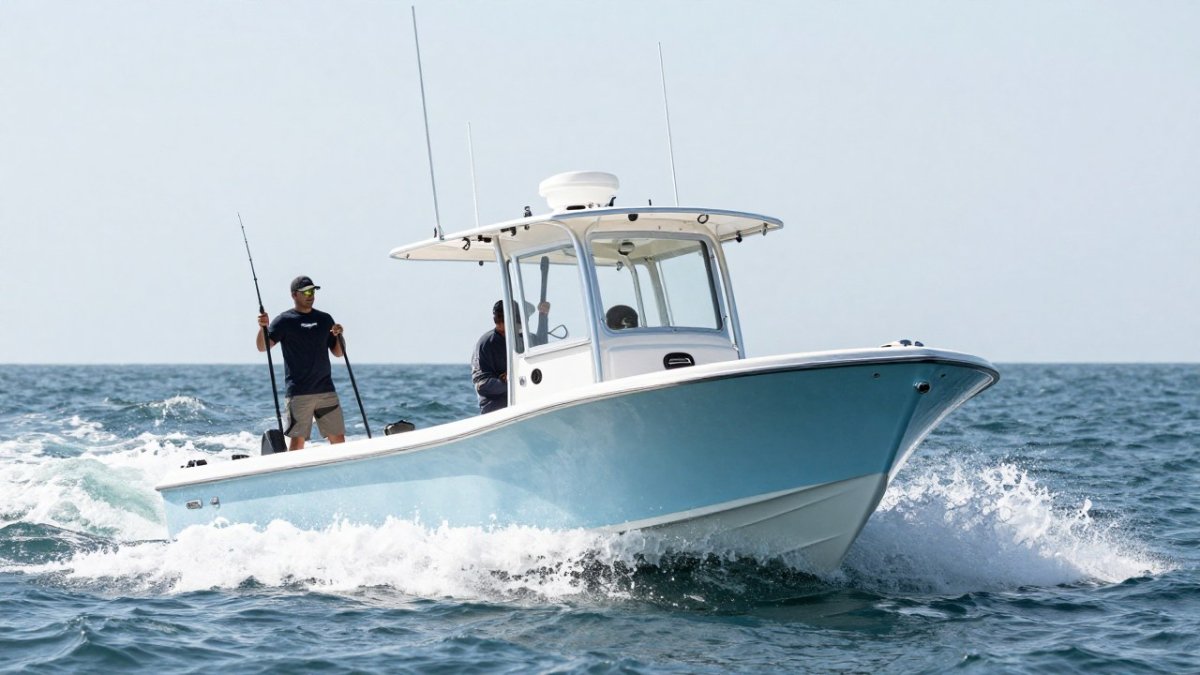
Seaworthiness is the sum of several factors:
- Deadrise and entry angle: how the bow meets the water
- Freeboard and flare: how much spray the hull throws clear
- Self-bailing decks and scuppers: how fast water leaves the boat
- Weight distribution: how the boat behaves when loaded
For a deeper comparison, our article on Deep-V vs modified-V hulls for choppy coastal waters walks through the trade-offs.
Ocean Fishing Boats for Sale: What Asking Prices Actually Tell You
Asking prices on ocean fishing boats for sale reflect what sellers hope to get, which can differ from what a boat is worth. Condition, hours, and electronics can vary considerably between two boats of the same year and model.
Marketplace listings show the spread clearly. Boat Trader's saltwater fishing boat listings currently range from roughly $11,603 to $1,508,306, while YachtWorld's saltwater fishing listings run from about $13,207 to $1,829,815. Those ranges describe inventory, not fair value.
What moves a boat toward the top of its range:
- Engine hours and service records
- Electronics package age and integration
- Hull condition and any prior repairs
- Trailer, covers, and included equipment
- Documentation and ownership history
Before you commit to a used center console, work through a structured inspection. Our 8-step used center console inspection guide covers what to check and in what order.
Total Cost of Ownership Beyond the Asking Price
Total cost of ownership runs well past the purchase price, and buyers who ignore that gap get surprised in year one. Fuel, insurance, dockage, maintenance, and depreciation compound, and the bigger the boat, the bigger the spread.
Fuel is often the largest variable, and one that buyers tend to underestimate. Fuel use depends on engine configuration, boat size, and how the boat is run, so the gap between boats can be significant across a season.
Insurance is the second fixed cost and scales with hull value, cruising area, and captain experience.
Dockage or dry storage surprises buyers who move up in length.
Maintenance is where the spread between a well-kept boat and a neglected one shows up. Outboard service intervals, lower-unit work, water pumps, and bottom paint are scheduled; electronics refresh, upholstery, and trailer work are irregular.
Depreciation is the second reality. Whether saltwater fishing boats hold their value depends on brand, condition, and market timing, and our breakdown of whether saltwater fishing boats hold their value covers the factors that matter most.
Financing adds another layer. Marine loan terms and rates depend on factors such as loan size, boat age, and credit profile, so it is worth comparing total interest cost across the term, not just the monthly figure.
A rough ownership checklist:
- Annual fuel cost at your realistic trip count and average burn rate
- Insurance premium for hull value, cruising area, and captain experience
- Dockage or dry storage priced by the foot or by the stack
- Scheduled engine service, lower-unit work, and bottom paint
- Electronics refresh and upholstery reserve every few years
- Reserve for unexpected repairs and haul-out costs
- Financing interest across the full loan term
Narrowing Your Shortlist With a Center Console Specialist
Narrowing a shortlist is where specialist guidance earns its keep. A center console specialist can help narrow options by considering how hulls handle a given sea state and which power packages suit your use.
Primo Yachts of Palm Beach has served the South Florida market since 2009 as a brokerage focused on the center console.
When you are ready to compare specific boats side by side, a structured buyer's comparison helps. Our comparison of used center console yachts for sale puts models next to each other on the criteria that decide offshore performance.
Factors to consider when narrowing a shortlist include:
- Actual fishing style and typical sea state
- Realistic offshore range and trip length
- Passenger capacity and crew needs
- Budget across the full ownership picture
The gap between a boat that looks capable and one that actually handles rough water comes down to hull design, range, and honest condition. Primo Yachts specializes in center console brokerage, with expert guidance for premium vessels, discreet support for buyers and sellers, and a focus on matching each client to the right boat. Get started with Primo Yachts and shortlist with confidence.
Frequently Asked Questions
What type of boat is best for ocean fishing?
Center consoles dominate offshore use because they put the helm and the fishing action on one open deck, with 360-degree access to the rails. Dual consoles and cabin boats trade some deck space for weather protection on longer runs. Hull type matters as much as layout: a deep-V monohull cuts chop well, while a catamaran offers a steadier ride and more deck width. Match the boat to how far offshore you run and how often you fish in rough water.
What size boat do you need for ocean fishing?
Offshore fishing boat size should follow your range and typical sea state, not a single number. Smaller center consoles suit inshore and near-coastal trips on calm days. Boats in the mid-to-upper 20-foot range and beyond give you the fuel capacity, freeboard, and ride quality for longer runs and rougher water. If you regularly cross open water or fish well offshore, prioritize length, fuel capacity, and hull deadrise over cockpit extras.
Are center console fishing boats good for ocean fishing?
Yes. Center console fishing boats are the most common choice for saltwater anglers running offshore. The open layout gives unobstructed casting and fighting space, and modern consoles carry livewells, rod storage, and electronics packages built for open water. The trade-off is weather exposure, which is why many offshore buyers add T-tops, hardtops, and enclosure curtains. Center consoles are a common choice for offshore anglers.
What features should you look for in an offshore fishing boat?
Start with hull design and deadrise for rough-water performance, then fuel capacity and engine configuration for range. Check fishability details: livewell volume, fish boxes, rod holders, and an open aft cockpit for working fish. Look at passenger capacity and crew seating, weather protection such as a hardtop or enclosure, and safety equipment including bilge pumps, EPIRB, and VHF. Finally, review service records and survey results, since maintenance history affects total cost of ownership more than cosmetics.