 how-to
Handle Rough Seas in a Center Console: A Guide
Table of Contents
- Understanding Wave Conditions and Your Center Console
- Pre-Departure Go/No-Go Planning
- Trimming a Boat for Rough Seas
- Speed and Throttle Management in Rough Water
- Wave Direction and Steering Techniques
- Navigating Inlets in Rough Conditions
- Boating Safety Gear for Offshore Fishing
- When to Turn Back: Emergency Response and Limits
- Frequently Asked Questions
Last Updated: October 16, 2026
Understanding Wave Conditions and Your Center Console
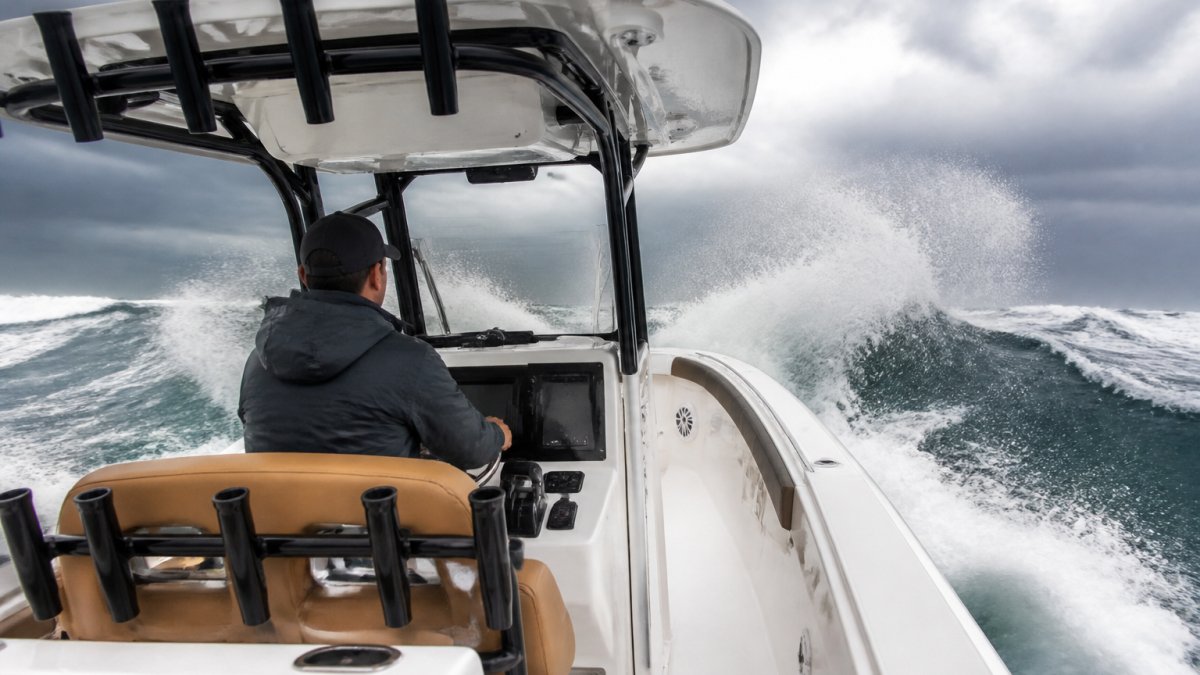
Learning to handle rough seas center console boating demands respect and preparation. Wave height, spacing, and direction determine whether a day is manageable or dangerous.
Wave height, spacing, and direction
Wave height is the vertical distance from trough to crest. A 3-foot wave looks small from shore but feels much bigger in a small boat.
Wave direction changes everything about your approach. Head seas hit hardest. Following seas create broaching, where your stern swings sideways. Beam seas test stability.
The real challenge is reading conditions before you leave the dock. Calm water near shore can hide rough conditions a few miles out.
How hull design affects rough-water performance
A deep-V hull cuts through waves more smoothly than a shallow-V, deflecting water to the sides instead of slamming it up into the boat.
A planing hull sits on top of the water at speed.
The best boats that handle rough seas center console fishing combine deep-V design with enough beam (width) to stay stable. Wider boats handle beam seas better.
Pre-Departure Go/No-Go Planning
Every offshore trip starts with a decision: go or stay. The best captains make this call before leaving the dock, not 20 miles out.
Checking weather, tide, and current
Start with current weather. Wind speed and direction matter most. A 15-knot wind creates manageable chop. A 25-knot wind creates dangerous seas.
Tide and current affect wave height directly. When tide runs against wind, waves get steeper and closer together; when tide and wind align, seas smooth out.
Check the inlet forecast if you're heading offshore. Inlets are where ocean swells meet shallow water and tidal current.
Setting your rough-water limits
Know your boat's limits before you need them. This means testing in progressively rougher conditions, not jumping straight to heavy seas. Your boat has a point where it stops handling well.
Set a personal limit for wave height. Many experienced center console operators stay out of water over 4 feet; some are comfortable with 6.
Set a limit for how far offshore you'll go.
Trimming a Boat for Rough Seas
Trim changes everything about how your center console handles rough water. Get this wrong and you'll pound. Get it right and you'll climb waves smoothly.
Trim tab and power trim adjustments
Trim tabs are small fins under the transom that tilt the boat's angle. They're your primary tool for rough-water control. In rough seas, trim the tabs up slightly.
Power trim (the main engine trim) works differently: trim in (toward the transom) lifts the bow higher, trim out (toward the water) pushes the bow down.
The balance between tabs and power trim is where skill comes in. Too much tab and you'll porpoise (bounce up and down).
Finding the right running attitude
Your boat's running attitude is the angle of the hull relative to the water. In flat water, you might run with the bow high for speed and fuel economy.
The goal is finding the "sweet spot" where your boat climbs waves smoothly without pounding.
Different sea conditions require different attitudes. Head seas might need a lower bow angle. Quartering seas might let you run slightly higher.
Speed and Throttle Management in Rough Water
Speed is your most powerful tool in rough seas. Most inexperienced boaters run too fast. Experienced captains slow down.
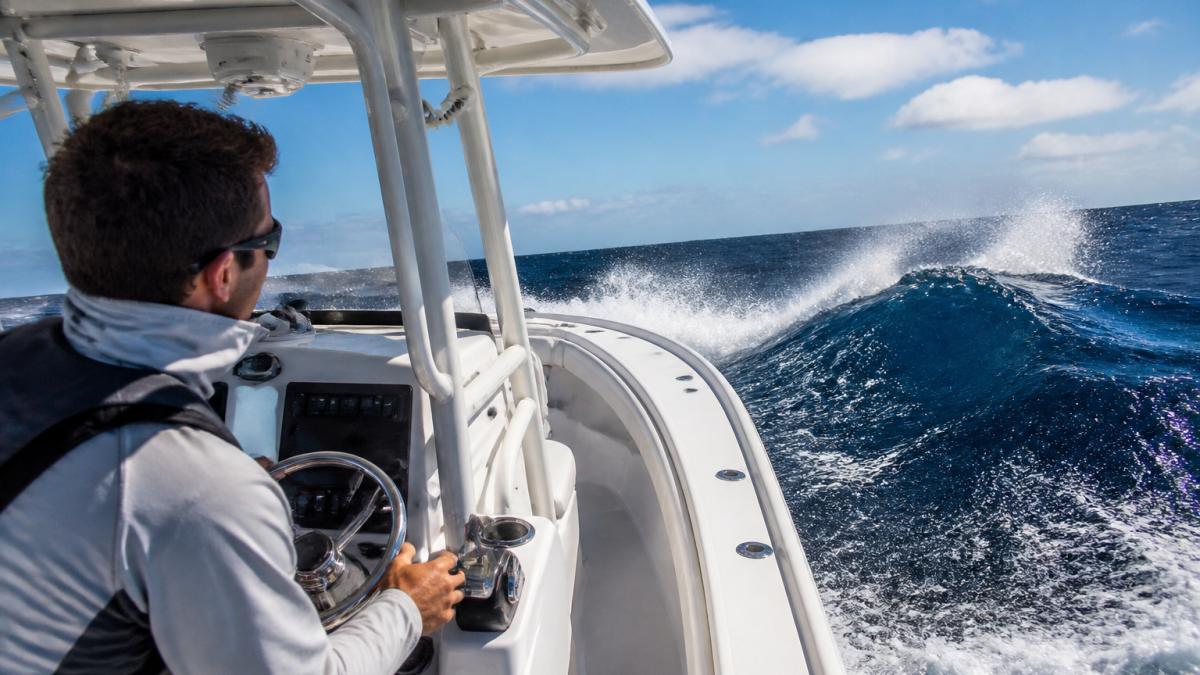
Slowing down to maintain control
Reducing speed gives your boat more time to climb each wave, reduces impact force, and gives you more control over steering and trim.
A good rule: slow to a speed where your boat climbs waves smoothly, not pounds.
Slowing down also reduces fuel consumption and keeps your crew more comfortable. An extra 30 minutes beats arriving exhausted or damaged.
Using power to climb waves
Throttle isn't just about speed, it's about momentum.
The technique is smooth and gradual. As your bow rises to meet a wave, add a touch of throttle. As you crest and start down the back, ease off slightly.
In very rough water, some captains use a technique called "powering through." They maintain steady throttle and let the boat's momentum carry them over waves. This works when waves are large but not breaking.
Wave Direction and Steering Techniques
How you approach waves matters as much as how fast you go. The angle of approach determines whether you'll have control or get tossed around.
Quartering into waves and head seas
Quartering into waves means approaching them at a 45-degree angle rather than head-on. This is the safest angle for most conditions. Your bow climbs the wave smoothly. Your stern stays planted. You maintain steering control.
Head seas (waves coming straight at you) require a different approach.
The key is maintaining a steady angle. Don't let your boat swing sideways relative to the waves. This is where steering becomes critical. Small, smooth corrections keep your heading steady.
Handling following seas and avoiding broaching
Following seas are deceptively dangerous. A wave from behind can pick up your stern and swing it sideways, called broaching, leaving the boat out of control and at risk of capsizing.
To avoid broaching, maintain enough speed that waves don't catch your stern. You're essentially surfing ahead of the wave.
Reach out now to see how we can help with your boating needs! →
Watch your wake. If it's curling back toward the boat, a wave is about to catch you. Adjust your speed or angle slightly.
Navigating beam seas safely
Beam seas (coming from the side) test your boat's stability. A center console's wide beam helps, but run slow enough that waves don't roll the boat excessively.
The technique is to keep your boat level. Trim tabs help maintain side-to-side balance. Avoid sharp turns in beam seas, they increase roll. If you need to change direction, do it gradually between waves, not while you're on the face of one.
Navigating Inlets in Rough Conditions
Inlets are where ocean swells meet shallow water and tidal current. Conditions there concentrate and intensify. Many boating accidents happen in inlets, not in open water.
Choosing a safe angle to approach breaking waves
Breaking waves form when deep-water swells enter shallow water. The wave face steepens until it breaks.
Approach breaking waves at a quartering angle, never head-on. A head-on approach into a breaking wave can flip a small boat.
Look for the calmest water through the inlet. Often this is on one side or the other. Experienced inlet runners know which side works best at different tide stages.
Timing your entry and maintaining maneuvering room
Timing matters in inlets. The worst conditions often occur at slack water, when current reverses; the best are usually at mid-tide when current is strongest and most predictable.
Maintain maneuvering room: don't enter an inlet so close to other boats that you can't adjust course.
Watch the water ahead. Uneven water, whitecaps, and confused wave patterns signal rough conditions. If it looks unsafe, wait or turn back. No fish is worth capsizing for.
Boating Safety Gear for Offshore Fishing
Safety gear isn't optional in rough water. It's the difference between going home and becoming a rescue statistic.
Essential safety equipment for crew and passengers
Every person on your boat needs a properly fitted life jacket. Not stored below deck, worn or easily accessible.
Carry a personal locator beacon (PLB) or emergency position-indicating radio beacon (EPIRB).
A first aid kit rated for marine use is essential. Rough water causes bumps and cuts.
Carry flares and a signaling mirror. If your radio fails, flares are how rescuers find you. A mirror signals planes and distant boats.
Securing gear and preventing injuries
Unsecured gear becomes a projectile in rough water. Coolers, tackle boxes, and loose equipment can injure crew. Secure everything with straps or nets.
Brief your crew before departure. Explain where they should sit or stand in rough water.
Wear non-slip shoes. Wet decks are slippery. Wet shoes on a wet deck are extremely slippery.
Keep the cabin clear of obstacles. If someone needs to move quickly (to secure something or help someone), a clear path matters.
When to Turn Back: Emergency Response and Limits
The best offshore captains know when to quit. Turning back isn't failure, it's survival.
Recognizing when conditions exceed your limits
Conditions change fast on the water. A forecast that looked good at dawn might be wrong by mid-morning. Wind can increase. Seas can build. Fog can roll in.
Watch your boat's behavior. If it's pounding hard, you're going too fast or the seas are too rough.
Fuel is another limit. Always maintain enough fuel to return to port with a safety margin. Don't push fuel limits in rough water.
Making the decision to return safely
Turning back early means a longer trip home in potentially worse conditions.
If you decide to turn back, do it decisively. Don't second-guess. Head toward the nearest safe harbor, not necessarily your original destination.
Communicate with others. Tell your family or a friend your new plan.
The ocean will always be there. Fish will be there tomorrow.
Rough water in a center console demands respect, preparation, and honest self-assessment.
| Rough-Water Technique | Key Adjustment | Expected Result |
|---|---|---|
| Trim tabs and power trim | Trim tabs up slightly, power trim out | Smoother wave climbing, reduced pounding |
| Speed management | Slow to wave-climbing speed | Better control, less fuel burn, safer ride |
| Wave approach angle | Quarter into waves (45-degree angle) | Stable climb, maintained steering control |
| Following sea handling | Maintain speed ahead of waves | Avoid broaching, maintain directional stability |
| Inlet entry | Approach at quartering angle, slow speed | Safe passage through breaking water |
According to U.S. Coast Guard boating safety guidance, proper life jacket wear is the single most effective prevention for boating fatalities. Wearing your life jacket in rough water isn't optional, it's the difference between a close call and a tragedy.
Research from National Weather Service marine forecasts shows that inlet conditions can differ dramatically from open water conditions just a few miles away.
Frequently Asked Questions
What is the best speed for a center console in rough seas?
Speed depends on wave height, spacing, and your boat's hull design. Most center consoles perform best when slowed to a speed where the boat maintains control and climbs each wave without pounding or becoming airborne. Generally, this means reducing throttle to 50-70% of cruise speed. Always prioritize maintaining steering control and a smooth ride over reaching your destination quickly. Adjust based on wave conditions and your crew's comfort.
How do you trim a boat for rough water?
Start by adjusting your trim tabs and power trim to keep the bow slightly higher than normal, which helps the hull climb waves without diving. Avoid running too bow-up, as this reduces forward visibility and can cause the boat to porpoise. Use small trim adjustments as conditions change. A properly trimmed boat will ride more smoothly, reduce pounding, and maintain better steering control. Test different settings at slower speeds before increasing throttle.
What safety gear is essential for offshore center console fishing?
Equip your boat with Coast Guard-approved life jackets for every person aboard, a functional radio or communication device, first-aid kits, flares, and a properly stocked emergency kit. Secure all fishing gear and loose items so they don't become hazards in rough water. Consider adding grab rails and non-slip surfaces where crew move about. Brief passengers on safety procedures before departure, and ensure everyone understands when to sit down and hold on during rough conditions.
How do you handle following seas in a center console?
Following seas are dangerous because waves can push the boat sideways, causing a broach. Maintain enough throttle to stay ahead of the wave set and keep the boat pointed straight. Avoid letting waves pass under your stern at an angle. If a wave threatens to overtake you, increase power to climb it rather than letting it lift the transom. Keep crew seated and alert, and be ready to adjust your course or speed if the boat begins to slide sideways.