 how-to
Managing Yacht Insurance During Closing: A Step-by-Step Guide
Last Updated: October 22, 2026
Quick Summary
Yacht insurance closing requires starting the process 4-6 weeks before your closing date, not at the closing table. Your lender won't fund without proof of insurance, marinas won't grant possession without coverage, and underwriters need time to inspect the vessel and issue a binder, making early yacht insurance closing coordination essential to avoid delays or deal failure.
- Contact your lender's closing department before making an offer to get specific insurance requirements in writing
- Bind coverage at least 2 weeks before closing; binding the day before is a recipe for disaster
- Lenders typically require hull coverage matching the loan amount, liability coverage of $300,000 to $1,000,000, and the lender listed as loss payee
- Provide your closing agent with proof of insurance, loss payee endorsement, certificate of insurance, proof of payment, and any additional insured endorsements 3-5 days before closing
- Schedule a professional marine survey immediately after your offer is accepted so the report reaches underwriters while the closing timeline has room
Table of Contents
- Why Yacht Insurance Planning Starts Before Closing
- Understanding Yacht Insurance Requirements for Financing
- When to Bind Boat Insurance: The Closing Timeline
- Getting a Boat Insurance Binder for Closing
- Yacht Insurance Survey Requirements and Underwriting
- Coverage Gaps and Effective Date Coordination
- Common Delays and How to Avoid Them
- Your Closing Insurance Checklist
- Frequently Asked Questions
Why Yacht Insurance Planning Starts Before Closing
Insurance isn't something you handle at the closing table. It needs to happen weeks earlier.
Here's why timing matters: lenders won't fund without proof of insurance. Underwriters need time to review your vessel and issue a policy.
According to YachtCoast's Marine Insurance for Yachts Explained guide, buyers are best served by addressing insurance early, once they are serious about a purchase.
The fix is simple: start conversations with your insurance agent the moment you're serious about buying.
Understanding Yacht Insurance Requirements for Financing
Your lender has specific insurance demands. They want to protect their investment in the vessel. These requirements vary by lender, but the basics are consistent.
Most lenders require:
- Hull coverage with an agreed value matching the loan amount
- Liability coverage at minimum $300,000 to $1,000,000
- The lender listed as loss payee on the policy
- Proof of insurance before funds are released
The lender's requirements are non-negotiable. If your policy doesn't meet their specs, they won't close.
Your marina may also have requirements. Some require higher liability limits. Others demand that the marina be listed as additional insured.
Ocean Independence's Complete Guide to Yacht Insurance in 2026 notes that yacht insurance costs typically range from 0.5% to 1% of a yacht's value per year.
When to Bind Boat Insurance: The Closing Timeline
Timing is everything. Bind too early and you pay premiums for coverage you don't need yet. Bind too late and you miss the closing date.
The ideal timeline looks like this:
- 4-6 weeks before closing: Meet with your insurance agent. Provide vessel details and purchase agreement.
- 3-4 weeks before closing: Agent submits application to underwriters. Underwriters may request a survey or vessel inspection.
- 2-3 weeks before closing: Underwriters issue a binder or conditional approval. You receive proof of insurance.
- 1-2 weeks before closing: Policy is finalized. Loss payee and additional insured endorsements are added.
This timeline assumes no complications. If the vessel requires a survey or if underwriters have questions, add another 1-2 weeks.
Don't rush this. Insurance underwriting for yachts is more thorough than standard boat insurance. They want to know the vessel's condition, maintenance history, and your boating experience.
Getting a Boat Insurance Binder for Closing
A binder is temporary proof of insurance. It covers the vessel from the binding date until the full policy is issued. Lenders accept binders as proof of coverage for closing purposes.
To get a binder, you need to:
- Contact a marine insurance agent who specializes in yachts
- Provide the vessel's make, model, year, and hull identification number
- Share the purchase agreement showing the agreed value
- Disclose your boating experience and intended use
- Answer underwriting questions about maintenance and storage
The agent submits this information to underwriters. Underwriters review it and either issue a binder or ask for more details. If they ask for a survey, the process takes longer.
What Your Lender and Closing Agent Need
Your lender and closing agent have a checklist. They need specific documents before they'll move forward.
Required documents include:
- Insurance binder or policy showing coverage effective before or on the closing date
- Loss payee endorsement naming the lender as loss payee for the full loan amount
- Certificate of insurance on the insurer's official letterhead
- Proof of payment showing the first premium has been paid or is due at closing
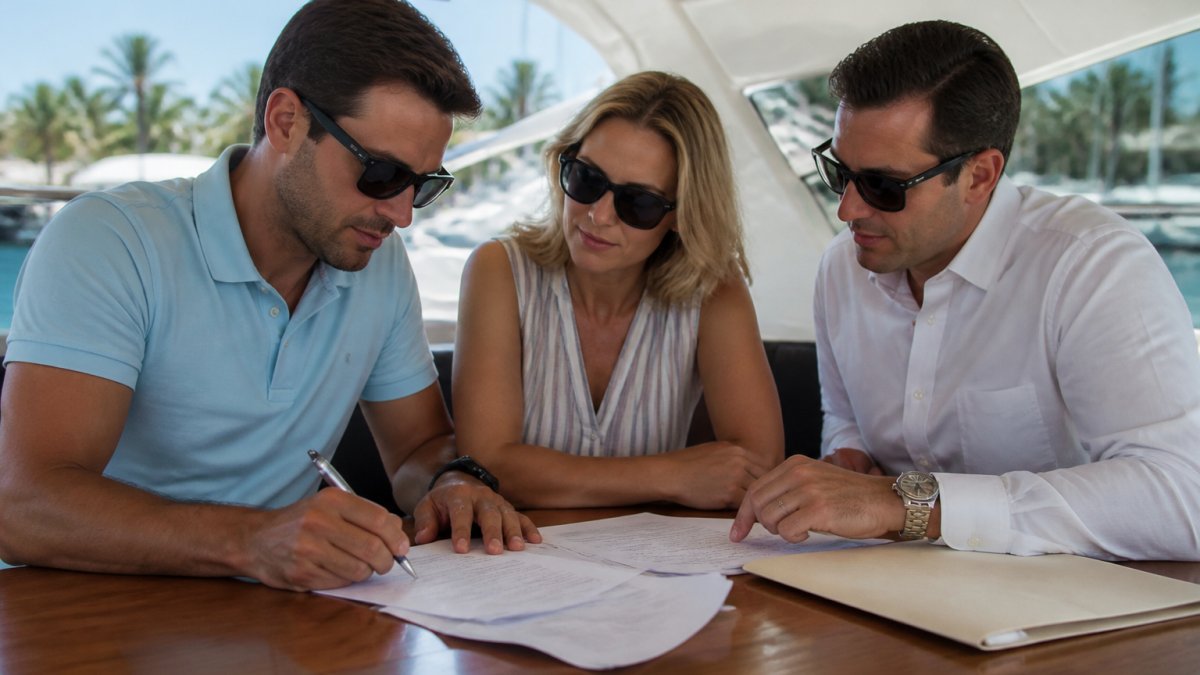
Your closing agent will ask for these documents 3-5 days before closing. Provide them immediately. Don't wait until closing day.
Proof of Insurance and Loss Payee Documentation
Proof of insurance is an official document from your insurer. It shows coverage dates, limits, and the named insured. This is what your lender needs to see.
The loss payee endorsement is critical. It tells the insurance company that if the vessel is damaged, claim payments go first to the lender to satisfy the loan.
Reach out now to see how we can help with your boating needs! →
Your insurance agent handles adding the lender as loss payee. This takes 24-48 hours once the policy is issued. Build this into your timeline.
Yacht Insurance Survey Requirements and Underwriting
Underwriters want to inspect the vessel before they commit to a yacht policy. For yachts, a professional marine survey is commonly required.
A closing-grade survey typically covers:
- Hull condition, structural integrity, and moisture readings
- Engine and mechanical systems, including hours and service history
- Electrical, plumbing, and fire-suppression systems
- Safety equipment, navigation electronics, and ground tackle
The buyer pays for the survey, not the underwriter. Survey costs vary with vessel size and location. Schedule the survey immediately after your offer is accepted so the report reaches the underwriter while the closing timeline still has room.
How Survey Findings Affect Closing
Survey findings do not just affect premium; they can affect whether the deal closes on time. Common underwriting outcomes include:
- Clean report: Underwriter issues a binder at the quoted terms.
- Recommendations only: Underwriter binds coverage but requires the items to be corrected within a stated period, often 30 to 90 days after closing. The lender may require a copy of the binder showing the condition.
- Material conditions: Underwriter requires repairs or a re-inspection before binding. This can push the closing date by one to three weeks.
- Declination: Underwriter declines the risk, and you must approach a surplus-lines or specialty marine market, which adds time and often cost.
Underwriting Contingencies That Touch the Closing
Beyond the survey, underwriters routinely attach conditions that the closing agent and lender will want to see resolved or disclosed:
- Valuation support: The agreed hull value must be supported by the survey or a recent appraisal. A lender will not accept a hull value materially above the loan amount without documentation.
- Navigation limits: Underwriters set cruising areas (for example, coastal, Bahamas, or Caribbean). If your delivery route or intended use falls outside those limits, you need an endorsement before closing.
- Named operator and experience: Underwriters may require a named captain or a minimum sea-time threshold. If you do not meet it, expect a higher deductible or a captain requirement.
- Lay-up period and storage: Winter storage location and hurricane-plan requirements can be conditions of coverage. Confirm the marina meets them before you sign the slip lease.
Ask your agent upfront whether a survey will be required and who pays for it. If yes, schedule the haul-out the week your offer is accepted, and ask the underwriter to list any binding conditions in writing so the closing agent can track them.
Coverage Gaps and Effective Date Coordination
Coverage gaps happen when the effective date of your insurance doesn't align with when you take possession of the vessel.
Here's the problem: You close on Friday. Your insurance is effective Monday. What covers the vessel over the weekend?
The answer: it depends on your policy and your lender's requirements.
This is why you need to coordinate with your agent and lender before binding.
Also coordinate delivery dates.
Common Delays and How to Avoid Them
The biggest delays happen because buyers don't communicate with their lender and closing agent early.
Common delays include:
- Missing underwriting documents: Underwriters ask for information you don't have readily available. Gather maintenance records, service history, and previous insurance documents before applying.
- Survey complications: The surveyor finds issues. The vessel needs repairs before underwriters will issue a policy. Build extra time into your timeline if the vessel is older or hasn't been recently surveyed.
- Loss payee confusion: The lender's name is spelled wrong on the endorsement. The endorsement doesn't cover the full loan amount. The closing agent rejects it and asks for corrections. Verify the lender's exact legal name and loan amount before the policy is issued.
- Coverage limit mismatches: Your policy limits don't meet the lender's requirements. You have to increase limits and reissue the policy. This adds 3-5 days.
The fix for all of these: communicate early and confirm everything in writing.
Your Closing Insurance Checklist
Use this checklist to stay organized. Check off each item as you complete it.
| Task | Timeline | Responsibility |
|---|---|---|
| Contact lender for insurance requirements | 6 weeks before closing | You |
| Meet with marine insurance agent | 5-6 weeks before closing | You |
| Submit insurance application | 4-5 weeks before closing | Insurance agent |
| Arrange vessel survey if required | 3-4 weeks before closing | Insurance agent |
| Receive underwriter approval or binder | 2-3 weeks before closing | Insurance agent |
| Add lender as loss payee | 2 weeks before closing | Insurance agent |
| Confirm effective date with lender | 10 days before closing | You |
| Provide proof of insurance to closing agent | 5 days before closing | You |
| Verify all endorsements are correct | 3 days before closing | You |
| Confirm first premium payment | 2 days before closing | You |
Print this checklist and share it with your insurance agent and closing agent. It keeps everyone aligned and prevents last-minute surprises.
Frequently Asked Questions
When should yacht insurance coverage begin during a purchase?
Yacht insurance should be bound before your closing date. Most lenders require proof of insurance at closing, and coverage typically becomes effective on the date the policy is bound or on a future date you specify, usually the same day you take ownership. Coordinate with your insurance agent and closing attorney to align the effective date with your ownership transfer. Binding early (often 2-4 weeks before closing) allows time for underwriting, survey scheduling, and any additional documentation your insurer requests.
What insurance documents may a lender require before closing?
Lenders typically require a declarations page or insurance binder showing coverage limits, deductibles, and effective dates. They also need proof that they are named as loss payee on the hull coverage and as additional insured on liability coverage. Your closing attorney will provide specific requirements, but expect to provide the full policy wording, proof of marine survey completion (if required), and evidence that the insurer has accepted your vessel's risk. Some lenders also request a certificate of insurance listing all coverages.
What information does an insurer need to bind yacht coverage?
Insurers need detailed vessel information: hull identification number, length, year, make, model, construction material, and engine specifications. They also require ownership details, navigation limits and intended use, your boating experience, and the vessel's location (home port and mooring details). For yachts over a certain value or age, a marine survey may be required before binding. Providing thorough, accurate information upfront signals professionalism and speeds underwriting approval.
Can a yacht purchase closing be delayed because of insurance?
Yes. If your insurance application is incomplete, the vessel fails survey inspection, or the insurer declines coverage, closing can be postponed. This is why starting the insurance process early, ideally once you are serious about a purchase, is critical. Delays are most common when survey scheduling conflicts with closing dates or when vessel information is incomplete. Coordinate closely with your insurance agent, closing attorney, and lender to identify and resolve any insurance issues before the closing date.
Managing yacht insurance requirements during closing doesn't have to be stressful. The key is starting early and staying organized. At Primo Yachts, we guide clients through this process regularly. We know the lender requirements, the marina rules, and the underwriting timelines. Reach out now to see how we can help with your boating needs! We'll connect you with the right insurance professionals and make sure your closing runs smoothly.