 ultimate-guide
What Makes a Center Console Yacht Premium in 2026
Table of Contents
- Hull Design and Ride Quality: The Foundation of Premium Performance
- Construction Materials and Structural Integrity
- Luxury Center Console Boat Features That Signal Premium Status
- Marine Electronics and Technological Integration Beyond Navigation
- What Sets the Best Offshore Fishing Center Consoles Apart
- Ergonomics, Noise Reduction, and Human-Centric Design
- How Premium Features Affect Center Console Yacht Resale Value
- Frequently Asked Questions
Last Updated: September 16, 2026
Hull Design and Ride Quality: The Foundation of Premium Performance
Ask any experienced captain what separates a great center console from an average one, and the answer rarely involves upholstery or electronics. It comes down to what happens when the hull meets rough water. Understanding what makes a center console yacht premium starts here, because the running surface dictates everything else: comfort, range, safety, and how the boat holds its value. This guide breaks down the engineering behind the badge.
A premium center console yacht is a vessel built with advanced hull geometry, marine grade materials, and integrated systems that deliver superior ride quality, fishability, and long-term durability compared to standard production boats.
Stepped Hulls, Deadrise, and Dry Ride Characteristics
Deadrise is the angle between the hull bottom and a horizontal plane, measured at the transom. More deadrise means a deeper V, which cuts through chop rather than slapping across it.
A stepped hull takes this further. By introducing a transverse step that aerates the running surface, the hull reduces drag and improves performance efficiency without sacrificing stability at rest. The result is a dry ride: spray is deflected away from the helm rather than soaking the crew.
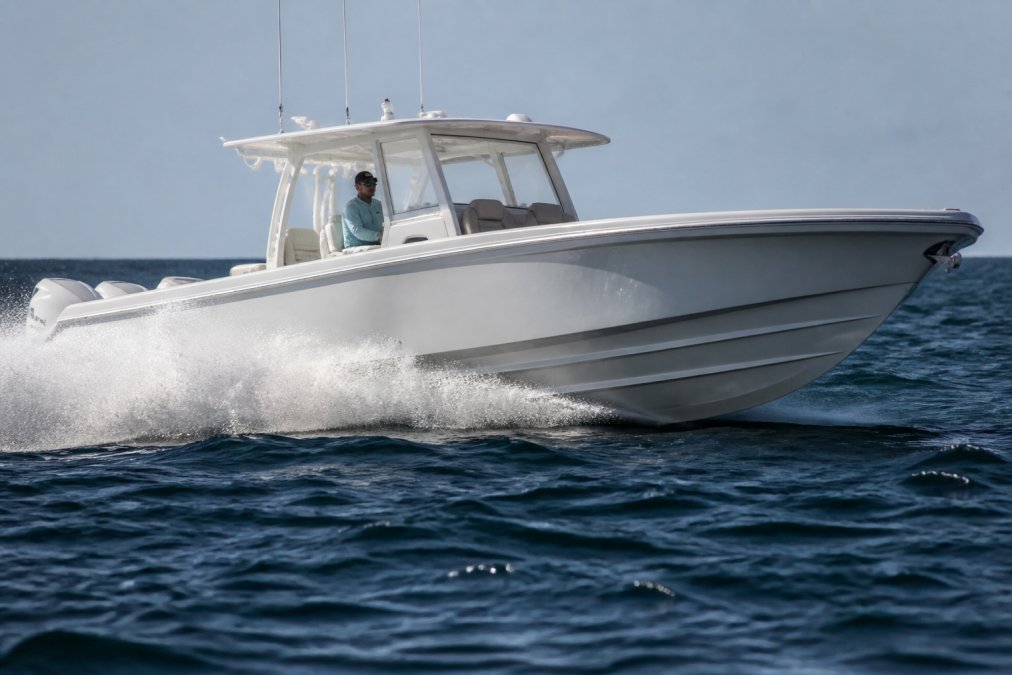
The trade-off is real. Stepped hulls demand precise weight distribution, and a poorly designed step can make a boat unpredictable in a following sea. This is where hull geometry separates serious builders from assemblers.
Construction Materials and Structural Integrity
Structural integrity begins below the gelcoat finish, and the differences show up in three places: the resin system, the reinforcement fabric, and the core. Standard production boats typically use orthophthalic polyester resin with chopped strand mat, which is inexpensive and forgiving to lay up but absorbs water over time and offers modest stiffness per pound. Premium builders move to vinylester or epoxy systems with stitched biaxial and quadaxial glass, which wet out more predictably and resist osmotic blistering far better in warm saltwater.
Resin Systems, Reinforcement, and Core Materials
The resin is only half the story. What the resin holds together matters just as much:
- Chopped strand mat, short random fibers, low cost, low directional strength. Common in entry-level hulls.
- Woven roving, stronger than mat, but the crimp in the weave creates resin-rich pockets that can crack under repeated flex.
- Stitched biaxial and quadaxial glass, fibers run straight with no crimp, so the laminate carries load more efficiently and resists fatigue. This is the baseline for a premium layup.
- Carbon fiber reinforcement, highest strength-to-weight, but expensive and difficult to repair without specialized labor.
Core material is the other lever. Balsa was the traditional choice, but it rots if water intrudes. Premium builders increasingly use closed-cell PVC, SAN, or co-infused foam cores because they do not absorb water, bond more consistently, and resist compression under hardware and cleats.
Carbon Epoxy vs. Traditional Fiberglass Layups
Carbon epoxy construction offers a higher strength-to-weight ratio than traditional fiberglass, which translates to less weight, better fuel economy, and a stiffer hull that resists flexing in heavy seas. The drawback is cost and repairability; carbon repairs require specialized labor and often a controlled environment, and a botched repair can create a hard point that concentrates stress.
| Construction Method | Weight | Strength-to-Weight | Typical Repair Complexity |
|---|---|---|---|
| Polyester/chopped strand | Heaviest | Baseline | Low |
| Vinylester/stitched glass | Moderate | Improved | Moderate |
| Carbon epoxy | Lightest | Highest | High |
The Cost-of-Ownership Angle Most Guides Skip
One more structural detail worth inspecting: how the hull and deck are joined. A shoebox joint that is through-bolted, bonded, and glassed on the inside is far stronger than one held together with screws and sealant. On a sea trial, look for the joint line and ask how it was assembled. It is one of the clearest tells of whether a builder treats structure as engineering or as assembly.
Luxury Center Console Boat Features That Signal Premium Status
Luxury center console boat features are the details a buyer notices in the first five minutes and appreciates for the next ten years. Upholstery, fit and finish, and marine grade materials tell you more about build philosophy than any spec sheet. But the features that actually define a premium center console for long-range use are the ones you feel in hour six, not minute five, and most guides never get into them.
Upholstery, Fit and Finish, and Marine Grade Materials
Storage capacity matters too. A premium walk-around deck layout uses every cubic inch, from insulated coffin boxes to lockable rod storage that keeps gear secure at speed.
Ergonomics and Human-Centric Design: The Feature No Spec Sheet Captures
This is where premium separates from merely well-equipped, and where most buying guides stop short. Ergonomics is not a bullet point, it is the accumulated result of hundreds of small design decisions, and it is the single biggest predictor of whether you will still enjoy the boat after a full season.
Long-Range Comfort and the Feel of the Boat
Noise and vibration reduction rarely appears in marketing copy, yet it defines the experience on an eight-hour run. Premium builders isolate engine mounts, use composite coring in the deck and console, and add vibration dampening material in high-contact areas. The result is a boat you can hold a conversation in at cruise, and one that does not leave you fatigued after a long day.
Marine Electronics and Technological Integration Beyond Navigation
Integrated marine electronics now extend well past a chartplotter and transducer. Digital switching replaces traditional breaker panels, letting you control lighting, pumps, and livewell systems from a touchscreen or your phone. Helm ergonomics improve because fewer physical switches clutter the dash.
What Sets the Best Offshore Fishing Center Consoles Apart
The best offshore fishing center consoles are engineered around fishability first, then dressed for comfort. That means livewell systems with proper flow rates, macerated drains, and lighting that keeps bait lively on long runs.
Livewell Systems, Fishability, and Fishing Versatility
A premium livewell is not just a box with a pump. It has a rounded interior to prevent bait injury, adjustable flow, and a clear lid for monitoring. Fishing versatility comes from layout: rod holders positioned for trolling spreads, a transom design that supports a fighting chair or rocket launcher, and gunwale height that lets anglers brace safely.
- Insulated fish boxes with overboard drainage
- Multiple livewells sized for different bait
- Under-gunwale rod storage with drainage
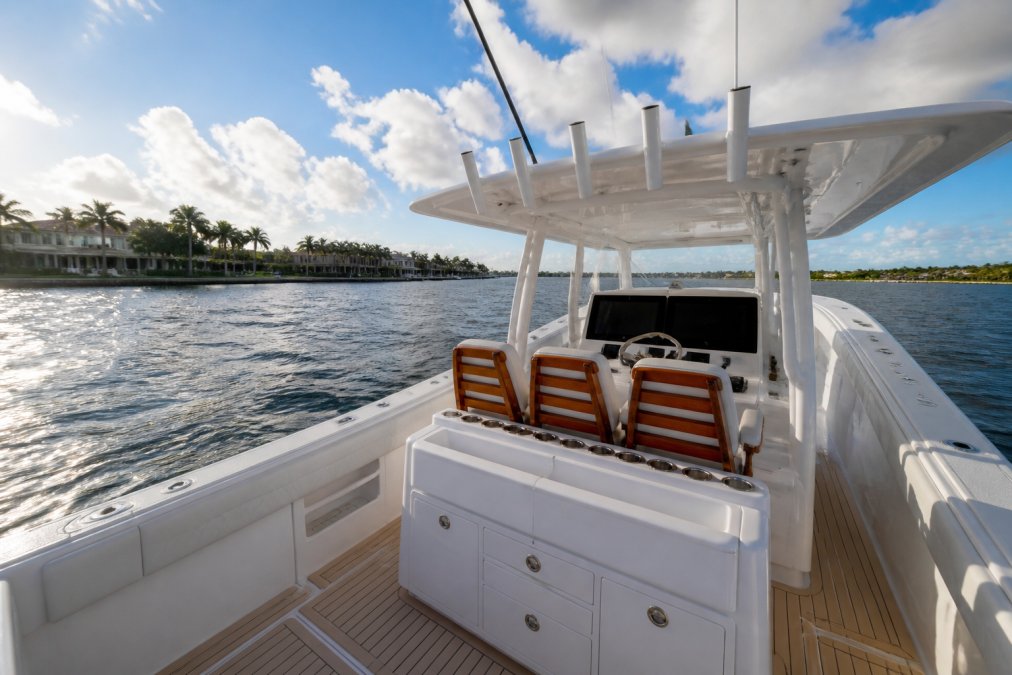
- T-top design with rod holders and electronics boxes
Ergonomics, Noise Reduction, and Human-Centric Design
Noise and vibration reduction rarely appears in marketing copy, yet it defines the experience on an eight-hour run. Premium builders isolate engine mounts, use composite coring in the deck and console, and add vibration dampening material in high-contact areas.
How Premium Features Affect Center Console Yacht Resale Value
According to BoatUS Foundation guidance on marine maintenance, documented maintenance directly influences a vessel's condition assessment at survey. For sellers, that means the premium features you paid for only translate to resale if you can prove they were maintained.
Frequently Asked Questions
What features distinguish a premium center console from a standard fishing boat?
Premium center consoles use carbon epoxy construction, stepped hull designs, and marine grade materials throughout. They include integrated marine electronics like joystick piloting and digital switching, plus luxury touches such as premium upholstery and gelcoat finishes. Standard fishing boats typically use traditional fiberglass layups and basic navigation equipment. The difference shows in ride quality, structural integrity, and long-term durability.
Which center console yachts hold their value best?
Center console yacht resale value depends on construction quality, brand reputation, and maintenance history. Boats with carbon epoxy hulls, reputable outboard power, and documented service records retain value better. Limited-production models from specialized builders often outperform mass-produced alternatives. Working with a specialist brokerage helps sellers position their vessel for the right buyer pool and achieve stronger returns.
How does hull construction impact the premium status of a center console?
Hull construction determines ride quality, structural integrity, and longevity. Carbon epoxy construction reduces weight while increasing strength compared to traditional fiberglass. Stepped hulls improve performance efficiency and stability at speed. Premium builders use vacuum infusion and cored laminates to eliminate excess resin and reduce weight. These methods produce a drier ride, better fuel economy, and a hull that holds up over years of offshore use.
What should I look for in the best offshore fishing center consoles?
Focus on livewell systems with adequate capacity and flow, fishability features like rod holders and tackle storage, and deck layouts that support fishing versatility. Check the transom design for outboard power compatibility and the walk-around deck for safe fish fighting. A t-top design with rod storage and electronics access adds practical value. Stability at rest and shallow draft matter for nearshore and offshore fishing alike.
The center console market rewards buyers who understand engineering, not just styling. Primo Yachts of Palm Beach has specialized in center console brokerage since 2009, offering a specialist brokerage, a focus on center console yachts, and expert guidance for buyers and sellers navigating the premium market. Get started with Primo Yachts of Palm Beach and find a vessel built to hold its value.