 ultimate-guide
Offshore Fishing Boat Hull Design Guide
Table of Contents
- Understanding Offshore Fishing Boat Hull Types
- Deep-V vs Modified-V Hull: Key Differences
- Deadrise Angle Explained: Impact on Performance
- Hull Design Features for Offshore Performance
- Matching Hull Design to Your Sea State
- Hull Design Impact on Fishability and Trolling
- Selecting the Right Offshore Fishing Boat Hull
- Conclusion
Last Updated: August 18, 2026
Understanding Offshore Fishing Boat Hull Types
Selecting the right offshore fishing boat hull design is one of the most critical decisions you'll make as a boat owner. The hull determines how your vessel handles rough water, manages fuel consumption, and whether you can safely reach your fishing grounds. At Primo Yachts of Palm Beach, we've guided countless clients through this decision: owners who understand hull design make better purchasing decisions and experience fewer regrets.
There are three primary categories of hulls used in offshore fishing vessels: displacement hulls, planing hulls, and semi-displacement hulls. Each has distinct hydrodynamic characteristics suited to different fishing scenarios and sea conditions.
Displacement vs. Planing Hulls
A displacement hull pushes water aside as it moves forward, providing exceptional stability and fuel efficiency at lower speeds. These hulls excel in rough water because their design keeps them in contact with the water surface, reducing wave impact and providing a smoother ride.
Planing hulls rise up on top of the water at higher speeds, reducing wetted surface area and allowing faster movement with the same engine power. When a planing hull reaches planning speed (typically 15-20 knots), the bow lifts and the stern digs in, creating a dynamic lifting effect. This design excels for boats prioritizing speed and fuel efficiency above 20 knots.
The trade-off is significant: planing hulls deliver a rougher ride in choppy conditions because they impact waves rather than flowing through them. At displacement speeds (below 8 knots), a planing hull is inefficient and burns excess fuel.
Semi-Displacement Hulls
Semi-displacement hulls incorporate characteristics of both designs, allowing efficient operation across a wider range of speeds. They partially plane at higher speeds while maintaining stability and efficiency benefits of displacement designs at lower speeds.
For offshore fishing, semi-displacement hulls have become increasingly popular because they offer flexibility. You can cruise economically to fishing grounds without excessive fuel burn, then increase speed when weather deteriorates or when returning to port quickly.
Deep-V vs Modified-V Hull: Key Differences
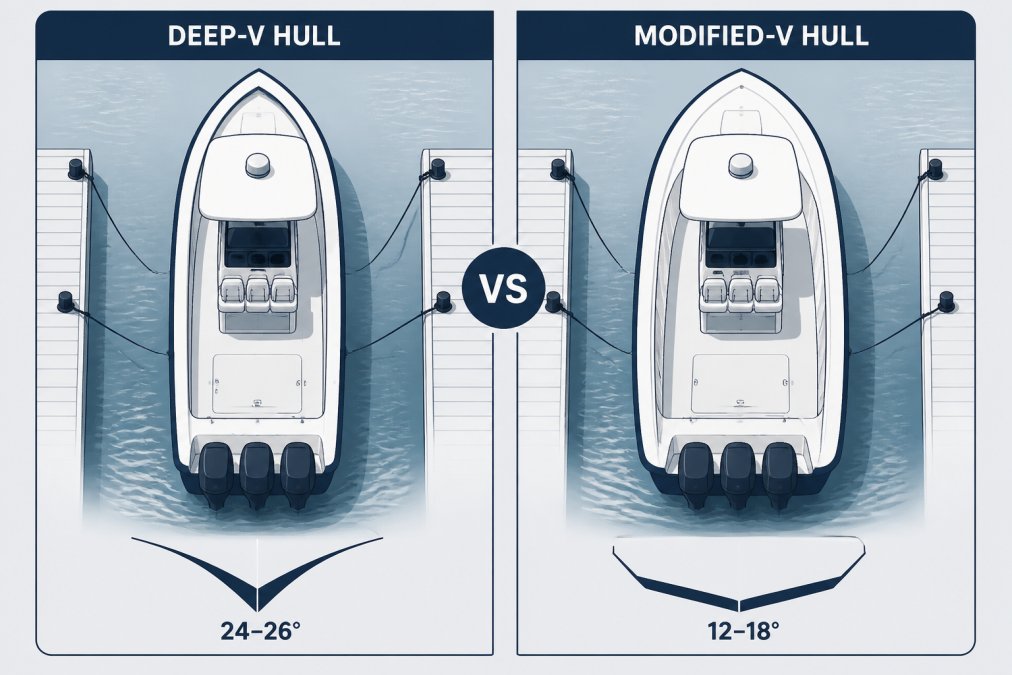
The deadrise angle, the angle at which the hull bottom rises from the keel to the chine, is the primary distinction between deep-V and modified-V hulls. A deep-V hull typically features a deadrise angle of 18-24 degrees or more, while a modified-V hull ranges from 12-18 degrees. This seemingly small difference creates substantial variations in how the boat handles rough water, fuel consumption, and comfort.
When to Choose Deep-V for Rough Water
Deep-V hulls excel in rough offshore conditions because the sharp V-shape cuts through waves rather than bouncing off them. The high deadrise angle creates entry angles that knife through wave faces, reducing jarring impact when a flatter hull hits a wave head-on. Boats with deep-V hulls maintain better directional stability in confused seas and provide significantly smoother rides when crossing large swells.
The downside is fuel efficiency. The deeper V-shape increases wetted surface area, creating more drag and requiring more horsepower to maintain speed. A deep-V hull burning 25 gallons per hour at 25 knots might consume 18 gallons per hour in a modified-V configuration at the same speed. For extended offshore fishing trips traveling 50+ miles to reach productive grounds, that fuel penalty compounds quickly.
Modified-V Benefits for Fuel Efficiency
Modified-V hulls offer a practical compromise for most offshore fishing scenarios. The shallower deadrise angle reduces drag and fuel consumption while still providing adequate rough water performance for typical offshore conditions. Modified-V hulls typically achieve 15-20% better fuel economy than comparable deep-V designs at equivalent speeds.
For a boat making regular 40-60 mile runs to fishing grounds, that translates to meaningful cost savings over a season. Modified-V hulls also sit higher in the water, providing better visibility from the helm and allowing operation in shallower water without risk of running aground on the keel.
Deadrise Angle Explained: Impact on Performance
The deadrise angle is the single most important hull design parameter for offshore fishing boats. Understanding how deadrise affects your boat's performance in different conditions will help you evaluate whether a specific hull design matches your typical fishing scenarios.
How Deadrise Affects Stability and Comfort
Deadrise angle directly influences how the boat interacts with waves. A high deadrise angle (20+ degrees) creates a sharp entry that cuts through wave faces, reducing impact force transmitted to the boat and crew. This translates to a smoother, more comfortable ride and less fatigue for anglers during long days offshore.
The sharp V-shape also provides better directional stability in confused seas where waves approach from multiple directions. However, high deadrise angles create a narrower hull bottom, which reduces initial stability when the boat is stationary or moving slowly.
Deadrise and Offshore Fishing Conditions
Most offshore fishing grounds are 30-100 miles from the nearest inlet. Your deadrise angle choice should reflect the typical sea conditions on your route and at your destination.
If you fish in areas with consistent long-period ocean swell (3-6 foot swells with 12+ second periods), a modified-V hull with 14-16 degree deadrise performs exceptionally well. If your fishing grounds are exposed to frequent short-period chop (2-4 foot waves with 6-8 second periods), a deeper V-shape (18-22 degrees) will provide noticeably better comfort and reduce crew fatigue.
Hull Design Features for Offshore Performance
Beyond the fundamental hull shape, several design features significantly impact offshore performance.
Chines, Strakes, and Entry Angle
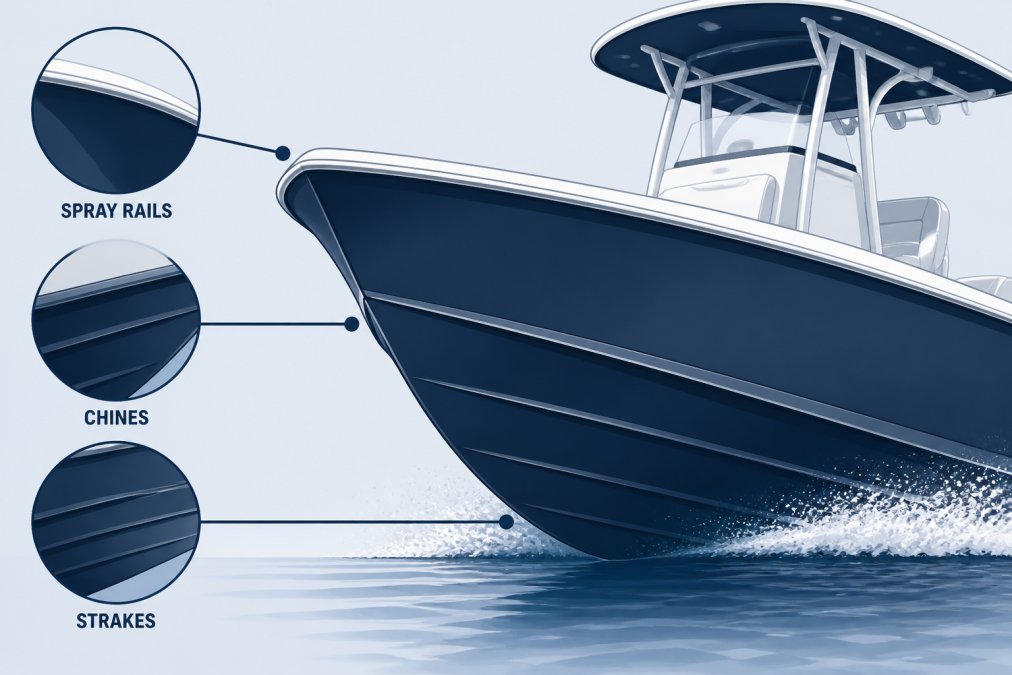
Chines are the hard edges where the hull's side meets the bottom. Multi-chine hulls feature two or more edges that affect how water flows off the hull and how effectively spray is deflected away from the boat.
Strakes are longitudinal ridges running along the hull surface that break up water flow, reducing suction effects and improving directional stability. They also help manage spray by directing water downward rather than allowing it to flow up and over the boat.
The entry angle, the angle at which the hull's bow meets the water, is critical for rough water performance. Most offshore fishing boats balance these characteristics with an entry angle between 16-22 degrees.
Spray Rails and Wave Piercing
Spray rails are small fins running along the lower hull sides, typically extending from the bow to mid-ship. These features redirect water downward, keeping spray off the deck and windshield, reducing visibility obstruction and making fishing more comfortable during rough conditions.
Wave-piercing bow designs incorporate a very fine entry angle and often a slight concave shape in the bow profile. This geometry allows the bow to slice through waves rather than deflect them upward, excelling in steep, short-period chop.
Trim Tabs and Center of Gravity
Trim tabs are small adjustable surfaces mounted on the transom that allow you to adjust the boat's running angle. By angling the tabs downward, you increase the bow angle to help the boat climb over large waves more effectively.
Center of gravity management is critical for offshore fishing boats because crew and fishing equipment shift the boat's weight distribution. A well-designed hull positions the center of gravity such that the boat maintains optimal running angle even when anglers are concentrated on one side or when fuel loads change.
Matching Hull Design to Your Sea State
The most important principle in selecting an offshore fishing boat hull is matching the design to the sea conditions you'll actually encounter. Many boat buyers select hulls based on worst-case scenarios they rarely experience, resulting in boats that are inefficient or uncomfortable in normal conditions.
Shallow Water vs. Offshore Capabilities
Shallow-water hulls typically feature modified-V designs with 10-14 degree deadrise and relatively flat bottoms, allowing operation in water depths of 2-3 feet while maintaining reasonable rough water performance. True offshore hulls feature deeper V-shapes with 18-24 degree deadrise, prioritizing rough water performance and comfort over shallow water capability.
The practical solution for most anglers is a compromise design: a modified-V with 14-16 degree deadrise that handles typical offshore conditions while still allowing operation in moderately shallow water (3-4 feet).
Hull Stability in Rough Water Conditions
Stability in rough water depends on multiple factors beyond hull shape. The boat's beam (width), freeboard (height of sides above waterline), and weight distribution all influence how the boat responds to waves.
A wider beam increases stability and reduces heel angle when the boat is hit by a wave from the side. Most offshore fishing boats balance these factors with beam-to-length ratios between 0.25 and 0.30. Higher freeboard keeps spray off the boat and crew, but increases the boat's profile to wind.
Hull Design Impact on Fishability and Trolling
The offshore fishing boat hull you select directly influences your ability to fish effectively. Hull design affects trolling speed stability, fuel consumption during extended fishing operations, and your ability to position the boat precisely over structure.
How Hull Shape Influences Trolling Speed
Most offshore fishing occurs at trolling speeds between 4-8 knots, well below the planning threshold for most hulls. At these speeds, the boat operates in displacement mode, and hull efficiency becomes critical.
A hull designed for displacement efficiency at trolling speeds will maintain a level running attitude and require minimal trim adjustment. Hulls optimized for high-speed planning often exhibit excessive bow-up angle at trolling speeds, reducing visibility and fuel efficiency.
Fuel Efficiency and Extended Fishing Range
A boat that burns 35 gallons per hour at 25 knots will burn 8-10 gallons per hour at 5-knot trolling speeds. Over a 6-hour fishing day, that's 48-60 gallons consumed just getting to and from the fishing grounds. Selecting a hull design that minimizes fuel consumption during transit directly extends your effective fishing range.
Semi-displacement and modified-V hulls typically outperform aggressive planing designs during low-speed transit portions of your fishing day. Many experienced offshore anglers choose boats with fuel capacities in the 300-400 gallon range to extend their range. A boat with an efficient hull design can reach 80+ miles from the inlet on a single tank.
Selecting the Right Offshore Fishing Boat Hull
Making the right hull selection requires honest assessment of where you fish, how far you travel, and what sea conditions you typically encounter.
Key Factors to Evaluate
Document your actual fishing patterns over a full season. How many days do you fish in each month? What's your average distance to fishing grounds? What's the typical sea state during your fishing season? What's the roughest condition you've encountered in the past three years?
Once you have this data, you can evaluate hull designs against your actual requirements rather than worst-case scenarios. A boat optimized for 40-mile runs in typical 2-3 foot seas will outperform a boat designed for 100-mile runs in 6-foot seas when you're actually fishing in normal conditions.
Consider the crew size and fishing style. A boat designed for two anglers fishing light tackle will have different requirements than a boat designed for six anglers chunking mackerel. Evaluate the boat's fuel capacity relative to your typical range requirements.
Fiberglass Construction and Hull Integrity
Modern offshore fishing boats are almost universally constructed from fiberglass, which provides excellent strength-to-weight ratio and durability. High-quality construction features solid fiberglass in high-stress areas (keel, chines, transom), proper layup schedules that match structural requirements, and thorough quality control during manufacturing.
The hull-to-deck joint is a critical structural area. A well-constructed hull will feature a substantial flange where the hull and deck are bonded, with multiple layers of fiberglass and proper sealant.
Check the transom construction carefully. The transom bears the entire weight of the engines and must be heavily reinforced with plywood or foam core. A soft transom that flexes when you press on it indicates inadequate reinforcement.
Selecting an offshore fishing boat hull is fundamentally about understanding hydrodynamics and honestly assessing your fishing requirements. The best hull design isn't the one that performs best in theoretical worst-case scenarios, it's the one that performs optimally in the conditions you actually fish. At Primo Yachts of Palm Beach, our specialists understand center console hull design intimately and can guide you toward vessels that match your specific fishing patterns and sea conditions. We've been helping discerning boat buyers make these critical decisions since 2009, and we know that the right hull choice leads to years of satisfying, safe fishing experiences.
| Hull Type | Deadrise Angle | Best For | Fuel Efficiency | Rough Water Comfort |
|---|---|---|---|---|
| Deep-V | 18-24° | Offshore, rough seas | Moderate | Excellent |
| Modified-V | 12-18° | Mixed offshore/shallow | Excellent | Good |
| Semi-Displacement | 12-16° | Extended range fishing | Very Good | Good |
| Displacement | 8-12° | Long-distance cruising | Excellent at low speed | Fair at speed |
Frequently Asked Questions
What is the difference between a deep-V and a modified-V hull?
A deep-V hull has a sharper deadrise angle (typically 20+ degrees), cutting through rough water with reduced pounding and superior stability in offshore conditions. A modified-V hull features a shallower angle (typically 12-18 degrees), offering better fuel efficiency and higher planing speeds in moderate seas. Deep-V excels in heavy offshore fishing conditions; modified-V suits anglers prioritizing speed and fuel economy in calmer waters.
How does deadrise angle affect offshore fishing performance?
Deadrise angle, the V-shape of the hull from bow to stern, directly influences ride quality, stability, and fuel consumption. Higher deadrise angles (20+ degrees) reduce impact loads when crossing waves, providing a smoother ride and better control in rough water, which is critical for offshore fishing. Lower angles improve fuel efficiency and speed but sacrifice comfort and safety in heavy seas. Offshore fishing boats typically require 18-22 degrees of deadrise for the best balance.
What is the most stable boat hull design for deep-sea fishing?
Deep-V and semi-displacement hulls rank highest for stability in deep-sea conditions. Deep-V designs distribute impact forces across a wider beam and deeper V, reducing roll and pitch. Semi-displacement hulls combine displacement characteristics with planing efficiency, offering exceptional stability at various speeds. Both designs prioritize center of gravity management and chine placement to maintain stability during trolling and in rough offshore sea states.
What factors should I consider when choosing an offshore fishing boat hull?
Evaluate your typical fishing grounds (sea state severity), desired cruising speed, fuel efficiency needs, and comfort priorities. Consider deadrise angle for your local conditions, hull construction quality (fiberglass integrity), beam width for stability, and draft for shallow-water access. Test different hull designs in conditions matching where you'll fish. Consult specialists familiar with your specific offshore fishing environment to match hull geometry to your performance requirements.
How do chines and strakes improve offshore boat performance?
Chines are the hard edges where the hull's side meets the bottom; multiple chines reduce spray and improve lateral stability by creating lift pockets. Strakes are longitudinal ridges running along the hull that break up water flow, reducing drag and spray while improving directional tracking. Spray rails (forward strakes) deflect water away from the cabin. Together, these features enhance rough-water handling, reduce pounding, and improve fuel efficiency in offshore conditions.
What is the 1/3 rule in boating?
The 1/3 rule guides safe fuel consumption: use 1/3 of your fuel to go out, 1/3 to return, and keep 1/3 in reserve for emergencies. This applies equally to offshore fishing boats regardless of hull design. However, hull efficiency, determined by deadrise, chines, and displacement characteristics, directly affects your actual range. A well-designed deep-V or semi-displacement hull maximizes distance covered per gallon, extending your safe fishing range offshore.
Does hull design affect trolling speed and fishing effectiveness?
Yes significantly. Hull design influences stability at low speeds, which is critical for trolling. Deep-V hulls maintain better directional control and comfort when trolling slowly in rough water. Modified-V hulls may porpoise or lose stability at very low speeds. Trim tabs help maintain optimal attitude during trolling regardless of hull type. A hull with proper deadrise and chine design allows smooth, controlled trolling speeds essential for effective offshore fishing.
This article was written using GrandRanker