 how-to
Marine Insurance Requirements for Private Yachts
Table of Contents
- What Marine Insurance Requirements for Private Yachts Actually Involve
- Yacht Insurance Coverage: Hull, Liability, and What Sits Between
- Yacht Insurance Application Requirements: Documents and Details Insurers Want
- Yacht Insurance Survey Requirements and Vessel-Condition Standards
- Yacht Insurance for Refits and Repairs: Keeping Coverage Intact
- Who Sets the Rules: Lenders, Marinas, Charter Use, and Cruising Areas
- Costs, Limits, and Exclusions in Private Yacht Insurance
- Conclusion
- Frequently Asked Questions
Last Updated: October 15, 2026
What Marine Insurance Requirements for Private Yachts Actually Involve
Marine insurance requirements for private yachts are set by three groups: state law, your lender, and your insurer.
At Primo Yachts, we have specialized in the center console market since 2009. The paperwork is not the hard part, knowing who sets each rule is.
Most owners assume insurance is one simple purchase. It is not.
Below, we break down what each rule-maker wants, what documents you need, and where coverage falls apart.
Yacht Insurance Coverage: Hull, Liability, and What Sits Between
Yacht insurance coverage splits into two core parts: hull coverage and liability coverage. Everything else is an add-on between them.
Hull and Physical Damage
Hull coverage pays to repair or replace your vessel after physical damage. It covers the hull itself, plus machinery, electronics, and onboard equipment.
The key question is how your insurer values the boat. Under agreed value, you and the insurer settle on a fixed number before the policy starts, and a total loss pays that amount. Under actual cash value, the payout is market value minus depreciation.
Liability and Onboard Property
Liability coverage handles bodily injury and property damage you cause to others, plus legal defense, which matters more than most owners expect.
Personal property coverage protects items stored aboard, such as fishing gear, electronics, and safety equipment. Check the limit carefully. Many policies cap it far below what a serious offshore setup is worth.
Yacht Insurance Application Requirements: Documents and Details Insurers Want
Yacht insurance application requirements come down to proof: ownership, skill, and vessel condition. These are not legal mandates but underwriting conditions, nothing in state law forces you to hand over a survey or boating resume. Your insurer asks to decide whether to accept the risk and at what price, and that distinction matters when each carrier wants a slightly different file.
The Core Application File
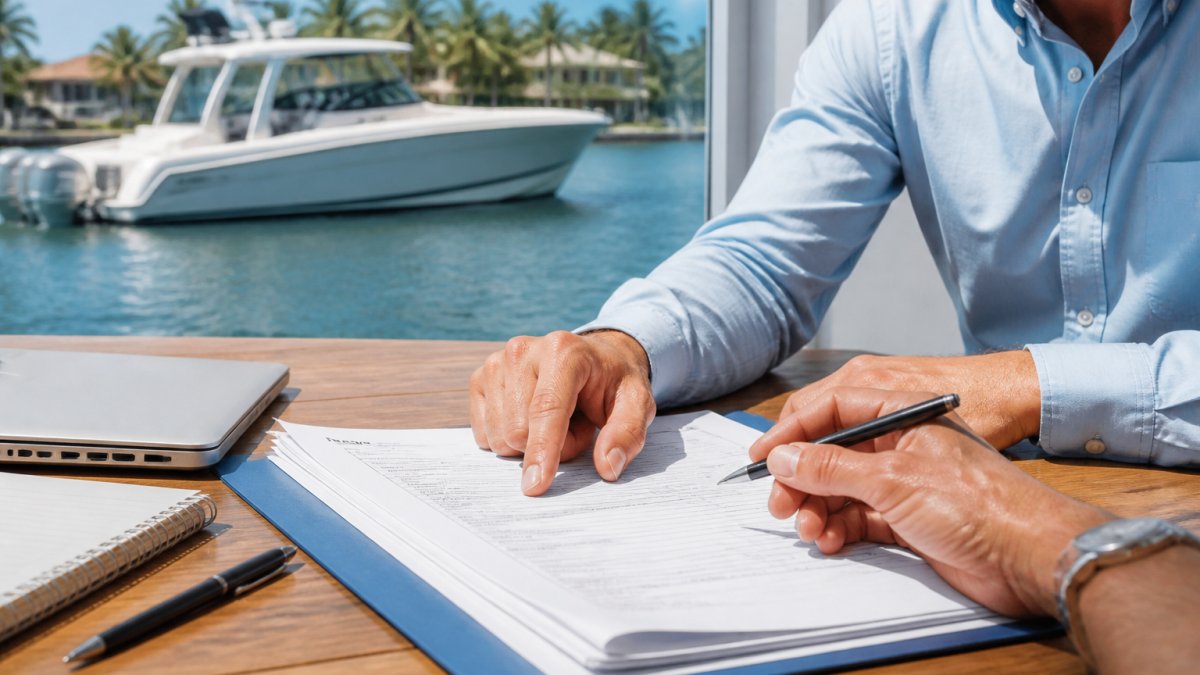
Have these ready before you start shopping:
- Proof of ownership. A state-issued certificate of number (registration) or a U.S. Coast Guard Certificate of Documentation. If documented, you also need the official number and the managing owner's name as it appears.
- Vessel identification. Hull Identification Number (HIN), year, make, model, length, beam, and propulsion type. The HIN is the 12-character code stamped on the transom; insurers use it to pull build records and loss history.
- Recent marine survey. Required by most carriers once a vessel passes a certain age or value threshold. See the survey section below for what triggers it.
What Actually Slows an Application Down
Missing items slow the process more than anything else: a complete file moves in days, a partial one sits for weeks. The three most common stalls are:
- A survey that does not exist yet. If the carrier requires one, you cannot bind coverage until the surveyor's report is in hand. Schedule the haul-out before you shop.
- A HIN that does not match the title. Typos and transposed digits are common and force a re-verification.
- An undisclosed charter or rental use. If you rent the vessel through a peer-to-peer platform even a few weekends a year, say so up front. A private pleasure policy will not respond to a paid-use claim.
Legal Requirement vs. Underwriting Requirement
State law generally requires liability coverage only if you operate a vessel that must be registered, and even then a homeowner's or umbrella policy often satisfies it. Your lender, marina, and insurer each impose their own conditions on top of that. Meeting the legal minimum does not satisfy a lender's loss-payee demand, and satisfying the lender does not satisfy the marina's certificate-of-insurance requirement.
U.S. Coast Guard National Vessel Documentation Center
National Association of State Boating Law Administrators
Yacht Insurance Survey Requirements and Vessel-Condition Standards
Yacht insurance survey requirements depend on the vessel's age, size, and value. Most carriers waive a survey on newer boats and require one as the vessel ages. Trigger points vary, but a common pattern is:
- New vessels under roughly five years old: survey typically waived, especially with a builder's warranty in force.
- Vessels roughly five to fifteen years old: a current survey, usually within the last 12 to 24 months, is commonly requested at binding or at the first renewal.
- Vessels over roughly fifteen to twenty years old: a full condition-and-valuation survey is standard, and some carriers require one every three to five years thereafter.
- Any vessel with a significant claim history, a prior sinking, or a major refit: survey required regardless of age.
These are underwriting conventions, not statutes. No state requires a marine survey to register or operate a private yacht. The carrier requires it because condition predicts claims.
What a Marine Survey Actually Evaluates
A marine survey is an independent inspection of the vessel's condition, systems, and structure. It overlaps with a purchase inspection but is not the same: for insurance, the surveyor grades risk rather than negotiating a sale. Securing an accurate assessment depends heavily on hiring a marine surveyor who understands the specific technical standards required by modern underwriters.
Expect the surveyor to check:
- Hull and structure. Moisture readings on cored and fiberglass hulls, tap testing for delamination, and inspection of stringers, bulkheads, and transom. Prior repairs are documented and rated.
- Deck and superstructure. Soft spots, hardware bedding, and stanchion and rail attachment points.
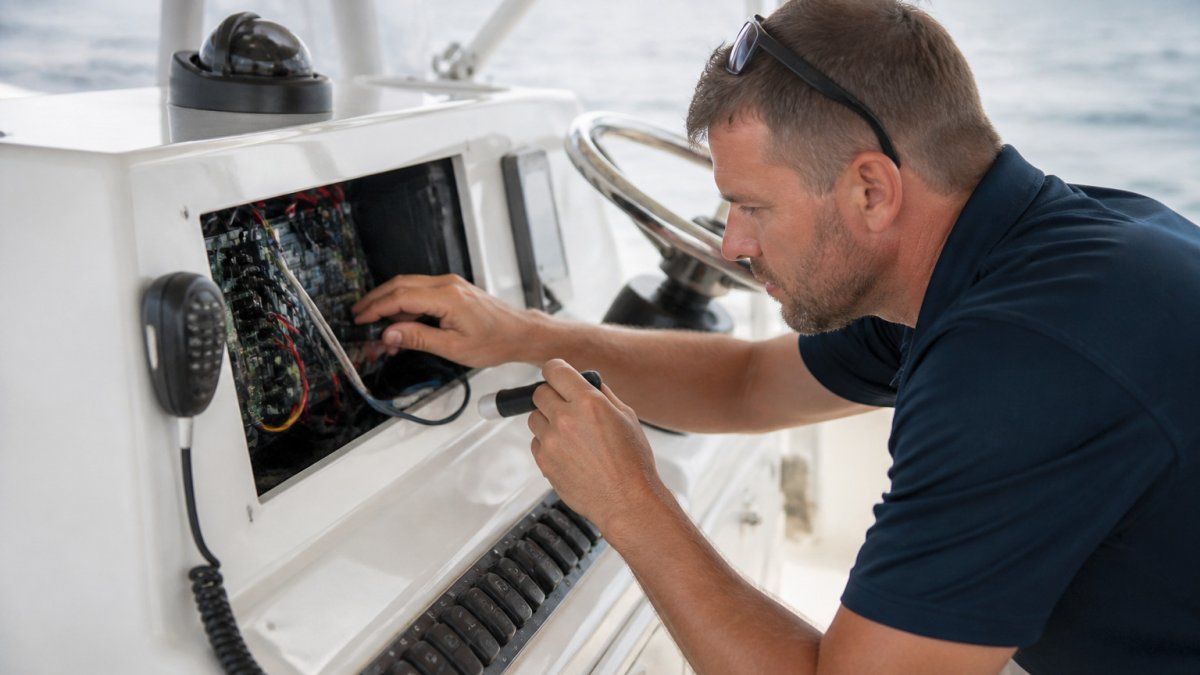
- Engines and running gear. Hours, service records, exhaust condition, shaft and strut alignment, prop condition, and through-hull fittings.
- Fuel, electrical, and plumbing systems. Tank condition, hose and clamp age, bonding and grounding, and corrosion at terminals.
How Survey Findings Affect Eligibility and Premium
A survey does not produce a pass or fail, it produces recommendations, and the carrier decides what to do with them. Three outcomes are common:
- Clean survey. Coverage binds at the quoted premium, sometimes with a small credit for documented maintenance.
- Recommendations with a compliance window. The carrier binds coverage but requires you to correct specified items within a stated period, often 30 to 90 days, and to provide proof of completion. Failure to comply can void coverage for a later claim tied to that item.
- Adverse findings. Structural issues, unrepaired damage, or a vessel the surveyor rates as unseaworthy can lead to declination, a surcharge, or a requirement that you complete repairs before the policy takes effect.
A well-kept boat is a lower risk, which shows up in your premium. A neglected one may be uninsurable through standard markets, pushing the owner toward surplus-lines carriers at materially higher cost.
Choosing a Surveyor
Look for a surveyor accredited by a recognized marine surveying body and experienced with your vessel type, a sportfishing specialist may not suit a sailing yacht or trawler. Ask for a sample report before booking, and confirm the survey includes a current market valuation, since most carriers want that number to set the insured value.
Reach out now to see how we can help with your boating needs! →
Yacht Insurance for Refits and Repairs: Keeping Coverage Intact
Yacht insurance for refits and repairs is where owners get caught. A boat under major work can lose coverage without anyone realizing it.
Tell your insurer before work begins. A repower, structural repair, or long yard period changes the risk, and some policies restrict coverage while a vessel is hauled out or under repair.
A few practical steps:
- Notify your insurer in writing before the yard period starts
- Confirm coverage during haul-out and transit
- Ask whether the yard carries its own liability coverage
- Keep your insured value updated as the refit adds value
The last point matters at resale. An outdated insured value can leave a gap between what you spent and what a total loss pays.
Who Sets the Rules: Lenders, Marinas, Charter Use, and Cruising Areas
Four parties can impose requirements, and they rarely match: lenders, marinas, charter operators, and cruising areas each set their own terms.
Here is how their demands differ:
| Rule-Maker | What They Typically Require | Why It Matters |
|---|---|---|
| Lender | Coverage at least equal to loan balance, named as loss payee | Protects their collateral, not you |
| Marina | Proof of liability coverage, often a minimum limit | Limits their exposure on the dock |
| Charter use | Commercial or charter endorsement | A private policy may not pay for paid use |
| Cruising area | Navigation limits and territorial limits | Claims outside the area can be denied |
Charter use is the biggest trap. The moment you take paying passengers, a private policy may stop applying.
Navigation limits work the same way. If your policy covers coastal waters and you run to the islands, you may be outside your cruising area when something goes wrong.
Costs, Limits, and Exclusions in Private Yacht Insurance
Private yacht insurance costs depend on the vessel, the owner, and the coverage you choose.
Risk factors that move your annual premium:
- Vessel length, age, type, and insured value
- Your boating experience and claims history
- Cruising area and how far you range
- Deductible you accept
Policy exclusions are standard across most carriers. Expect no coverage for:
- Wear and tear and gradual deterioration
- Manufacturer's defects and recalls
- Damage from lack of maintenance
- Intentional damage or unlawful use
Coverage limits cap what each part of the policy pays. Read them together, not one at a time.
For crew, maritime employers' liability and Jones Act coverage come into play when you hire paid hands.
Pricing depends on your vessel and coverage choices. Reach out to us for current guidance, or check with your insurer directly for a quote.
Conclusion
Getting the requirements right is harder than it should be, because three parties set them and none talk to each other.
That is where Primo Yachts comes in. We have specialized in the center console market since 2009, and we help owners in the Palm Beach and Jupiter area buy and sell with confidence.
Reach out now to see how we can help with your boating needs.
Frequently Asked Questions
Is marine insurance legally required for a private yacht?
No federal law requires private yacht insurance. But that does not mean you can skip it. Most lenders require hull and liability coverage as a condition of a marine loan, marinas often demand proof of liability limits before issuing a slip contract, and Florida requires proof of financial responsibility only if you have certain boating violations. Without a loan or slip, you may legally operate uninsured, but you carry the full cost of any loss yourself.
What information do insurers require to insure a yacht?
Expect to provide the vessel's hull identification number, year, make, model, and length; a recent marine survey; purchase price or current market value; your boating experience and any formal training; the intended cruising area and navigation limits; whether the vessel is captained or owner-operated; and details on onboard equipment, machinery, and accessories. Insurers also ask about prior claims. Missing or vague answers slow down underwriting and can lead to a higher annual premium or a declined application.
Does yacht insurance cover refits, repairs, or equipment upgrades?
Standard policies cover sudden physical damage from a covered event, not the cost of upgrading or refitting your yacht. If you repower, add electronics, or replace machinery, that work is not insured until you update the insured value and add the new equipment to the policy. Talk to your insurer before a refit begins, keep receipts, and request a coverage endorsement for the new items so a total loss claim reflects the vessel's actual condition.
What exclusions should private yacht owners check in a policy?
Read the policy exclusions carefully. Common ones include wear and tear, manufacturer's defects, gradual deterioration, lack of maintenance, and damage while the vessel is outside its stated cruising area. Many policies also exclude commercial or charter use unless you add an endorsement. Confirm how the deductible applies, whether agreed value or actual cash value is used for a total loss, and what navigation limits apply. These four points decide most claim disputes.