 how-to
How to Improve Center Console Fuel Efficiency
Table of Contents
- How Hull Cleanliness and Bottom Paint Affect Fuel Efficiency
- Boat Trim and Fuel Efficiency: The Role of Trim Tabs and Engine Tilt
- Outboard Engine Maintenance Schedule for Peak Performance
- Finding the Best Cruising Speed for Center Console Hulls
- Propeller Selection and Pitch: Matching the Prop to the Load
- Managing Vessel Weight and Gear Distribution
- Track Your Results and Adjust Your Routine
- Frequently Asked Questions
Last Updated: September 7, 2026
Fuel efficiency is the difference between a center console that costs a fortune to run and one that respects your operating budget. For owners of 34-foot and larger vessels, the gap between good and poor fuel economy often comes down to a handful of controllable factors rather than the hull design itself.
Fuel efficiency is a system, not a single adjustment. Hull condition, engine health, propeller pitch, trim angle, vessel weight, and cruising speed all interact. Below, we walk through each lever in order of impact.
How Hull Cleanliness and Bottom Paint Affect Fuel Efficiency
A fouled hull is the single largest drag penalty most center consoles carry. Barnacle growth, slime, and algae create hydrodynamic resistance that forces the engine to work harder at every throttle setting.
The fix is a scheduled haul-out and hull cleaning regimen. For boats kept in warm South Florida waters, inspect the running gear and bottom at least every 90 days (navy.mil). A properly applied multi-season anti-fouling coating reduces the frequency of intermediate cleanings.
The Impact of Barnacle Growth on Fuel Burn Rate
Barnacle growth does not just slow you down; it changes how the engine operates. As fouling accumulates, the hull loses its ability to plane efficiently, forcing the operator to add throttle to maintain the same speed, translating directly into higher fuel burn rate at the helm.
In warm waters, growth does not pause for the season. Pairing quality anti-fouling paint with periodic in-water cleaning yields steadier performance and more predictable fuel consumption year-round.
Boat Trim and Fuel Efficiency: The Role of Trim Tabs and Engine Tilt
Boat trim and fuel efficiency are directly linked through hull resistance. When a center console runs bow-high, the hull pushes more water, increasing drag and forcing the engine to burn more fuel to hold speed. Correct trim lets the hull ride on its designed planing surface.
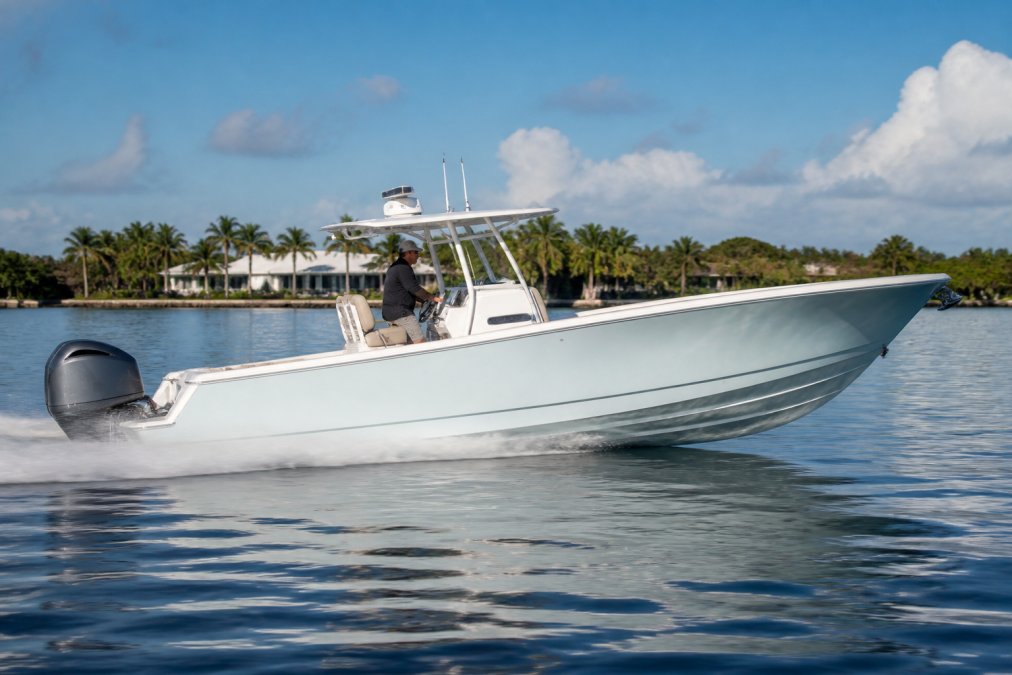
Engine tilt is the primary trim control on an outboard-powered center console. At planing speed, trim the engine out in small increments until the bow rises slightly and steering feels light, keeping the hull level without porpoising. Trim tabs add a second layer of control, correcting side-to-side list when weight shifts or beam seas push the hull off balance.
The most common trim error is over-trimming. Too much engine tilt makes the propeller ventilate, losing bite and wasting fuel; too little keeps the bow down, dragging the hull. The correct setting changes with sea state, load, and speed, so check trim every time conditions change.
Outboard Engine Maintenance Schedule for Peak Performance
A well-maintained outboard motor is the foundation of any fuel efficiency strategy. Engine maintenance directly determines combustion efficiency, and a poorly tuned powerhead burns more fuel for the same output. The outboard engine maintenance schedule is the difference between an engine that delivers its rated power and one that quietly underperforms.
Core maintenance items that affect fuel burn rate include fresh spark plugs, clean fuel filters, and properly adjusted throttle linkage. A fouled plug or restricted filter makes the engine run rich, wasting fuel and increasing carbon buildup. Follow the manufacturer's service intervals and log every service.
Finding the Best Cruising Speed for Center Console Hulls
The best cruising speed for center console hulls is the throttle setting where the boat achieves its lowest fuel burn per nautical mile, not its lowest fuel burn per hour. A boat burning 20 gallons per hour at 30 knots covers more distance per gallon than one burning 12 gallons per hour at 15 knots while struggling to stay on plane.
Most planing hulls display a distinct efficiency curve. Below planing speed, the hull pushes water and burns fuel without covering ground. At wide open throttle, the engine runs at maximum fuel flow with diminishing speed returns. The efficient zone sits between these extremes, where the hull is fully planing and the engine runs at a moderate percentage of its rated RPM range.
| Speed Range | Hull Condition | Fuel Burn Pattern | Best Use |
|---|---|---|---|
| Below planing | Plowing water | High burn, low distance | Avoid except no-wake zones |
| On plane, low RPM | Fully planing | Lowest burn per nautical mile | Long-distance cruising |
| Mid-range cruise | Planing, efficient | Balanced speed and economy | Daily offshore runs |
| Wide open throttle | Maximum speed | Highest burn, steep drop-off | Only when speed is critical |
Using a Fuel Flow Meter to Find Your Boat's Sweet Spot RPM
A fuel flow meter removes guesswork from finding your boat's optimal RPM. This instrument displays real-time gallons per hour, letting you read exactly what the engine consumes at any throttle setting, without it, you are estimating based on speed alone.
To find your sweet spot, run the boat at a fixed throttle setting on calm water and record both speed and fuel flow. Calculate nautical miles per gallon at that setting, then repeat across the cruising range. The RPM where distance per gallon peaks is your most efficient cruise.
Propeller Selection and Pitch: Matching the Prop to the Load
Propeller pitch is the gear ratio of your boat, and getting it wrong wastes fuel at every throttle setting. Too much pitch overloads the engine, preventing it from reaching its designed RPM range at wide open throttle; too little lets the engine over-rev, burning fuel without converting it into forward speed.
The goal is a propeller that lets the engine reach the top of its recommended wide open throttle RPM range with a typical load aboard. Propeller selection should be revisited whenever you modify the boat or change how you load it.
Calculating Propeller Slip to Diagnose Efficiency Loss
Propeller slip is the difference between theoretical and actual forward travel, expressed as a percentage. It is the single most informative number for diagnosing whether your prop is wasting engine power. A healthy, correctly matched prop on a clean hull runs at 10-15% slip at cruising speed; slip above 20% indicates a damaged blade, incorrect pitch, or the prop running too high in ventilating water.
To calculate slip, you need three numbers: boat speed (in knots), propeller pitch (in inches), and propeller shaft RPM (engine RPM divided by the gear ratio, typically 1.85:1 or 2.00:1, check your manufacturer's specs). The formula is:
Slip (%) = [1 − (Boat Speed in knots × 121.5) / (Pitch in inches × Shaft RPM)] × 100
The correct formula uses a constant accounting for pitch measured in inches per revolution and 6,076 feet (72,912 inches) per nautical mile:
Slip (%) = [1 − (Boat Speed in knots × 72,912) / (Pitch in inches × Shaft RPM × 60)] × 100
Simplified, the constant becomes 1,215.2 (72,912 / 60):
Slip (%) = [1 − (Boat Speed in knots × 1,215.2) / (Pitch in inches × Shaft RPM)] × 100
Using the example above: (35 × 1,215.2) = 42,532. (19 × 2,432) = 46,208. Slip = [1 − (42,532 / 46,208)] × 100 = 8.0% slip, an excellent number indicating a well-matched prop.
If your calculated slip exceeds 15% at cruise, inspect the prop for cupping damage, bent blades, or excessive ventilation. A prop too small in diameter or too high on the shaft can also cavitate, showing up as high slip with no corresponding speed gain.
The RPM Sweet Spot Table for Common Center Console Configurations
While every hull is different, the following table provides a starting range for finding your most efficient cruise based on common outboard configurations. These are general patterns observed across the market, not guarantees for your specific boat, always verify with your own fuel flow data.
| Engine Type | Typical WOT RPM Range | Sweet Spot Cruise (RPM) | Expected Slip at Cruise |
|---|---|---|---|
| Single 250-300 HP 4-stroke | 5,800-6,300 | 4,200-4,800 | 8-12% |
| Twin 200-250 HP 4-stroke | 5,800-6,300 | 4,000-4,600 | 8-12% |
| Single 350-450 HP 4-stroke | 6,000-6,400 | 4,500-5,000 | 9-13% |
| Twin 300-350 HP 4-stroke | 6,000-6,400 | 4,300-4,800 | 9-13% |
A prop correctly pitched for your load will let the engine sit in the sweet spot RPM band at cruise, with slip in the single digits to low teens. If slip exceeds 15% at cruise, check the hull for fouling and the engine for correct mounting height before spending money on a new wheel.
Adding 500-800 pounds of tower and gear typically requires dropping pitch by 1-2 inches to maintain the same WOT RPM (yamahaoutboards.com).
Managing Vessel Weight and Gear Distribution
Every pound aboard a center console costs fuel. Vessel weight directly affects how much power the hull needs to reach and hold planing speed, and excess weight compounds at every throttle setting. Weight management is the most controllable variable you have.
Start by auditing what you carry. Fuel, water, tackle, safety gear, and personal items accumulate quickly, and much stays aboard trip after trip. Remove gear you do not use, and fill water tanks only when needed. Keep heavy items low and centered to avoid adding trim resistance.
Track Your Results and Adjust Your Routine
Fuel efficiency improves with measurement. A digital fuel management system or a simple logbook entry per trip gives you the data to see whether your adjustments are working. Record hours, fuel added, and nautical miles run, then compare fuel burn rate across trips.
Digital Fuel Management: Moving Beyond the Logbook
Most center console owners rely on analog gauges or the speedometer to judge efficiency, both estimates at best. A digital fuel management system removes the guesswork by measuring actual fuel flow in real time. The marine industry standard is the NMEA 2000 network, allowing fuel flow sensors, GPS, and engine data to communicate on a single backbone.
Key components include:
- Fuel flow sensors (e.g., Floscan, Garmin, or Lowrance units) that measure gallons per hour in real time. These sensors are installed in the fuel line between the tank and the engine, and they send data to a compatible display.
- NMEA 2000 backbone that connects the sensor to a chartplotter or dedicated gauge. This network also carries engine RPM, speed over ground from GPS, and engine temperature, all of which are necessary for calculating nautical miles per gallon.
- A display or chartplotter that shows instantaneous fuel flow, total fuel used, and calculated fuel economy (nautical miles per gallon). Most modern chartplotters from Garmin, Raymarine, Simrad, and Lowrance have built-in fuel management pages that require only the sensor and network connection.
Using Real-Time Data to Find Your Boat's Sweet Spot RPM
With a fuel flow system installed, finding your most efficient cruise becomes a 20-minute exercise. On a calm day with a typical load, run the boat at a fixed throttle setting and record both speed (from GPS) and fuel flow (from the sensor). Calculate nautical miles per gallon, then repeat across the cruising range in 200-300 RPM increments.
The RPM where distance per gallon peaks is your most efficient cruise. A typical 34-foot center console with twin 300 HP outboards might show the following pattern:
| RPM | Speed (knots) | Fuel Flow (GPH) | Nautical Miles per Gallon |
|---|---|---|---|
| 3,500 | 22 | 18.5 | 1.19 |
| 4,000 | 28 | 24.0 | 1.17 |
| 4,500 | 33 | 31.0 | 1.06 |
| 5,000 | 37 | 41.5 | 0.89 |
| 5,500 | 41 | 54.0 | 0.76 |
In this example, the sweet spot is around 3,500-4,000 RPM. Running at 5,500 RPM burns nearly twice the fuel per mile as cruising at 3,500 RPM, a difference that adds up quickly on a long offshore run.
Building a Trip Log That Actually Tells You Something
If a digital system is not in your budget this season, a structured logbook can still reveal trends, but only if you record the right numbers. For each trip, log:
- Engine hours at start and end
- Fuel added (from the pump receipt, not the gauge)
- Nautical miles run (from GPS, not the speedometer)
- Average RPM and average speed for the cruise portion
- Sea state and wind (rough conditions increase burn rate by 10-20%) (transportation.gov)
- Load aboard (number of passengers, fuel load, water tank level)
Divide nautical miles by fuel added to get your true trip economy. Compare trips with similar conditions and loads to isolate the effect of a maintenance change or a new prop. A gradual increase in fuel burn per mile is often the first sign of a fouled bottom or developing engine issue, catching it early keeps the boat at its efficient baseline.
This routine turns maintenance from an expense into a performance program. The owners who get the best fuel economy from their center consoles are not the ones with the newest engines, they are the ones who measure, compare, and adjust based on data rather than habit.
Frequently Asked Questions
What is the most fuel-efficient cruising speed for a center console?
The most fuel-efficient speed is typically found at the RPM range where the hull is fully planing but before fuel burn rate rises sharply. For many center consoles, this is around 25 to 35 mph, but the exact figure depends on hull design, weight, and engine power. Use a fuel flow meter to test different throttle positions. You want the lowest fuel burn rate that maintains a comfortable, safe plane without constantly adjusting the throttle.
How does engine trim affect fuel consumption on a center console?
Proper engine trim reduces drag and improves fuel efficiency. When trimmed too far in, the bow plows water, increasing resistance. When trimmed too far out, the propeller loses grip and RPMs rise without adding speed. Adjust the trim to raise the bow slightly for a flatter ride. This reduces wetted surface area on the hull, allowing the boat to plane more efficiently at lower throttle settings.
How often should I service my outboard motors to maintain peak efficiency?
Follow an outboard engine maintenance schedule that includes a full service at least once a year or every 100 hours of operation, whichever comes first. Key tasks include replacing spark plugs, fuel filters, and lower unit gear oil. Check the water pump impeller every two years. Proper maintenance ensures complete combustion and optimal engine efficiency, preventing a higher fuel burn rate caused by worn parts.
Does carrying extra gear or water impact center console fuel efficiency?
Yes. Extra weight requires more energy to push the hull through the water, increasing fuel burn rate. A center console loaded with full water tanks, heavy tackle, and unnecessary gear will burn noticeably more fuel. Empty water tanks if you are fishing inshore, and remove gear you do not use on every trip. Distribute remaining weight evenly to maintain proper trim and balance.