 ultimate-guide
How to Choose a Luxury Center Console Boat in 2026
Table of Contents
- Start With Your Mission: Offshore Fishing vs. Coastal Cruising
- Hull Design and Ride Quality: Deep-V, Stepped, and Deadrise Explained
- Center Console Boat Size Guide: Matching Length to Your Needs
- Offshore Fishing Center Console Features That Matter
- Power and Performance: Outboard Configurations and Fuel Efficiency
- New vs. Used Center Console Brokerage: What Buyers Should Know
- Total Cost of Ownership: Beyond the Purchase Price
- The Pre-Purchase Marine Survey and Sea Trial Checklist
- Frequently Asked Questions
Last Updated: September 15, 2026
Start With Your Mission: Offshore Fishing vs. Coastal Cruising
How to choose a luxury center console boat starts with one question: what will the boat actually do on a Saturday six months from now? Mission drives every specification.
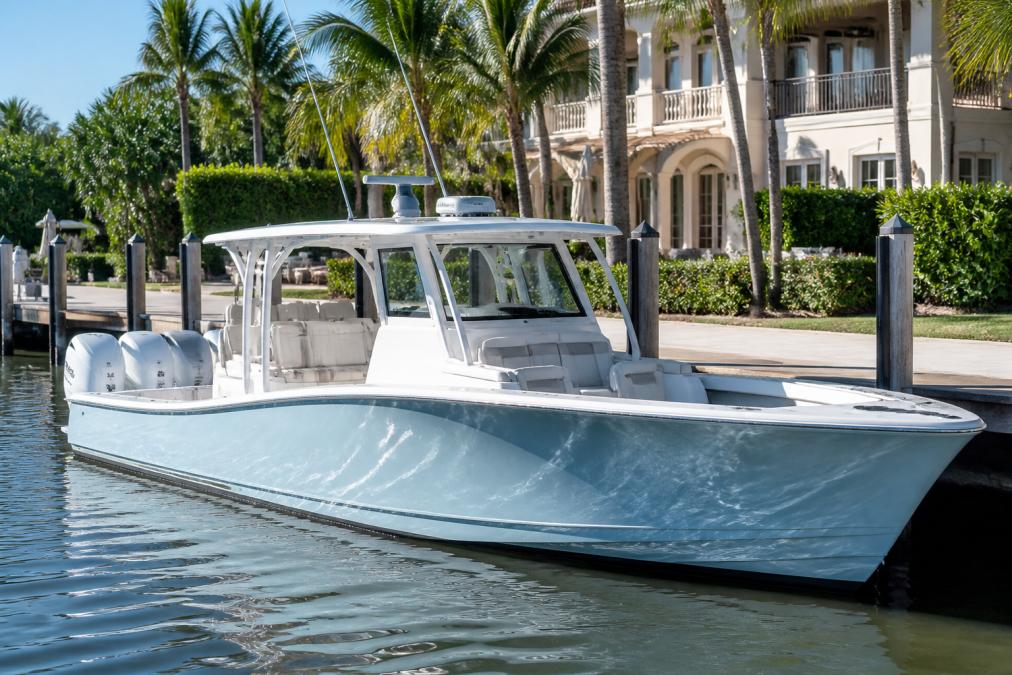
A luxury center console is a high-end, open-deck motor yacht built around a central helm station, typically 34 feet and above, finished with premium materials and outfitted for serious offshore capability. The category splits into two buyer profiles: one runs 60 miles out to blue water and wants fishability above all; the other cruises the Intracoastal with family and cares about seating, shade, and a head guests will actually use. Most buyers want both, but the compromise shows up in hull design, deck layout, and power.
Get the mission wrong and no gelcoat finish will fix it. Decide where the boat spends 80 percent of its hours.
Hull Design and Ride Quality: Deep-V, Stepped, and Deadrise Explained
Ride quality comes down to deadrise, the angle between the hull bottom and horizontal, measured at the transom. A deep-V hull with 22 to 24 degrees of deadrise cuts chop cleanly but demands more power and fuel. Flatter hulls in the 16 to 18 degree range plane easily and stay stable at rest, which matters when drift fishing.
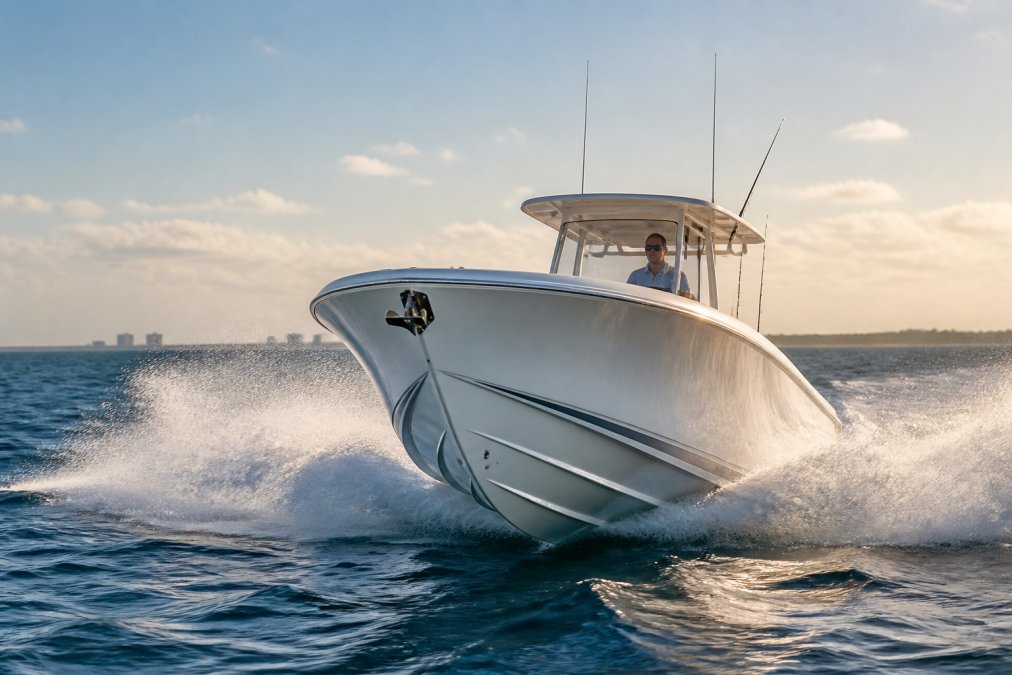
Stepped hulls add a notch along the running surface that introduces air under the hull, reducing drag and improving top-end efficiency, but the ride can feel looser in following seas. A common mistake is buying on top speed alone: most owners run at cruise, and a well-matched deep-V at 30 knots beats a nervous stepped hull at 45.
Center Console Boat Size Guide: Matching Length to Your Needs
Length is the clearest predictor of range, comfort, and cost, so use this center console boat size guide as your first filter. Beam and dry weight climb with length, affecting towing, storage, and head-sea handling.
34-38 Feet: Day Trips and Nearshore Fishing
This range suits single or twin outboard power, fits most wet slips, and handles nearshore runs comfortably. It is the most trailerable tier in the luxury class, though a heavy 38-footer still demands a serious tow vehicle.
40-45 Feet: The Offshore Sweet Spot
Twin or triple outboards, a full helm station, and enough fuel capacity for genuine offshore range define this tier. Most experienced buyers land here because it balances fishability with cruising amenities.
46+ Feet: Long-Range and Overnight Capability
Quad configurations, cabin space, and generator capacity push these boats into overnight territory. Draft increases, so shallow-water access narrows.
| Length | Typical Power | Best For | Watch Out For |
|---|---|---|---|
| 34-38 ft | Single/twin outboard | Day trips, nearshore | Limited range |
| 40-45 ft | Twin/triple outboard | Offshore fishing | Higher fuel burn |
| 46+ ft | Triple/quad outboard | Overnight, long range | Draft, slip size |
Offshore Fishing Center Console Features That Matter
Fishability is where luxury and utility either align or collide. The offshore fishing center console features worth prioritizing are the ones you touch every trip: livewell capacity, fish box insulation, and a casting deck that lets two anglers work without tangling.
Livewells, Fish Boxes, and Casting Decks
A livewell should hold bait at volume with reliable aeration, and its pickup should sit where it will not clog. Insulated fish boxes preserve the catch on long runs. Casting decks forward of the console add fishing space but eat into bow seating, so decide which you value.
T-Tops, Hardtops, and Helm Ergonomics
A hardtop offers more shade and mounting surface for marine electronics than a fabric t-top. At the helm station, check ergonomics in person: can you reach the throttle, trim tabs, and chartplotter without leaning? Gunwale height should let you brace while fighting a fish. Integrated displays and control systems require careful placement to ensure visibility, so consider how your planned marine electronics upgrades will influence the overall layout and functionality of your cockpit.
Power and Performance: Outboard Configurations and Fuel Efficiency
Outboard power choices run from a single engine on smaller hulls to quad configurations on the largest center consoles. The decision is not "how much horsepower can I bolt on", it is a hull-to-power matching problem, and getting it wrong is the most common performance regret owners report.
How Outboard Count and Horsepower Actually Map to Hull Size
A useful rule of thumb: plan for roughly 5 to 7 horsepower per foot of length for a planing center console, then adjust for loaded weight. A 38-foot hull at 12,000 pounds loaded behaves very differently from the same hull at 15,000 pounds with full fuel, ice, and four anglers. The maximum horsepower rating on the capacity plate is a ceiling, not a target, running at the ceiling usually means more weight, more fuel burn, and no meaningful cruise-speed gain (uscgboating.org).
- Single outboard: Practical on hulls under roughly 30 feet. No redundancy offshore.
- Twin outboards: The default for offshore work. One engine can bring you home, and twins simplify docking with counter-rotation.
- Triple outboards: Common on 40-45 foot hulls where weight and thrust justify the third leg. Adds a third service interval.
- Quad outboards: Reserved for 45-foot-plus hulls. Docking control and redundancy are excellent; fuel burn and maintenance line items climb accordingly.
Prop Selection, Pitch, and Why Cruise Speed Beats Top Speed
Propeller pitch is the variable most buyers ignore and most dealers under-explain. Pitch is the theoretical distance the prop advances in one revolution, measured in inches. Too much pitch and the engine lugs below its recommended wide-open-throttle (WOT) rpm range, straining the powerhead; too little and you hit the rev limiter before the hull reaches efficient cruise. The correct prop lets the engine reach the top of its WOT range with a normal load aboard.
This matters because most owners run at cruise, not top speed. A well-propped deep-V at 30 knots often burns less fuel per mile than a nervous stepped hull pushed to 45. Ask the dealer for a prop demo, most will swap props during a sea trial to dial in the match.
Reading Real Fuel Burn Numbers
Brochure fuel burn is measured at optimal conditions: light load, calm water, one person aboard.
Maintenance Intervals and the Hidden Cost of Extra Engines
New vs. Used Center Console Brokerage: What Buyers Should Know
Delivery Windows and the Cost of Waiting
Depreciation: What the First Few Years Actually Cost
Repower Risk and Engine Hours
What a Specialist Brokerage Actually Does
A Simple Decision Framework
Total Cost of Ownership: Beyond the Purchase Price
Insurance, Financing, and Storage Costs
Trailerability vs. Wet-Slipping
| Cost Category | Driver | Buyer Tip |
|---|---|---|
| Insurance | Hull value, navigation area | Compare agreed-value policies |
| Financing | Lender, credit profile | Ask about marine-specific lenders |
| Storage | Slip, dry stack, or trailer | Factor seasonal rates |
| Maintenance | Engines, systems, gelcoat | Budget annually, not reactively |
The Pre-Purchase Marine Survey and Sea Trial Checklist
Frequently Asked Questions
What features define a true luxury center console boat?
A luxury center console boat combines offshore capability with refined comfort. Key features include a deep-V or stepped hull for stability, high freeboard and gunwale height for safety, premium marine upholstery, and a well-laid-out helm station with advanced marine electronics. Amenities like bow seating, a hardtop, and integrated livewell systems separate luxury models from standard fishing boats. The gelcoat finish and hull integrity also reflect build quality.
What is the most important factor when buying a pre-owned luxury center console?
Hull condition and engine hours top the list. A pre-purchase marine survey reveals structural issues, moisture intrusion, or prior damage that photos cannot show. Engine diagnostics and a sea trial confirm performance under load. For pre-owned vessels, verify the gelcoat finish, check the transom for stress cracks, and review the maintenance log. A specialized brokerage familiar with center consoles can help you evaluate these factors before committing.
How do I determine the right size center console for offshore fishing vs. cruising?
For offshore fishing, 40 to 45 feet offers the range, fuel capacity, and deck space needed for trolling and casting. Boats in this range handle twin or triple outboard configurations and provide enough beam width for stable fishing platforms. If cruising with family is a priority, 34 to 38 feet balances maneuverability with comfort features like bow seating and a head compartment. Larger vessels above 46 feet suit overnight trips and long-range runs.
How does hull design impact the ride quality of a luxury center console?
Deadrise angle and hull type determine how a boat handles chop and offshore swell. A deep-V hull with 22 to 24 degrees of deadrise cuts through waves smoothly but requires more power. Stepped hulls reduce drag and improve fuel efficiency at speed. Draft affects shallow-water access, while beam width influences stability at rest. Test different designs during a sea trial to find the ride quality that matches your typical conditions.