 how-to
How to Choose a High Performance Center Console
Table of Contents
- Understand Your Intended Use and Operating Conditions
- How to Choose the Right Size Center Console Boat
- Evaluate Hull Design: Deadrise, Stepped Hulls, and Seaworthiness
- Match Engine Configuration and Power to Your Boat
- Center Console Boat Range and Fuel Capacity Considerations
- Assess Fishing Space, Deck Layout, and Practical Features
- Used Center Console Boat Inspection Checklist
- Conduct a Sea Trial and Evaluate Real-World Performance
- Frequently Asked Questions
Last Updated: October 10, 2026
Understand Your Intended Use and Operating Conditions
Before you even look at a specific model, understand how to choose a high performance center console by defining what you'll actually do with the boat. Are you fishing offshore in rough Atlantic conditions, cruising coastal waters, or entertaining family on calm days? Your primary use case determines everything else: hull design, power requirements, and deck layout.
Boats optimized for offshore fishing perform poorly as family cruisers, and vice versa.
Write down your typical operating conditions: water temperature, wave height, distance from shore, and how many people you'll typically carry. This becomes your filter for every decision that follows.
How to Choose the Right Size Center Console Boat
Choosing the right size is not about picking a number, it's about matching length, beam, and draft to your operating area, typical sea state, fuel capacity needs, and the number of people you'll carry. Size directly affects stability, range, ride quality, and whether you can safely operate in your intended conditions.
Size Categories and Their Performance Trade-Offs
24-28 feet: Best for coastal fishing within 20 miles of shore in calm to moderate seas (2-4 feet). Trailerable and fuel-efficient, but sacrifice range and rough-water capability. A 26-footer burns 2-4 gal/hr at cruise with 150-250 gallon capacity (200-300 mile range). Beam of 8-9 feet limits stability in beam seas above 3 feet.
28-35 feet: The sweet spot for mixed-use fishing and cruising. Handle offshore conditions (4-6 foot seas) with sleeping berths and galley. A 32-footer carries 300-500 gallons, cruises at 20-25 knots with 0.8-1.2 gal/hr burn. Beam of 10-11 feet improves stability. Require permanent mooring or heavy-duty trailer.
35-42 feet: For extended offshore trips and rough Atlantic conditions. Fuel capacity 600-1,000 gallons (100+ mile range). A 38-footer cruises at 25-30 knots, burning 1.5-2.5 gal/hr. Not trailerable; require marina access. Maintenance and insurance costs rise significantly.
42+ feet: Luxury and expedition-class vessels for serious offshore work, multi-day trips, and rough-water capability. These boats are rare in the center console market and typically reserved for commercial or high-end private use.
The Decision Framework: Matching Size to Your Real Operating Pattern
Before you settle on a size, answer these questions in order:
1. How far from shore will you typically operate? If you fish within 10 miles and rarely venture beyond 20 miles, a 26-28 footer is sufficient. If you regularly run 40+ miles offshore, you need 32+ feet with 400+ gallon fuel capacity. Distance from shore determines your safety margin; you need enough fuel to return home at cruise speed plus a 25 percent reserve, even if one engine fails.
2. What sea state do you need to handle? Coastal waters average 2-3 foot seas; offshore Atlantic reaches 6-8 feet. A 28-footer with 8.5-foot beam and 20-degree deadrise pounds in 4-foot seas; a 32-footer with 10.5-foot beam and 24-degree deadrise rides smoothly. Rough-water capability requires size, beam, and deadrise working together.
3. How many people will you carry? Passenger weight affects trim, fuel efficiency, and stability. Eight people at 200 pounds each add 1,600 pounds, reducing power-to-weight ratio and increasing fuel burn by 10-15 percent. Size up or add horsepower if you regularly carry a full load.
4. What's your typical trip duration? Day trips (4-8 hours) need enough fuel for your round-trip distance plus 25 percent reserve. Overnight or multi-day trips require sleeping berths, a galley, and a head, features that don't appear on boats under 32 feet.
5. Will you trailer the boat or keep it at a marina? Trailerable boats (under 28 feet, under 10,000 pounds) save on mooring and storage fees but require a capable truck and launch ramp access.
Practical Testing: Rent Before You Buy
Rent or charter the size you're considering for a full day in your typical operating conditions. Run it loaded with the number of people and gear you'll actually carry. Observe fuel burn at cruise speed, how it handles turns, and whether the helm position and visibility work for your height and reach. You'll learn more in four hours than from any specification sheet or brochure.
Evaluate Hull Design: Deadrise, Stepped Hulls, and Seaworthiness
Hull design determines how your boat rides, accelerates, and handles rough water. This choice separates boats that work from boats that punish you.
Center Console Deadrise for Rough Water
Deadrise is the hull bottom angle from bow to stern. Higher deadrise (25-30 degrees) cuts through waves smoothly; lower deadrise (15-20 degrees) planes faster but pounds in chop. For Atlantic offshore use, deadrise above 22 degrees is essential. Stepped hulls reduce wetted surface, accelerate faster, and burn less fuel at cruise, but cost more to build and maintain.
Match Engine Configuration and Power to Your Boat
Power-to-weight ratio determines acceleration, top speed, and loaded handling. Outboard engines dominate the center console market; quad outboards provide redundancy and trim control but add complexity and cost. Aim for 0.05-0.08 hp per pound for fishing and cruising; offshore performance boats run 0.10 or higher. Underpowered boats struggle in rough conditions and waste fuel.
Center Console Boat Range and Fuel Capacity Considerations
Range and fuel capacity are not just about how far you can go, they're central to your total cost of ownership. A boat with low fuel efficiency or inadequate range forces you to refuel frequently, limits your fishing grounds, and burns money on premium fuel and extra dockside charges.
Calculating True Range and Fuel Requirements
Range depends on three variables: fuel capacity, cruise speed fuel burn, and the safety margin you maintain.
Formula: Practical range = (Fuel capacity × Gal/hr at cruise) × 0.75. The 0.75 factor accounts for never running a tank empty. A 32-footer with 400 gallons and 1.0 gal/hr cruise burn has 300-mile range; a 28-footer with 250 gallons and 0.8 gal/hr has 150-mile range.
Calculate your typical trip distance and add 50 percent as safety margin. Fishing 40 miles offshore requires fuel for a 120-mile round trip plus reserve, roughly 150 gallons minimum at 1.0 gal/hr cruise burn. A 100-gallon tank cannot safely make that trip.
High-Performance Burn vs. Cruise Efficiency
Top speed and cruise speed fuel consumption differ dramatically. A boat capable of 40 knots burns 15-20 gal/hr at WOT but only 2-3 gal/hr at 18-knot cruise. Understand the difference between rated top speed and real-world cruise speed (where you'll run 90 percent of the time). A boat cruising at 20 knots burning 1.2 gal/hr is more useful than one cruising at 25 knots burning 2.5 gal/hr for typical 30-mile trips.
Total Cost of Ownership: Fuel, Maintenance, Insurance, and Storage
Fuel is only one piece of the ownership cost equation. A high-performance center console with quad outboards or twin diesels carries hidden costs that compound over time.
A 32-footer running 100 hours/year at 20 knots (1.5 gal/hr) consumes 150 gallons annually at $3.50/gal = $525/year.
Outboard engines require annual impeller replacement, oil changes, and filter service. Quad-outboard setup: $1,200-$1,600/year. Twin diesels: $800-$1,200/year. Single outboard: $300-$500/year.
Center console insurance averages $800-$1,500/year for a 32-footer. A $400,000 boat costs $1,200-$1,800/year; a $250,000 boat costs $800-$1,200/year. Offshore fishing boats cost more to insure than coastal cruisers.
Trailerable boats (under 28 feet) store for $50-$150/month. Boats 28+ feet require marina mooring at $300-$800/month. A 32-footer at a full-service coastal marina costs $600-$1,000/month ($7,200-$12,000 annually).
Most boats require haul-out every 12-24 months for bottom cleaning, zinc replacement, and hull inspection. Haul-out costs $1,500-$3,000 per event for a 32-footer, plus $200-$500 for bottom paint and zincs.
Total annual ownership cost (32-foot center console with quad outboards): Fuel $525 + Engine maintenance $1,400 + Insurance $1,200 + Marina mooring $7,200 + Haul-out $1,500 = ~$11,825/year.
Matching Fuel Capacity and Range to Your Actual Use
Before you buy, define your realistic operating pattern. If you fish 20 miles offshore once or twice per month and cruise locally the rest of the time, you don't need a 600-gallon tank. A 300-gallon tank with good fuel efficiency serves you better and costs less to operate. If you run 60+ miles offshore regularly, undersizing fuel capacity forces you to refuel at expensive dockside pumps or limits your fishing time.
Most recreational boaters run 80-150 hours per year. A boat burning 1.0 gal/hr at cruise costs $280-$525/year in fuel; one burning 2.5 gal/hr costs $700-$1,312/year. Over ten years: $4,200-$7,870 difference. Factor this into your purchase decision.
Assess Fishing Space, Deck Layout, and Practical Features
Walk the deck and visualize your fishing day: casting position, first mate seating, rod holder placement. A well-designed 32-footer offers more usable deck than a poorly laid-out 38-footer. Livewell size and circulation affect catch quality; a 40-gallon livewell with good circulation outperforms a 60-gallon tank with poor exchange. Helm visibility, electronics integration, and comfort compound over eight hours on the water. Poor positioning creates safety risks.
Used Center Console Boat Inspection Checklist
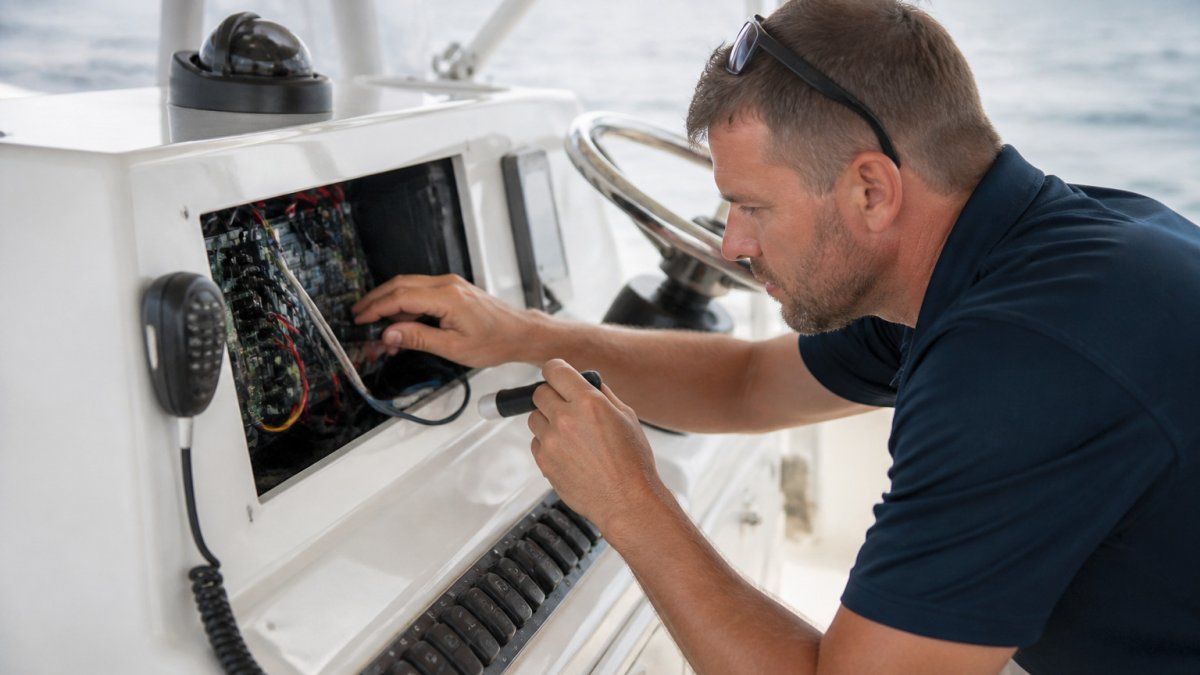
Inspect the hull for cracks, stress marks, soft spots, and impact damage. Examine engine hours and maintenance records; low hours don't guarantee good condition. Test all systems: trim tabs, through-hulls, electrical, and electronics. Check for corrosion and oxidation. Review the boat's history: freshwater vs. saltwater use, and reason for sale. Saltwater boats require more maintenance.
Conduct a Sea Trial and Evaluate Real-World Performance
A sea trial reveals what a boat actually does under load in real conditions. Don't accept a dockside demo. Take the boat out in typical conditions for at least two hours.
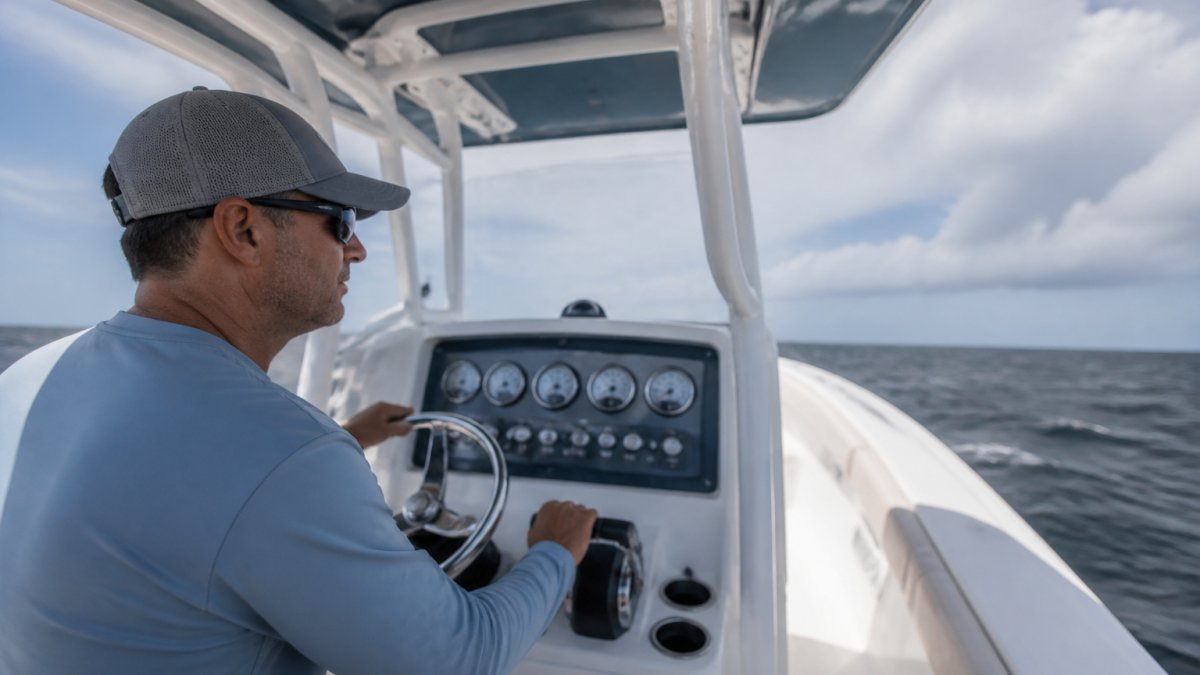
Check acceleration, top speed, and fuel consumption at various throttle settings. Listen for unusual engine noise. Feel how the boat handles turns and rough water. Test the trim tabs to see how they affect ride quality.
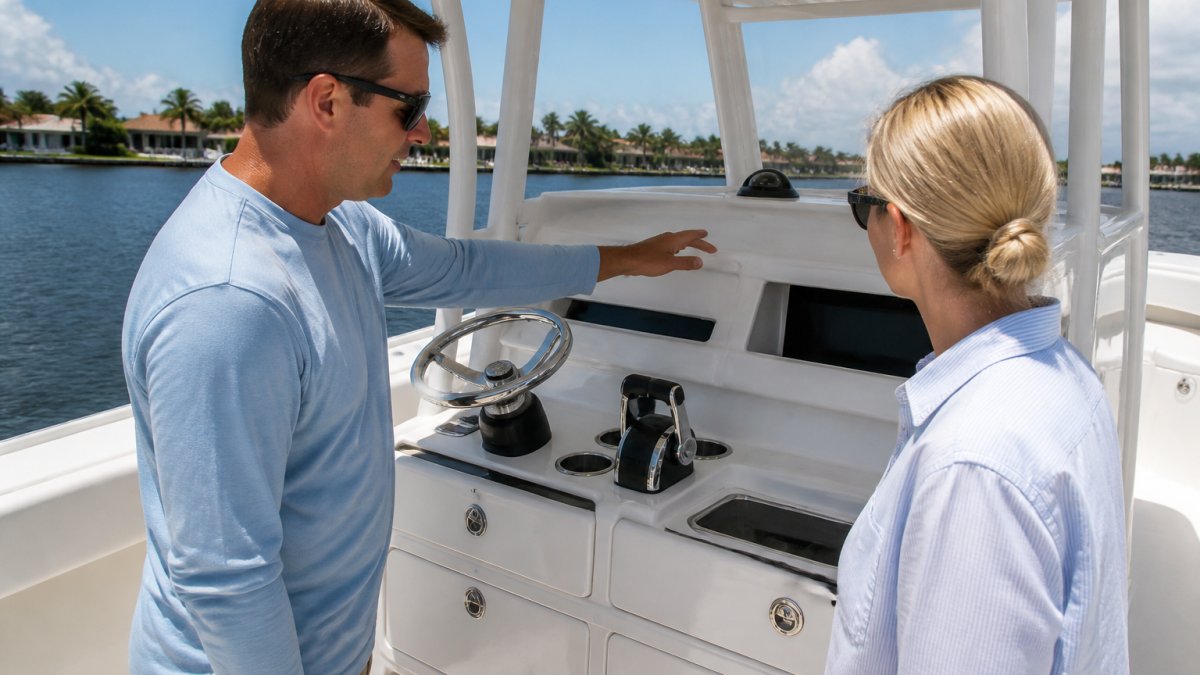
Bring a captain or experienced operator if you're not confident running the boat yourself. They'll spot issues you'd miss. Ask them about handling characteristics, visibility from the helm, and whether the boat matches its specifications.
Pay attention to comfort. Does the helm position work for your height? Can you reach all controls easily? How loud is the engine at cruise speed?
| Evaluation Criteria | What to Assess | Why It Matters |
|---|---|---|
| Hull Condition | Cracks, soft spots, impact damage | Structural integrity affects safety and resale value |
| Engine Hours & Service | Maintenance records, oil change history | Predicts remaining engine life and reliability |
| Deck Layout | Fishing space, storage, visibility | Determines usability for your actual fishing style |
| Sea Trial Performance | Acceleration, fuel burn, handling | Confirms the boat matches specifications and your needs |
| Systems Check | Trim tabs, through-hulls, electronics | Identifies costly repairs before purchase |
Learning how to choose a high performance center console requires matching the boat to your specific conditions and use case.
Frequently Asked Questions
What size center console is best for offshore fishing?
Boat size depends on your fishing grounds and sea conditions. For offshore fishing in rough water, a high-performance center console between 35 and 45 feet offers the stability, range, and seaworthiness needed. Smaller consoles (under 30 feet) work for nearshore trips, while larger vessels provide more comfort and fuel capacity for extended offshore runs. Consider your typical fishing distance, crew size, and local weather patterns when selecting the right size center console boat.
How much deadrise do I need for rough water?
Deadrise, the angle of the hull bottom, directly affects ride quality in rough conditions. For offshore fishing, aim for 20 to 25 degrees of deadrise. This range balances a soft ride in chop with good stability at rest. Stepped hulls with variable deadrise add efficiency without sacrificing comfort. Center console deadrise for rough water should be evaluated alongside your local sea conditions; calmer inshore waters tolerate less deadrise, while Atlantic offshore conditions benefit from steeper angles and advanced hull designs.
What range and fuel capacity do I need?
Range depends on your fishing grounds and fuel economy. A high-performance center console burning 50 to 80 gallons per hour at cruise will cover 200 to 400 miles on a full tank, depending on tank size and speed. Calculate your longest planned trip, add a 20% safety margin, and choose fuel capacity accordingly. Center console boat range and fuel capacity should account for headwinds, idle time, and the reality that fuel burn increases at higher speeds. Discuss real-world gallons per hour with the manufacturer or a sea-trial captain.
What should I check when inspecting a used center console?
A thorough used center console boat inspection checklist includes hull integrity (check for soft spots, cracks, or delamination), engine hours and service records, corrosion on hardware and through-hulls, upholstery and deck condition, electronics functionality, and structural soundness of the console and railings. Have a marine surveyor inspect the engine and systems. Test all systems under power during a sea trial. Review maintenance history and ask why the owner is selling. This diligence prevents costly surprises after purchase.