 how-to
How to Plan Yacht Crew Training During a Refit
Table of Contents
- Why Refit Periods Are the Right Time to Train Crew
- Building a Yacht Crew Training Plan Around Refit Phases
- Setting a Yacht Crew Training Schedule That Fits the Yard Timeline
- Running Yacht Crew Drills Onboard During the Refit
- Using a Yacht Crew Training Checklist to Track Progress
- Booking Your Refit Training Plan With Primo Yachts
- Frequently Asked Questions
How to Plan Yacht Crew Training During a Refit
Last Updated: October 31, 2026
Why Refit Periods Are the Right Time to Train Crew
Most yacht crews treat a refit as a stretch of lost time. The boat is in the yard, the guests are gone, and the crew is waiting. That view misses something important. A refit period can be one of the best windows you have for yacht crew training, because the vessel is quieter and the schedule is more flexible than during charter season.
Crew can practice onboard while work continues around them. Refit periods can give crew room to try new routines and take formal courses without a guest in the room.
Training during a refit also helps with the timing problem. Crew are not juggling guest service and drills at the same time. Here are the main advantages:
- Fewer guests to serve. Crew can rehearse routines without interruption.
- Predictable hours. Sessions can be scheduled around known yard work.
- Access to the whole crew. Deck, engineering, interior, and galley can train together.
- A clear outcome. The refit gives everyone a deadline to be ready for the next season.
Building a Yacht Crew Training Plan Around Refit Phases
A refit has phases, and each phase suits different training. Early work is usually planning, demolition, and structural jobs. Mid-refit brings systems installation and finish work. Late refit covers commissioning, sea trials, and vessel readiness. Matching training to these phases keeps sessions relevant and gives the crew a clear sense of progression.
Lay out the plan before the yard starts. List each phase, its expected dates, and the crew skills it will need. A simple version looks like this:
| Refit Phase | Typical Focus | Suitable Training | Suggested Cadence |
|---|---|---|---|
| Planning and preparation | Specifications, yard selection, budget | Refit scope review, contractor coordination, safety orientation | 1-2 sessions before yard arrival |
| Yard arrival and strip-out | Access control, demolition, hot work | Yard safety induction, PPE, emergency assembly points, fire watch | Daily short briefings plus one drill per week |
| Active works (systems and finishes) | Installation, testing, finish trades | Equipment handling, maintenance logs, systems checks, role-specific skills | 2-3 sessions per week, scheduled around quiet work areas |
| Commissioning and sea trials | Systems commissioning, dock and sea trials | Sea trial procedures, guest operations, emergency drills under way | Daily drills and debriefs in the final two weeks |
| Handover and season readiness | Snag lists, stores, crew readiness | Service standards, tender operations, full crew drill | One full-crew exercise before delivery |
Keep the plan flexible. Yard schedules shift, so review the phase map every week and move sessions as needed. A common pattern is to protect two short windows per week during active works and then increase training frequency as the yard workload drops toward commissioning.
Assigning Role-Specific Training Goals
Each department needs different skills, so give every role its own goals. Deck crew may focus on line handling, tender operations, and deck maintenance. Engineering crew may focus on systems checks, maintenance logs, and spare-parts tracking. Interior crew may focus on service standards, table settings, and cabin readiness. Galley crew may focus on food handling, provisioning, and galley safety.
Write one or two measurable goals per role. For example, a deckhand might aim to handle a tender launch alone by the end of the refit. An engineer might aim to complete a full maintenance log sign-off for the new systems. An interior crew member might aim to run a full table setting and service sequence without supervision. Clear goals make it easier to see whether training is working and give supervisors a basis for sign-off.
Coordinating Training Around Yard Safety and Contractors
Shipyards bring their own risks. Contractors work overhead, move heavy loads, and use tools that crew may not see every day. Before any drill, confirm the work area with the yard and the site supervisor. For more on managing crew logistics during shipyard work, see the dedicated guide. Agree on which zones are closed and when. Confirm permit requirements for hot work, confined-space entry, and any task that affects crew access.
A short daily briefing helps. Tell the crew which areas to avoid, who is working where, and what the emergency assembly point is. Training should never run in an active hot-work area or under a suspended load. Where possible, include contractor access routes in drills so crew practice communicating with outside workers during an emergency.
Protecting Training Time and Budget
Training during a refit competes with yard deadlines and crew workload. Protect it the same way you protect a yard milestone: put it in the project schedule, assign an owner, and review it at the weekly progress meeting. A practical approach is to allocate a fixed number of training hours per crew member per week and treat them as non-negotiable unless a safety-critical yard event takes priority.
Budget for training as a line item alongside yard costs. Include course fees, instructor time, materials, and any overtime needed to cover watchkeeping while crew train. Where budget is tight, prioritize drills and role-specific skills that directly support sea trials and the next season, and defer optional external courses to the shoulder season.
Setting a Yacht Crew Training Schedule That Fits the Yard Timeline
A good yacht crew training schedule respects the yard's rhythm. Plan short, frequent sessions rather than long blocks that clash with contractor work. Two to three sessions per week often works better than one full day, since skills stick with regular practice.
Build the schedule in this order:
- Mark fixed yard events. Note sea trials, inspections, and delivery dates.
- Block training windows. Pick times when the work area is quiet.
- Assign sessions to roles. Keep each session focused on one department or one skill.
- Leave buffer days. Yard delays are common, so hold a few open slots.
Share the schedule with the yard project manager early. Agreement at the start prevents conflicts later.
Running Yacht Crew Drills Onboard During the Refit
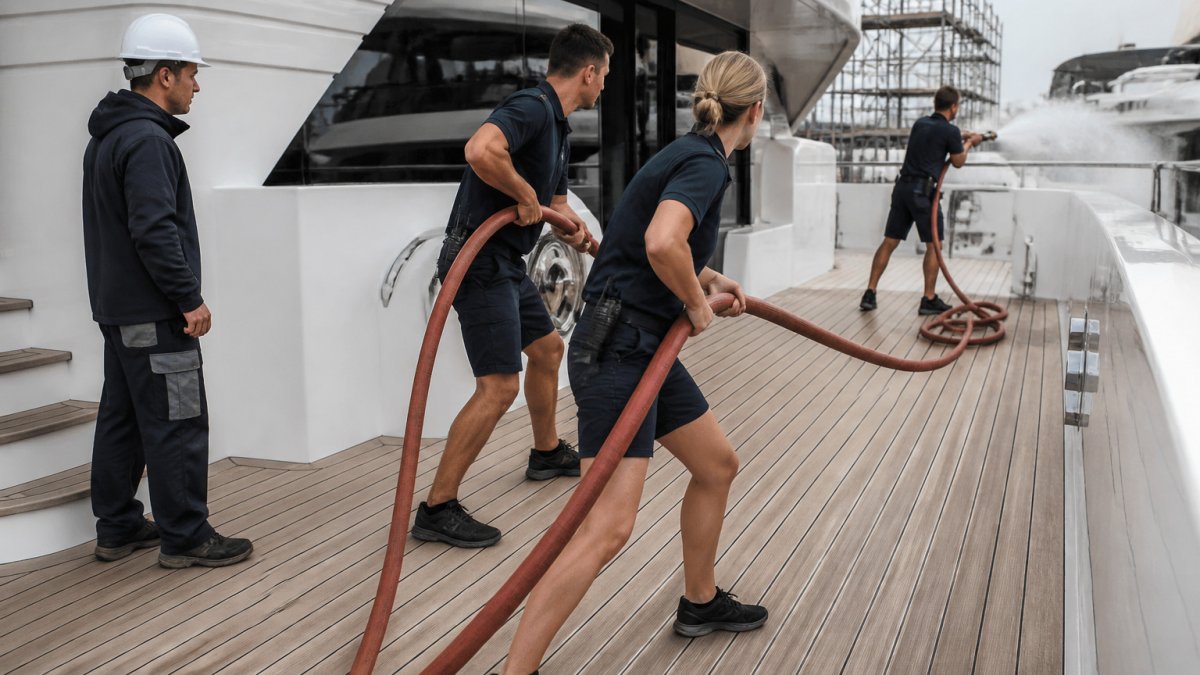
Drills are where training becomes real. Start with the basics: man overboard, fire response, and abandon ship. Run each drill slowly at first, then add time pressure as the crew improves.
Reach out now to see how we can help with your boating needs! →
!A small group of yacht crew in work uniforms practicing a fire drill on a teak deck while a shipyard worker stands nearby in a hard hat
Keep a debrief after every drill. Ask what worked, what was slow, and what confused people. Record the answers so you can track improvement over the refit.
Use the yard as part of the scenario when it is safe. A drill that includes a contractor's access route teaches crew how to communicate with outside workers during an emergency.
Using a Yacht Crew Training Checklist to Track Progress
A written checklist shows what each crew member has completed. Track each skill, the date it was practiced, and who signed it off. This turns training into a record you can review before sea trials and the next charter season, and it gives the captain evidence of competency if a question arises later.
A simple checklist can track each skill, the date it was practiced, and who signed it off.
- Safety briefing and emergency assembly point confirmed
- Fire drill completed and debriefed
- Man overboard drill completed
- Role-specific skill goal reviewed with supervisor
- Practical sign-off recorded with date and initials
Building a Competency Matrix
A checklist records completion; a competency matrix records depth. Build a matrix with crew names across the top and required skills down the side. Mark each cell with a simple scale, such as not started, practiced, competent, or signed off. This makes gaps visible at a glance and helps supervisors plan the next training block.
A practical matrix for a refit might include rows for yard safety induction, fire drill, man overboard drill, abandon ship drill, role-specific equipment handling, and sea trial procedures. Update the matrix weekly and review it with department heads so no crew member reaches sea trials without the required sign-offs.
Measuring Training Outcomes
Completion rates alone do not show whether training worked. Pair the checklist with simple outcome measures:
- Drill times. Record how long each drill takes and compare across the refit.
- Debrief actions. Log what went wrong and confirm each action is closed.
- Practical assessments. Have a supervisor observe the skill and sign it off.
- Post-training checks. Re-test a sample of skills two to four weeks later to confirm retention.
A common pattern is to run a baseline drill at the start of the refit, repeat it mid-refit, and run a final drill before sea trials. The comparison gives the captain a defensible record of improvement.
Recordkeeping and Handover Notes
Handover notes are especially useful when crew rotate during a long refit, because the incoming crew member can see what has already been covered.
Update the checklist and matrix weekly so gaps are visible early. Before sea trials, review the full record with the captain and department heads, and carry any outstanding items into the first weeks of the season.
Booking Your Refit Training Plan With Primo Yachts
If you want help with your boating needs, reach out to Primo Yachts.
Frequently Asked Questions
What training can yacht crew complete during a refit?
Crew can complete safety refreshers, seamanship drills, engineering familiarization and guest-service practice during a refit, often using onboard time when systems are partly out of service. Online learning and in-person courses both fit into refit schedules, especially when the yard timeline is long. Choose training that matches the work crew will do once the vessel returns to service, and confirm course availability and scheduling directly with the training provider before committing.
How do you schedule crew training around a yacht refit?
Map training to the refit phases: early weeks for classroom and online modules, middle phases for onboard drills when contractors are working in other areas, and the final weeks for readiness checks before sea trials. Coordinate with the yard project manager so drills do not conflict with hot work or confined space entry. A written yacht crew training schedule shared with the crew and the shipyard keeps everyone aligned.
How can a captain track crew training during a refit?
A simple yacht crew training checklist listing each course, drill, completion date and assessor initials gives the captain a clear record. Review the checklist weekly against the refit schedule to spot gaps early. Keep certificates and drill logs in a shared folder so records are available for insurance, flag state or charter requirements.
How should crew prepare for sea trials after a refit?
Run a final round of yacht crew drills covering man-overboard recovery, fire response, steering failure and emergency communications, using the systems as they will be operated during sea trials. Confirm every crew member knows their station and the location of safety equipment that was relocated or replaced during the refit. Document each drill so the captain can confirm readiness before the vessel leaves the dock.