 how-to
Choose Marine Upholstery for Center Consoles
Table of Contents
- Why Marine Upholstery Selection Matters for Center Consoles
- Understanding Exposure Zones in Center Console Seating
- Marine Vinyl for Boat Seats: Performance Criteria
- How to Choose the Right Marine Fabric Beyond Vinyl
- Boat Seat Foam Replacement: Selecting the Right Cushion Core
- Construction Details That Determine Longevity
- Material Selection Checklist for Center Console Upholstery
- Vinyl Failure Diagnosis and Prevention
- Frequently Asked Questions
Last Updated: October 19, 2026
Why Marine Upholstery Selection Matters for Center Consoles
Choosing the right marine upholstery center console isn't just about aesthetics. It's about protecting your investment.
The difference between a well-chosen upholstery system and a poor one shows up within months. Cheap vinyl cracks and becomes sticky. Seams fail. Foam deteriorates.
Owners who invest time upfront in understanding their exposure zones, material performance ratings, and construction quality end up with boats that look and feel great for a decade or more.
Understanding Exposure Zones in Center Console Seating
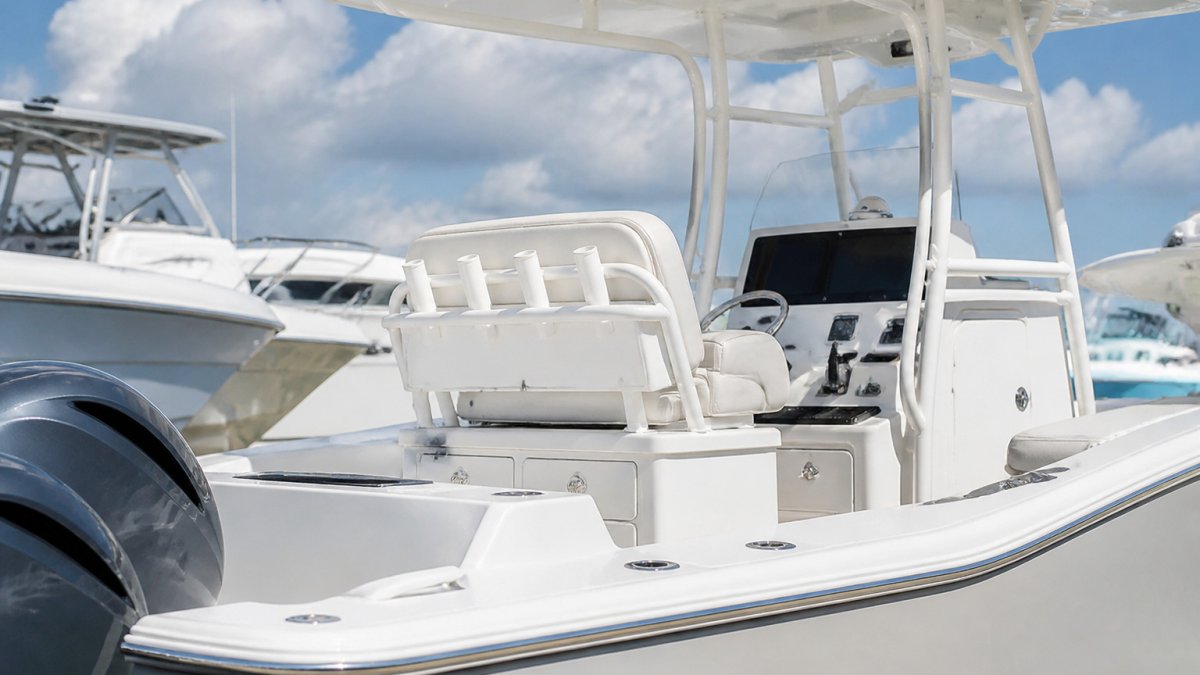
Not all seating on a center console faces the same conditions. The helm seat bakes in direct sun all day. The leaning post gets grabbed and leaned on constantly. The sun lounge might stay shaded or get full exposure depending on layout.
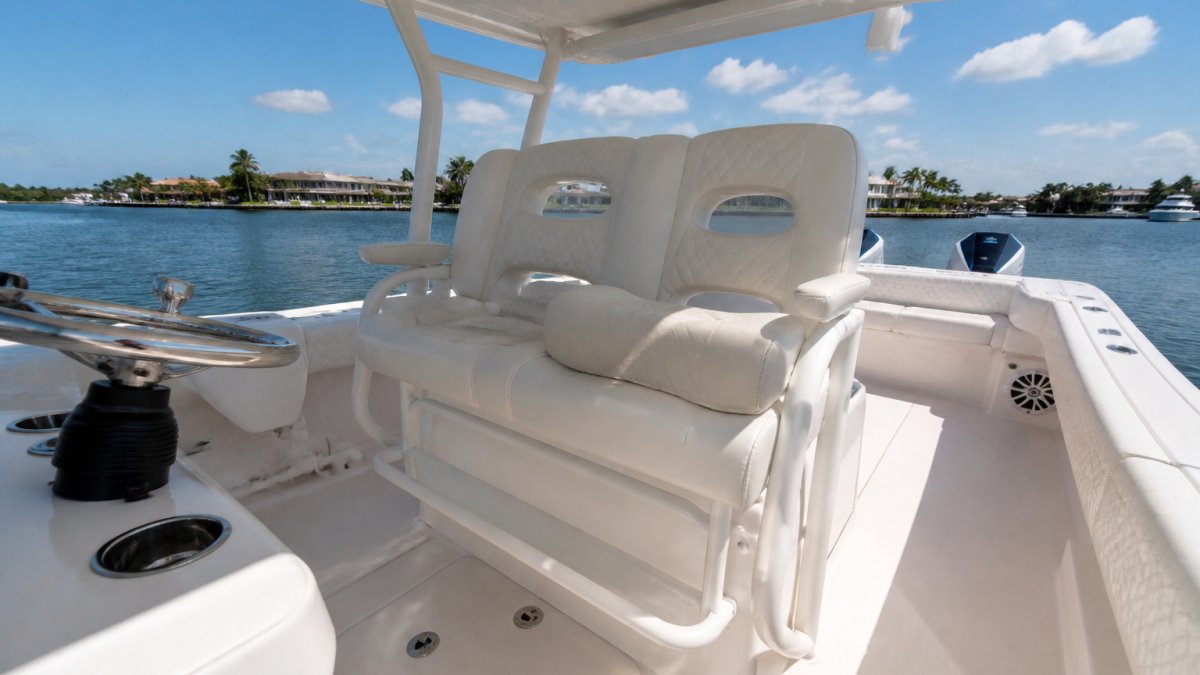
Helm seat and helm bolster
The helm seat is ground zero for UV damage and wear, exposed to direct sunlight for hours at a time. The bolster takes constant pressure from the captain's back and shoulders. This zone needs maximum UV resistance and abrasion durability.
The material here must also tolerate temperature swings. Dark vinyl can reach 160°F or higher in summer sun, then cool rapidly when you're moving through water. That expansion and contraction cycle breaks down weak adhesives and causes seams to separate.
Passenger seating and leaning posts
Passenger seats get less direct sun than the helm but still face significant UV stress. Leaning posts are functional equipment as much as seating: anglers hang on them, brace against them, and put their full body weight on them repeatedly.
Leaning posts need exceptional abrasion resistance. The material must resist pilling, fading, and tearing from friction and repeated contact. The backing and seams take real punishment in this zone.
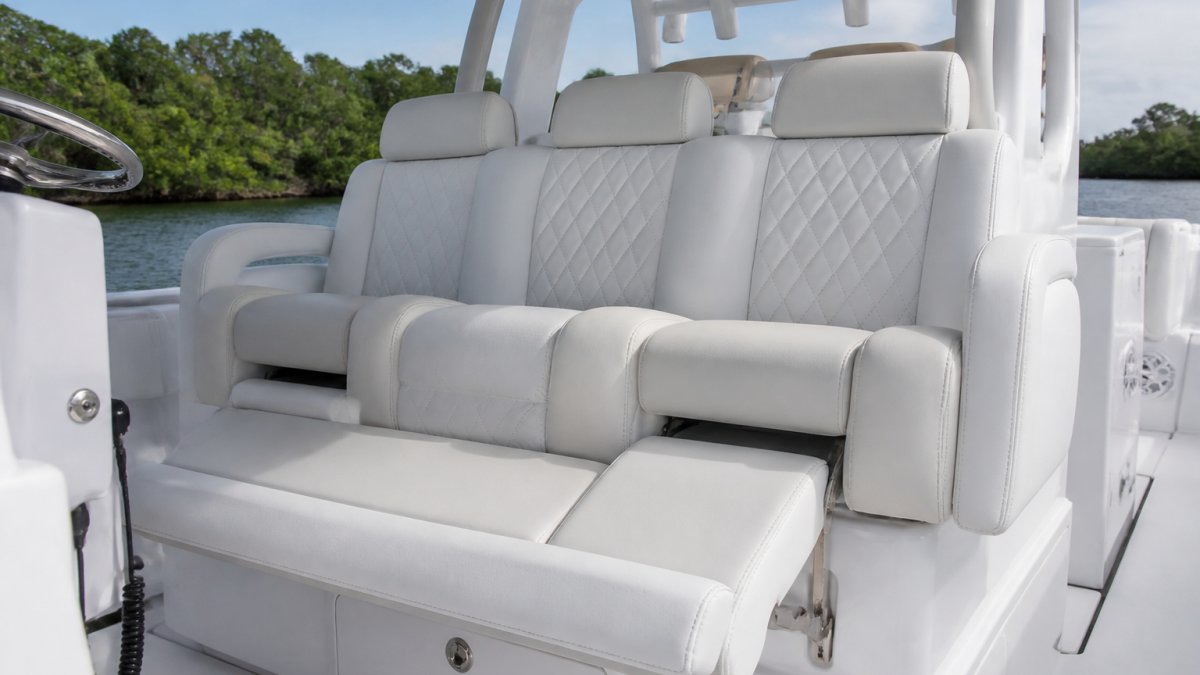
Sun lounge and cockpit areas
Sun lounges and cockpit seating vary widely by boat design. If your sun lounge gets afternoon sun, treat it like the helm seat for material selection. If it's shaded, you have more flexibility with color and material choice.
The key is honest assessment of your actual use pattern. If you fish all day, your boat sits in the sun. If you cruise and dock in shade, exposure is lighter.
Marine Vinyl for Boat Seats: Performance Criteria
True marine-grade vinyl is engineered to resist UV degradation, saltwater corrosion, and extreme temperature swings. But not all marine vinyl performs equally. The specifications matter.
UV and fade resistance ratings
Look for vinyl rated for marine use with explicit UV resistance claims. The best includes carbon black or other UV absorbers that protect against sun damage. Vinyl without these additives fades noticeably within a season.
Manufacturers often claim "excellent fade resistance" without specific metrics. When possible, ask for samples and compare them side by side in direct sunlight. Faded samples show the difference immediately.
High-quality marine vinyl maintains its color and texture for 5-7 years in full sun exposure. Lower-grade vinyl shows significant fading within 2-3 years.
Cold-crack and saltwater durability
Cold-crack resistance matters if you boat in cooler climates. Vinyl not formulated for cold becomes brittle and cracks when flexed at low temperatures. Marine-grade vinyl includes plasticizers that keep it flexible even when cold.
Salt spray corrodes backing material and weakens seams. Ask manufacturers whether their vinyl is rated specifically for saltwater environments. Generic vinyl backing fails quickly in coastal use.
Double-rub abrasion and anti-pinking
The double-rub test measures abrasion resistance. Marine vinyl should exceed 100,000 double-rubs for helm seating; leaning posts and high-contact areas should exceed 150,000.
Anti-pinking refers to resistance to color separation under stress. When vinyl is stretched or flexed repeatedly, dyes can separate from the base material, creating pink or white lines. Quality marine vinyl resists this.
Check the product spec sheet for these numbers. If a manufacturer doesn't publish them, the material likely doesn't meet marine standards.
How to Choose the Right Marine Fabric Beyond Vinyl
Marine vinyl dominates the market, but high-performance woven fabrics have improved dramatically. For some applications and aesthetic preferences, fabric offers real advantages.
High-performance woven fabrics
Woven fabrics designed for marine use combine durability with a different aesthetic than vinyl. They feel softer, don't get sticky in heat, and breathe, which some users prefer for comfort.
Marine-grade woven fabrics are typically solution-dyed polyester or acrylic. Solution-dyed means color is built into the fiber itself, making the fabric far more fade-resistant than surface-dyed alternatives.
The trade-off is maintenance. Woven fabrics require more regular cleaning than vinyl. They can absorb water if not treated with water-repellent coatings.
Water resistance and drainage
True marine-grade woven fabrics include water-repellent treatments, the best being fluorocarbon-based, which repel water and oils while allowing moisture to evaporate from the underside.
Drainage is equally important. Cushion cores must let water drain away from the foam, and backing materials should be perforated or mesh-like. Standing water accelerates mold and mildew growth.
Ask whether the fabric backing is solid or perforated. Solid backing traps moisture. Perforated or mesh backing allows air circulation and drainage.
Mildew and mold resistance
Mildew grows on any material that stays damp. Woven fabrics are more susceptible than vinyl because they absorb moisture. The solution is water-repellent treatment and proper drying.
Some marine fabrics include antimicrobial treatments, but these aren't foolproof.
Vinyl resists mildew growth better because it doesn't absorb water. However, mildew can still grow on the surface if the vinyl stays damp and dirty. Regular cleaning prevents this.
Boat Seat Foam Replacement: Selecting the Right Cushion Core
The foam inside your cushions determines comfort and durability as much as the cover material. Choosing the right foam type and density makes a real difference.
Closed-cell versus open-cell foam
Closed-cell foam has sealed cells that trap gas inside, making it buoyant, water-resistant, and durable. It resists water absorption and maintains its shape under repeated compression.
Reach out now to see how we can help with your boating needs! →
Open-cell foam has interconnected cells that let water and air pass through. It's softer initially but absorbs water readily, trapping moisture and leading to mold and deterioration in marine applications.
For center console seating, closed-cell foam is the only practical choice. It resists water absorption, maintains buoyancy if the boat takes on water, and lasts significantly longer than open-cell alternatives.
Density, durability, and comfort trade-offs
Foam density is measured in pounds per cubic foot. Higher density is firmer, more durable, and more expensive; lower density is softer but compresses faster and loses shape over time.
For helm seating, where the captain sits for hours, a density of 2-3 pounds per cubic foot provides good comfort with adequate durability.
The trade-off is firmness. Very high-density foam feels hard for extended sitting; very low-density foam flattens within a few years.
Construction Details That Determine Longevity
The best cover material and foam mean nothing if the construction is poor. Seams fail. Stitching unravels. Backing deteriorates. These details separate a 10-year upholstery system from a 3-year one.
Seams, stitching, and backing quality
Look at the seams closely. Double-stitched seams are stronger than single-stitched. The thread should be marine-grade polyester, not cotton. Cotton absorbs water and rots. Polyester resists saltwater and UV degradation.
The seam spacing matters too. Tight, closely-spaced stitches create a stronger seam than widely-spaced stitches. Professional marine upholstery typically uses stitches spaced 1/8 inch apart or closer.
Backing material is often overlooked but critical. Vinyl backing must be flexible and resistant to saltwater corrosion. Woven fabric backing should be mesh or perforated to allow drainage.
Piping and edge reinforcement
Piping, the decorative cord running along seams, serves a functional purpose beyond aesthetics. It reinforces seams and protects the edge of the cover material from UV damage and tearing.
Quality piping is made from marine-grade vinyl or fabric, not cheap plastic. It's tightly wrapped and securely stitched. Loose piping unravels and exposes the seam underneath to UV and water damage.
Edge reinforcement at corners and high-stress areas prevents tearing and extends service life. Corners should be reinforced with extra stitching or binding tape.
Material Selection Checklist for Center Console Upholstery
Use this checklist when evaluating upholstery options for your center console:
| Criteria | What to Look For | Why It Matters |
|---|---|---|
| UV Resistance | Marine-grade vinyl with carbon black; solution-dyed fabric | Prevents fading and degradation in sun |
| Saltwater Durability | Corrosion-resistant backing; marine-specific formulation | Extends life in coastal environments |
| Abrasion Resistance | 100K+ double-rubs for helm; 150K+ for leaning posts | Resists wear from contact and friction |
| Cold-Crack Resistance | Flexible at low temperatures; marine formulation | Prevents brittleness in cool weather |
| Mildew Resistance | Water-repellent treatment; perforated backing | Prevents mold and mildew growth |
| Foam Type | Closed-cell only; 2.5-3.5 lbs per cubic foot | Resists water; maintains comfort and shape |
| Seam Quality | Double-stitched; marine-grade polyester thread | Prevents seam failure and water penetration |
| Backing Material | Mesh or perforated; saltwater-resistant | Allows drainage and air circulation |
| Piping & Edges | Reinforced; marine-grade material | Protects from UV and tearing |
Before ordering upholstery, verify that your choice meets these standards. Ask the manufacturer for spec sheets. Request samples. Compare side by side. The time invested now prevents costly replacements later.
Vinyl Failure Diagnosis and Prevention
Even quality vinyl eventually fails. Recognizing the warning signs lets you address problems before they become catastrophic.
Recognizing sticky vinyl and cracking
Sticky vinyl is a sign that the plasticizers, chemicals that keep vinyl flexible, are breaking down.
Sticky vinyl indicates that UV degradation is accelerating. Once this starts, cracking usually follows within months. The material becomes brittle and tears easily under stress.
Cracking appears as fine lines or splits in the vinyl surface. Early cracks are hairline-thin.
Prevention is simpler than repair. Use a quality UV protectant designed for marine vinyl. Apply it every 3-6 months, especially after winter storage.
Maintenance practices that extend service life
Regular cleaning is the foundation of vinyl longevity.
Use a mild soap and water for deeper cleaning.
Apply a vinyl protectant quarterly. The best products contain UV absorbers and antioxidants that slow degradation.
Store your boat with the upholstery protected.
Address small problems immediately. A small crack can be sealed with marine vinyl repair tape or adhesive.
Choosing marine upholstery for your center console involves balancing durability, comfort, aesthetics, and budget.
Reach out now to see how we can help with your boating needs.
Frequently Asked Questions
What is the best material for center console boat upholstery?
Marine-grade vinyl remains the industry standard for center console upholstery due to its superior UV resistance, saltwater durability, and ease of cleaning. High-performance woven fabrics offer enhanced breathability and comfort but require more maintenance. The best choice depends on your primary use: vinyl excels in high-sun, offshore fishing environments, while specialty fabrics work well for cruising vessels with covered cockpits. Evaluate your exposure zones, maintenance commitment, and comfort priorities before deciding.
How do I choose marine vinyl for boat seats that won't crack or fade?
Look for marine vinyl with a minimum 500,000 double-rub abrasion rating, UV-resistant pigments, and cold-crack resistance rated to at least -20°F. Check that the backing is marine-grade polyester or acrylic, not standard fabric. Request samples from manufacturers who specialize in saltwater applications and verify they test for anti-pinking properties. Vinyl with acrylic backing performs better in wet environments than PVC-only formulations. Compare fade ratings using ASTM testing standards when available.
When should boat upholstery be replaced?
Replace marine upholstery when you observe permanent stickiness that won't clean away, visible cracking or peeling, seam separation, or foam that no longer provides support. High-quality marine vinyl typically lasts 5-7 years in heavy offshore use; 8-10 years in moderate use. Woven fabrics may require replacement sooner if exposed to constant sun. Proactive replacement of foam before cracking occurs prevents water damage to seat structures. Budget for replacement as part of regular vessel maintenance.
How do I know which foam density is right for my boat seat cushions?
For center console seating, use closed-cell foam with a density of 3-4 pounds per cubic foot for durability and water resistance. Higher density (4+ pounds) offers better longevity but less comfort; lower density (2-3 pounds) feels softer but compresses faster. Helm seats benefit from medium-density foam that balances comfort during long hours with resistance to saltwater absorption. Always specify marine-grade closed-cell foam; open-cell varieties retain water and degrade quickly. Request density specifications from your upholstery supplier rather than guessing by feel.