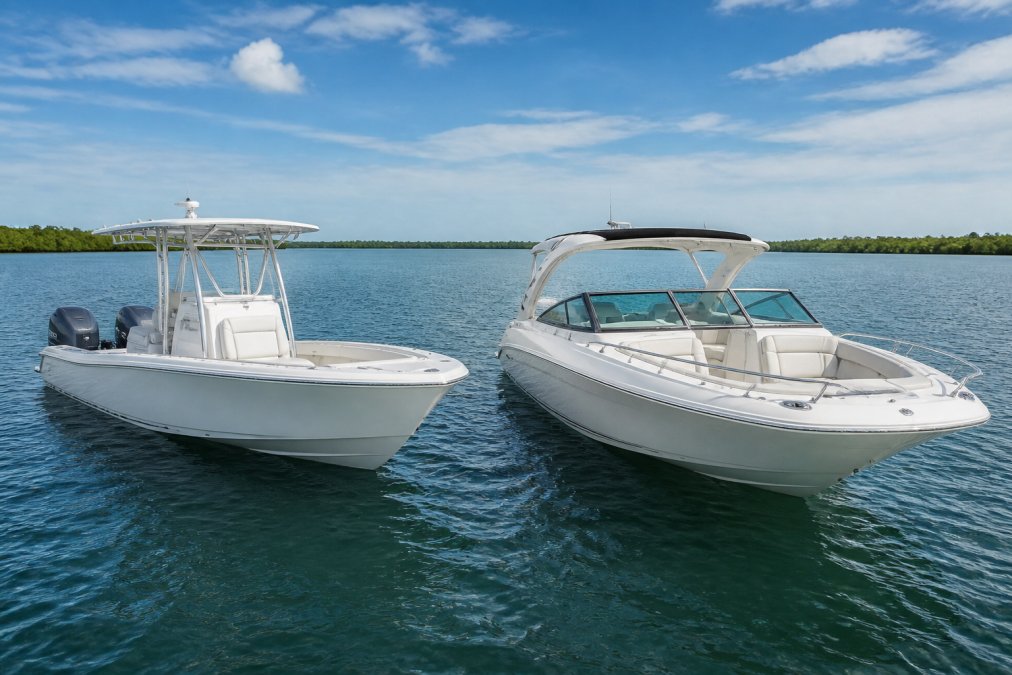
 comparison
Center Console vs Walkaround: Which Yacht Wins
Table of Contents
- Center Console vs Walkaround: The Core Structural Differences
- 360-Degree Fishability and Deck Access
- Offshore Fishing Center Consoles: Performance and Stability
- Center Console Yacht Cabin Amenities vs Open-Air Design
- Visibility, Helm Station Ergonomics, and Weather Protection
- Versatility: Family Cruising vs Hardcore Fishing
- Maintenance, Trailerability, and Long-Term Ownership Costs
- Which Design Wins for Your Boating Style
- Frequently Asked Questions
Last Updated: September 20, 2026
Center Console vs Walkaround: The Core Structural Differences
The center console yacht benefits over walkaround designs start with one fundamental advantage: unobstructed deck access. At Primo Yachts of Palm Beach, we provide expert guidance for those seeking premium vessels, and the structural layout determines everything about how you'll actually use the vessel. A center console places the helm in the middle of the boat, leaving both sides of the deck open for movement, fishing, and entertaining. A walkaround design wraps cabin space around the sides, restricting lateral movement and creating what many experienced anglers call "dead zones" where you can't comfortably cast or move passengers around safely.
The difference is functional. When running offshore or managing multiple anglers, free movement around the vessel matters. Center consoles provide this freedom; walkarounds sacrifice it for cabin amenities, a trade-off that makes sense for some boaters, but not for those prioritizing fishing or 360-degree functionality.
360-Degree Fishability and Deck Access
A center console yacht offers what serious anglers call 360-degree fishability: you can cast from the bow, both sides, and the stern without obstruction. The helm sits centerline, leaving the entire perimeter of the deck available for fishing rods, tackle storage, and movement. No cabin walls block your casting arc. No side railings force you into awkward angles.
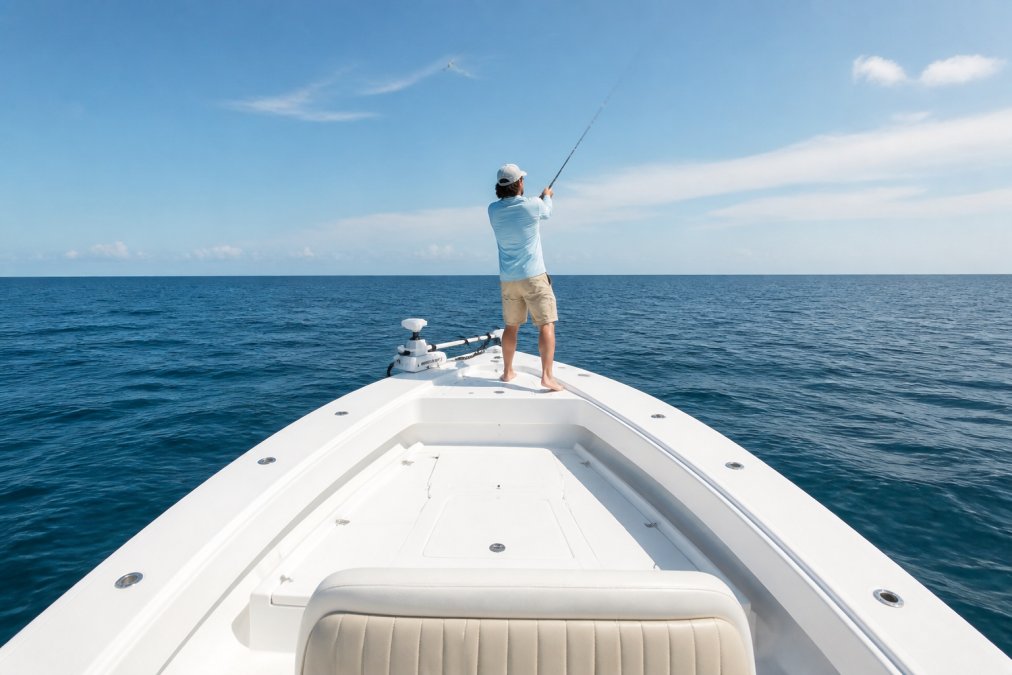
Walkaround designs restrict this. The cabin extends along the sides, creating barriers to movement. You can fish the bow and stern, but the sides become cramped. With multiple guests, one angler at the bow and another at the stern leaves others stuck in the cabin or leaning over the roof to fish.
Center consoles also allow flexible positioning relative to structure, reef drops, or weed lines, you're not fighting the vessel's layout while fighting the fish.
Offshore Fishing Center Consoles: Performance and Stability
Hull Design and Weight-to-Power Ratio
Center consoles feature deep-V or modified-V hulls optimized for offshore performance. Less cabin weight means the hull sits higher, reducing drag and improving fuel efficiency. Walkarounds carry more superstructure, increasing weight and affecting rough-sea handling.
A center console turns sharper, accelerates faster, and maintains control better than a heavier walkaround with the same engines, less weight forward means more precise steering response.
Fuel Efficiency and Range
A center console's lighter weight and optimized hull reduce fuel consumption.
Center Console Yacht Cabin Amenities vs Open-Air Design
This is where walkarounds win, and it's worth acknowledging honestly. A walkaround design provides more enclosed cabin space, better weather protection, and more comfortable overnight accommodations. If your priority is cruising with family, spending weekends anchored in calm bays, and sleeping aboard regularly, a walkaround offers genuine advantages.
Center consoles offer minimal cabin space: a small head, galley, and tight V-berth. Walkarounds provide real amenities: full galley, master stateroom, guest cabin, and salon for entertaining in bad weather.
The trade-off is real. Choose a center console if you prioritize fishing and day-cruising performance. Choose a walkaround if you plan extended overnight trips and want your family comfortable in bad weather.
Visibility, Helm Station Ergonomics, and Weather Protection
Center consoles offer superior helm visibility. The elevated, centerline helm provides a clear 360-degree view for safety, navigation, spotting fish signs, and maneuvering in crowded anchorages.
Walkarounds place the helm further aft with cabin structure blocking forward sightlines. In rough seas or crowded anchorages, reduced visibility becomes a safety issue. Some designs mitigate this with elevated helms or windshield cutouts, but cabin structure still restricts the captain's view compared to a center console.
Helm Station Design and Control Integration
Modern center console helm stations integrate digital switching, navigation, trim controls, and rod holders in a compact layout. The captain controls engines, trim tabs, autopilot, and electronics without leaving the seat. Helm chairs feature suspension systems and lumbar support for extended runs.
High-end center console helm chairs can feature suspension systems, lumbar support, 360-degree swivel, and integrated control access. Walkaround helm stations often use standard pedestal seats without suspension. For day-cruising this is adequate; for 4+ hour offshore runs, the center console's ergonomic design can be a factor.
Weather Protection Trade-offs
Center consoles typically have a T-top that shades the helm but leaves sides open to wind and spray. On hot days, the T-top provides shade without heat buildup; in cold rain or rough seas, open sides expose the helm operator to the elements. Side curtains or full enclosures reduce visibility and add weight and cost.
Walkarounds offer complete weather protection with a full cabin and climate-controlled helm. For extended family cruising or cold-water runs, this is a genuine advantage. The trade-off is reduced visibility and less deck access for fishing.
For tropical offshore fishing, the T-top is preferable, shade without heat buildup and better air circulation. In cold-water climates, a walkaround's full cabin protection becomes more valuable.
Helm Visibility in Rough Seas
In 4-6 foot seas, the elevated center console helm provides better wave-reading capability. The captain sees wave patterns ahead and adjusts trim proactively. Walkaround helms, positioned lower and further aft, lose sight of incoming waves sooner, reducing reaction time.
For safety and operational control, the center console's helm visibility advantage is measurable and consistent across conditions.
Versatility: Family Cruising vs Hardcore Fishing
Center console yachts excel at fishing but struggle with extended family cruising. Walkarounds excel at family cruising but compromise fishing functionality. This isn't a hidden trade-off, it's the core design philosophy of each layout.
A center console is built for people who fish hard and day-cruise. You can bring a family for a day trip and grill at the stern, but cannot comfortably accommodate a family of four for a three-day cruise.
A walkaround is built for people who want to cruise with family and fish casually. Cabin space and comfort matter more than 360-degree deck access.
Know your boating priorities. Fishing 80% of the time? Center console. Cruising 80% of the time? Walkaround. If it's 50/50, you're compromising either way.
Maintenance, Trailerability, and Long-Term Ownership Costs
Center consoles are lighter and more compact, easier to trailer. A 34-foot center console can often be trailered with a heavy-duty rig rated for 14,000-16,000 pounds. A 34-foot walkaround rarely can; cabin structure adds 3,000-5,000 pounds, pushing you toward wet-slip or dry-stack dockage.
Trailerability impacts long-term ownership costs. A trailerable center console avoids marina slip fees ($100-250 per foot annually), haul-out costs ($2,000-$5,000), and logistics of finding slips. Home or facility storage can reduce annual carrying costs. A walkaround typically requires permanent dockage, leading to recurring slip fees regardless of usage.
Maintenance Complexity and System Upkeep
Center consoles require less maintenance: engine servicing, through-hull checks, and T-top canvas care. Walkarounds require additional interior maintenance: cabin ventilation, window seals, galley plumbing, head systems, lighting, and air conditioning.
Center consoles consolidate helm systems around the captain's station. Walkarounds distribute systems across helm, cabin, and galley, requiring more wiring and potential failure points. Retrofitting electronics is faster and cheaper on center consoles.
Insurance and Financing Implications
Insurance premiums and financing terms differ between hull types. Center consoles used for recreational fishing fall into standard classifications. Charter fishing or commercial use may increase premiums or require commercial liability coverage.
Walkarounds used for family cruising qualify for standard recreational policies. Live-aboard or boat-sharing use may reclassify the vessel, affecting premiums and coverage limits.
Lenders sometimes view center consoles as specialized vessels with narrower resale markets, which can result in different interest rates or loan terms. Walkarounds appeal to a broader buyer pool and can qualify for different financing.
Long-Range Cruising Ergonomics and Fatigue
On extended offshore runs (50+ miles), walkarounds offer an advantage. Center consoles concentrate seating at the helm or on jump seats; on a 6-hour run, the captain sits in a single chair and passengers sit on benches or stand. Walkarounds distribute seating across helm, cabin, and salon, allowing crew to rotate positions and rest.
Which Design Wins for Your Boating Style
The center console yacht benefits over walkaround are real, but they apply to specific boating styles. If you fish offshore regularly, run charters, or want maximum deck access and fuel efficiency, a center console is the right choice. The 360-degree fishability, superior visibility, and lighter weight create measurable advantages.
Frequently Asked Questions
What are the main structural differences between a center console yacht and a walkaround boat?
A center console features a single helm station positioned in the middle of the vessel, creating open deck space on both sides from bow to stern. A walkaround has the helm offset to one side with a cabin structure, reducing overall deck space. Center consoles offer 360-degree fishability and easier movement around the boat, while walkarounds provide more enclosed cabin storage and weather protection. The center console's open design prioritizes accessibility and fishing functionality, whereas walkarounds balance fishing with overnight cruising comfort.
Why do offshore fishing center consoles offer better fishability than walkaround models?
Offshore fishing center consoles deliver unobstructed casting angles from bow to stern, allowing multiple anglers to fish simultaneously without interference from cabin structures. The open deck design provides easy access to rod storage, tackle drawers, and fish boxes positioned throughout the vessel. Walkarounds have cabin structures that block sightlines and limit where anglers can position themselves. Center console's low-profile helm station and elevated bow seating maximize visibility of structure, baitfish, and game fish, critical for offshore success.
What trade-offs exist in cabin comfort when choosing a center console over a walkaround?
Center consoles prioritize fishing utility over enclosed cabin space, offering minimal below-deck storage and limited overnight amenities. Walkarounds provide full cabins with sleeping berths, galley facilities, and head compartments suited for multi-day cruising. However, modern center consoles now feature modest cabin amenities including compact sleeping quarters, marine electronics integration, and weather-protected helm stations. The choice depends on your primary use: serious offshore anglers accept reduced cabin comfort for superior deck functionality, while family boaters prefer walkaround's enclosed spaces for day trips and overnighting.
Are center console yachts more stable in rough offshore conditions than walkarounds?
Center consoles with deep-V hull designs deliver superior stability in rough water by cutting through waves rather than riding over them, reducing pounding and improving comfort. Their lighter weight and lower profile compared to cabin-heavy walkarounds improve weight-to-power ratio and offshore performance. The distributed weight across the open deck (fuel, tackle, passengers) maintains better balance than walkarounds with concentrated cabin mass. However, stability depends equally on hull design, beam width, and outboard power configuration, both vessel types can be engineered for rough-water capability when properly designed and powered.