 listicle
Best Offshore Center Console Fishing Boats: 2026 Guide
Table of Contents
- How We Evaluated the Best Offshore Center Console Fishing Boats
- Quick Comparison: Top Offshore Center Console Models
- Deep V Hull Center Console Performance: What the Geometry Actually Does
- Top Offshore Fishing Boat Brands and Their Best Models
- Offshore Fishing Boat Features That Separate Good from Great
- Center Console Boat Buyer's Guide: New vs. Used and Total Cost of Ownership
- Which of the Best Offshore Center Console Fishing Boats Fits Your Needs?
- Conclusion
Last Updated: August 2, 2026
Choosing the best offshore center console fishing boats is one of the most consequential decisions an angler or boating family can make. At Primo Yachts of Palm Beach, we have guided South Florida buyers through this decision since 2009. Most buyers underestimate hull geometry, overestimate brand reputation alone, and rarely think about total cost of ownership until year two. Below, we break down the top models by performance, fishability, and fit-and-finish.
How We Evaluated the Best Offshore Center Console Fishing Boats
Our evaluation criteria at Primo Yachts of Palm Beach center on six pillars: rough water performance, deck layout and fishability, engine configuration flexibility, fit-and-finish quality, livewell and fish box capacity, and total cost of ownership over a five-year horizon.
We weighted regional relevance heavily. South Florida buyers face specific demands: the Gulf Stream produces steep, fast-building seas; the Bahamas crossing requires serious fuel capacity; and summer squalls demand predictable vessel handling. According to the National Marine Manufacturers Association's recreational boating data, center console boats consistently represent the largest and fastest-growing segment of the saltwater fishing market.
Quick Comparison: Top Offshore Center Console Models
| Model | Best For | Hull Type | Max HP | Fuel Capacity |
|---|---|---|---|---|
| Yellowfin 36 Offshore | All-around offshore performance | Twin-step deep-V | 1,350 HP | 477 gal |
| Contender 32 ST | Hardcore tournament anglers | Deep-V | 800 HP | 300 gal |
| Boston Whaler 360 Outrage | Safety-focused family fishing | Unsinkable composite | High | N/A |
| Regulator 34 | Ride comfort + fish storage | Deep-V | 1,050 HP | N/A |
| Grady-White Canyon 336 | Family-friendly offshore | SeaV2 | N/A | N/A |
| Invincible 36 Open Fisherman | Speed and efficiency | Cored deep-V | 1,350 HP | 475 gal |
| Pursuit S 378 Sport | Fishing meets luxury cruising | Sport hull | N/A | N/A |
| Scout 350 LXF | Crossover fishing and comfort | Stepped | N/A | N/A |
| Cobia 344 CC | Value-oriented offshore | Deep-V | N/A | N/A |
Deep V Hull Center Console Performance: What the Geometry Actually Does
Hull design is the most consequential spec on any offshore center console. A deep-V hull is defined by its sharp entry angle at the bow, which slices through waves rather than riding over them, producing a softer, more controlled motion in rough saltwater conditions.
Deadrise Angle and Rough Water Behavior
Deadrise is the angle between the hull bottom and a horizontal plane, measured at the transom. Higher deadrise angles, typically 22 to 24 degrees on premium offshore models, produce a drier, softer ride in confused seas. For South Florida conditions, a transom deadrise below 20 degrees is a compromise most serious offshore anglers regret.
Stepped Hulls vs. Traditional Deep-V: Trade-Offs
Stepped hulls introduce horizontal breaks in the hull bottom that trap air, reducing wetted surface area and drag. The result is higher top speed and better fuel efficiency at cruise. The Yellowfin 36 Offshore uses a twin-step design to achieve its balance of speed and ride quality. The trade-off is real: stepped hulls can feel less predictable in very slow-speed maneuvering and require more attention in following seas.
Top Offshore Fishing Boat Brands and Their Best Models
The nine models below represent the strongest performers across different buyer profiles in 2026.
1. Yellowfin 36 Offshore
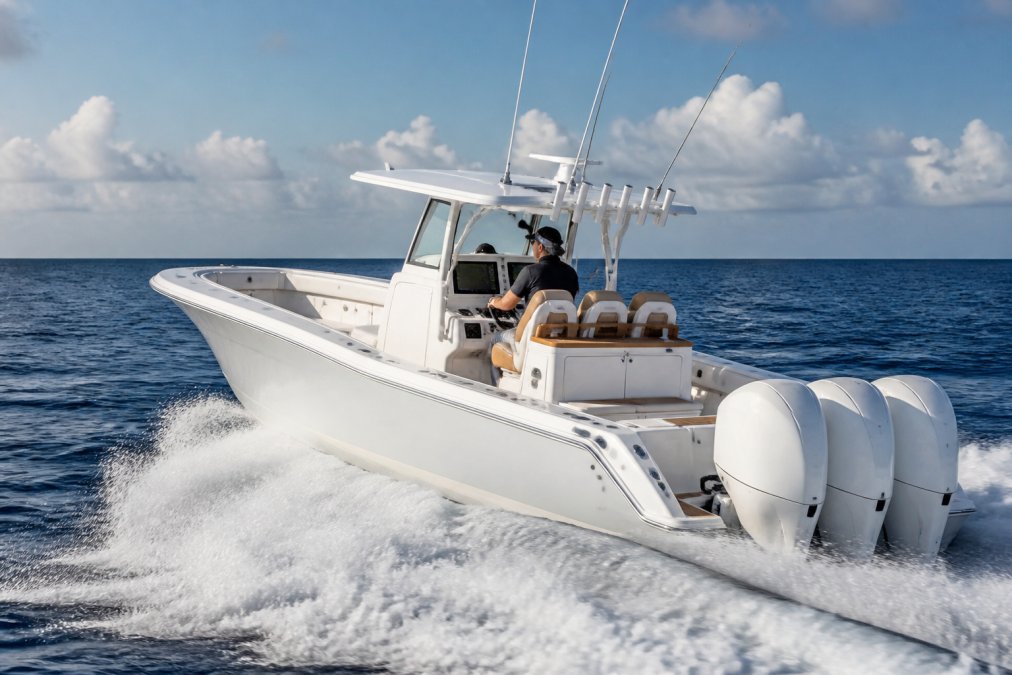
The Yellowfin 36 Offshore is the most versatile performer on this list. The twin-step hull delivers a genuinely dry ride at speed, the 10-foot beam provides stability for fighting fish, and the 477-gallon fuel capacity makes serious offshore runs practical. With up to 1,350 HP available through triple outboard configurations, the 36 Offshore can be built for tournament speed or efficient cruising.
What works: The twin-step hull delivers a noticeably drier ride than traditional deep-V competitors. Best for: Anglers and families who want one boat for Gulf Stream fishing, Bahamas crossings, and weekend cruising.
2. Contender 32 ST
The Contender 32 ST is built for one purpose: catching fish offshore as efficiently as possible. Hand-laid fiberglass construction with foam-cored stringer system produces a hull that is both stiff and light, translating directly to speed and fuel efficiency. The 300-gallon standard fuel tank is generous for a 32-foot boat.

What works: Rough water performance is exceptional in steep Gulf Stream seas. Best for: Hardcore tournament anglers prioritizing fishing over comfort.
3. Boston Whaler 360 Outrage
The Boston Whaler 360 Outrage is the most safety-conscious choice on this list without sacrificing serious offshore capability. The unsinkable hull construction is a structural reality that has made Boston Whaler the default recommendation for buyers who prioritize peace of mind alongside performance. The integrated hardtop with optional electronics packages makes the 360 Outrage one of the most complete turnkey offshore platforms available.
What works: Safety, durability, and resale value form a package no other builder matches at this size.
4. Regulator 34
The Regulator 34 delivers one of the most comfortable offshore rides in its class. The fish storage configuration is well-considered: an 88-gallon in-deck fish box, 42-gallon transom livewell, and 55-gallon transom fish box give serious anglers capacity for a full tournament day. Maximum horsepower of 1,050 HP provides plenty of performance headroom.

What works: The balance of ride quality and fish-specific features is hard to beat at this size.
5. Grady-White Canyon 336
The Grady-White Canyon 336 takes family-friendliness seriously. The SeaV2 hull design produces a soft, dry ride that non-anglers appreciate, and optional diesel generator and air conditioning make extended trips genuinely comfortable. The integrated hardtop with rod holders and storage gives the Canyon 336 completeness that pure fishing machines lack.
What works: Ride quality in varied sea conditions is exceptional. The family-fishing balance is the best on this list.
6. Invincible 36 Open Fisherman
The Invincible 36 Open Fisherman is the choice for buyers who prioritize speed and efficiency above all else. The 100% vinylester resin hull with vacuum-bagged cored construction produces a boat that is both light and stiff, enabling speed without sacrificing seaworthiness. With 475 gallons of standard fuel capacity and a maximum of 1,350 HP, the range and performance numbers are serious.
What works: Speed, efficiency, and construction quality form a compelling package for hardcore offshore anglers.
7. Pursuit S 378 Sport
The Pursuit S 378 Sport reimagines what a center console can be. The patented entertainment center converts from fishing deck to dining setup, and a massive hardtop features an electric retractable sunshade. Triple Yamaha outboards deliver the performance to back up the luxury appointments.
What works: The versatility is real. This boat transitions from a serious fishing platform to an entertaining venue without awkward compromises. Best for: Buyers with dual passions for offshore fishing and coastal entertaining.
8. Scout 350 LXF
The Scout 350 LXF brings a full cabin with berth and head to the center console category, changing overnight capability. The stepped hull design delivers efficiency at cruise, and the integrated hardtop with full windshield adds weather protection that open-cockpit boats cannot match.
What works: The combination of a full cabin, stepped hull performance, and advanced helm electronics makes this a genuine crossover platform.
9. Cobia 344 CC
The Cobia 344 CC earns its place by delivering offshore capability at a more accessible price point. Large fish boxes, twin or triple engine options, and an integrated hardtop give buyers core offshore fishing features without premium brand markup.
What works: The price-to-capability ratio is strong for buyers who want offshore performance without brand prestige.
Offshore Fishing Boat Features That Separate Good from Great
The best offshore center console fishing boats share features that go beyond horsepower and hull length.
Deck Layout, Rod Storage, and Tackle Station Design
A well-designed deck layout determines whether a fishing day is productive or frustrating. Rod storage capacity, tackle station placement, and gunwale height all affect how efficiently a crew can fish. Gunwale height matters more than most buyers realize. Too low and spray comes aboard in rough conditions; too high and fighting a fish becomes awkward. Premium offshore center consoles typically run gunwale heights calibrated for standing anglers in 2-3 foot seas.
T-Top vs. Hardtop: Shade, Electronics, and Structural Differences
A T-top is a lightweight, open frame structure that provides shade and a mounting surface for marine electronics. A hardtop is a solid, structural overhead that offers more weather protection and better electronics integration. For South Florida offshore fishing, the hardtop has become the preferred configuration on boats 34 feet and above. According to the U.S. Coast Guard's recreational boating safety guidelines, proper electronics mounting and visibility are critical factors in offshore safety.
Livewell Capacity, Fish Box Size, and Transom Configuration
Livewell capacity is a fishing-specific specification that general reviews frequently underweight. A livewell that cannot maintain water temperature and oxygen levels in South Florida summer conditions is a liability on a tournament day. The Regulator 34's transom configuration, with a dedicated livewell and separate fish box, is a benchmark worth using when evaluating any offshore center console.
Center Console Boat Buyer's Guide: New vs. Used and Total Cost of Ownership
Buying an offshore center console is a long-term financial commitment. The purchase price is only the beginning.
Buying Used: What to Inspect on an Offshore Center Console
A used offshore center console in South Florida has almost certainly spent significant time in saltwater conditions, which accelerates corrosion and wear on expensive components. The inspection checklist should include:
- Hull osmotic blistering: Check the hull bottom carefully for blistering, which indicates water intrusion into the fiberglass laminate.
- Stringer and transom integrity: Press firmly on the transom and listen for soft spots. Wet or delaminated stringers are a serious structural issue.
- Outboard engine hours and service history: Request complete service records. Gaps in service history are a red flag.
- Electrical systems: Corrosion in marine electrical systems is common and expensive to remediate.
- Livewell and bilge pump operation: Test all pumps under power. The bilge should be dry.
A professional marine survey from a certified surveyor is non-negotiable on any pre-owned offshore center console above 30 feet.
Total Cost of Ownership: Beyond the Purchase Price
Total cost of ownership for an offshore center console over five years typically includes annual maintenance, engine service, bottom paint, insurance, dockage, fuel, and systems upgrades. Engine configuration has a direct impact on annual maintenance cost. Triple outboard configurations offer redundancy and performance but require three sets of service intervals. Fuel capacity and efficiency matter more than buyers realize. A boat with a 300-gallon tank and a fuel burn of 40 gallons per hour at cruise has a very different annual fuel cost profile than a stepped-hull boat burning 28 gallons per hour to achieve the same speed.
Regional Offshore Requirements for South Florida Buyers
South Florida imposes specific demands that buyers in other markets do not face. The Gulf Stream crossing to the Bahamas requires a minimum fuel range of 120 nautical miles in each direction, with reserve. Most experienced South Florida captains want 150+ nautical miles of range before they feel comfortable with a Bahamas run. For offshore runs beyond 20 miles from shore, experienced South Florida anglers typically carry EPIRB units, a life raft, a comprehensive first aid kit, and redundant navigation electronics. The U.S. Coast Guard's offshore safety equipment requirements provide the regulatory minimum, but local conditions warrant exceeding them. Summer weather patterns in South Florida also demand attention to radar capability.
Which of the Best Offshore Center Console Fishing Boats Fits Your Needs?
Choosing among the best offshore center console fishing boats ultimately comes down to three honest questions: How far offshore do you run? How often do you fish with non-anglers aboard? And what does your five-year ownership cost look like?
For pure offshore fishing performance, the Yellowfin 36 Offshore and Invincible 36 Open Fisherman lead the field. For family-fishing balance, the Grady-White Canyon 336 and Boston Whaler 360 Outrage are the most complete packages. For buyers who want luxury and fishing capability in equal measure, the Pursuit S 378 Sport and Scout 350 LXF are the strongest crossover options. The Contender 32 ST and Regulator 34 occupy the serious-angler middle ground. The Cobia 344 CC is the value play, delivering genuine offshore capability at a lower price point.
What most buyers get wrong is treating this as a brand decision rather than a specification decision. The hull geometry, fuel capacity, and deck layout of the specific model matter more than the name on the console. Get on the water in the conditions you actually fish before committing.
Selecting the right offshore center console deserves specialist guidance, not a generalist's shortlist. Primo Yachts of Palm Beach has focused exclusively on center console yachts since 2009. Every conversation starts with the right questions: your offshore range, your crew profile, and your real five-year cost tolerance. Contact Primo Yachts of Palm Beach to access a private register of pre-owned offshore center consoles and get expert guidance matched to South Florida's specific offshore demands.
Frequently Asked Questions
What makes a center console boat good for offshore fishing?
The most important factors are hull design, fuel capacity, and deck layout. A deep-V hull with sufficient deadrise handles rough offshore chop and delivers a dry ride. High gunwale height improves safety at sea. Large fuel tanks, generous livewell capacity, dedicated rod storage, and a functional tackle station allow you to fish far offshore for extended periods without compromising on fishability or crew safety.
What size center console is best for offshore fishing?
For serious offshore work in saltwater conditions, most experienced anglers target the 32- to 38-foot range. Boats in this class carry enough fuel for long runs, handle beam width requirements for stability, and still offer manageable vessel handling. Models like the Yellowfin 36, Regulator 34, and Contender 32 ST represent the sweet spot where seaworthiness, fishability, and outboard power options converge without excessive operating costs.
Which offshore fishing boat brands have the strongest resale value?
Boston Whaler and Grady-White consistently hold their value well in the used boat market, partly because of their build quality and brand recognition. Yellowfin, Regulator, and Contender also retain value strongly among serious sport fishing buyers. Fit-and-finish quality, fiberglass construction standards, and original engine configuration all influence resale. Boats with documented service records and original Seakeeper or marine electronics packages tend to command a premium at resale.
What should I inspect when buying a used offshore center console?
Focus on the hull for stress cracks, osmotic blistering, and transom flex, which can signal water intrusion in fiberglass construction. Check bilge access for moisture and staining. Inspect the stringers and deck for soft spots. Review outboard service logs and compression test results. Verify livewell pumps, trim tabs, and all through-hulls are functional. A pre-purchase survey by a certified marine surveyor is standard practice for any offshore vessel above 30 feet.
What is the total cost of owning an offshore center console fishing boat?
Purchase price is only part of the equation. Annual costs typically include dockage or dry storage, insurance, fuel, routine outboard service, bottom paint, and registration fees. Offshore models with triple outboard configurations consume significantly more fuel per hour than twin-engine setups. Marine electronics upgrades, Seakeeper gyro service, and periodic repower costs add to long-term ownership expenses. Buyers should budget for these recurring costs before committing to a specific model or power configuration.
This article was written using GrandRanker