 listicle
5 Top Rated Center Console Boat Brands for Rough Water
Table of Contents
- How We Evaluated These Center Console Boats
- 1. Regulator Marine: The Deep-V Standard
- 2. Contender Boats: Speed and Tournament Durability
- 3. Boston Whaler: Unsinkable Construction and Offshore Confidence
- 4. Yellowfin Yachts: Stepped-Hull Efficiency Meets Rough Water Handling
- 5. Everglades Boats: RAMCAP Safety and Luxury Fishing
- Best Offshore Center Console Boats Under 30 Feet
- Center Console Hull Design for Rough Water
- How to Choose an Offshore Fishing Boat
- Frequently Asked Questions
Last Updated: September 13, 2026
How We Evaluated These Center Console Boats
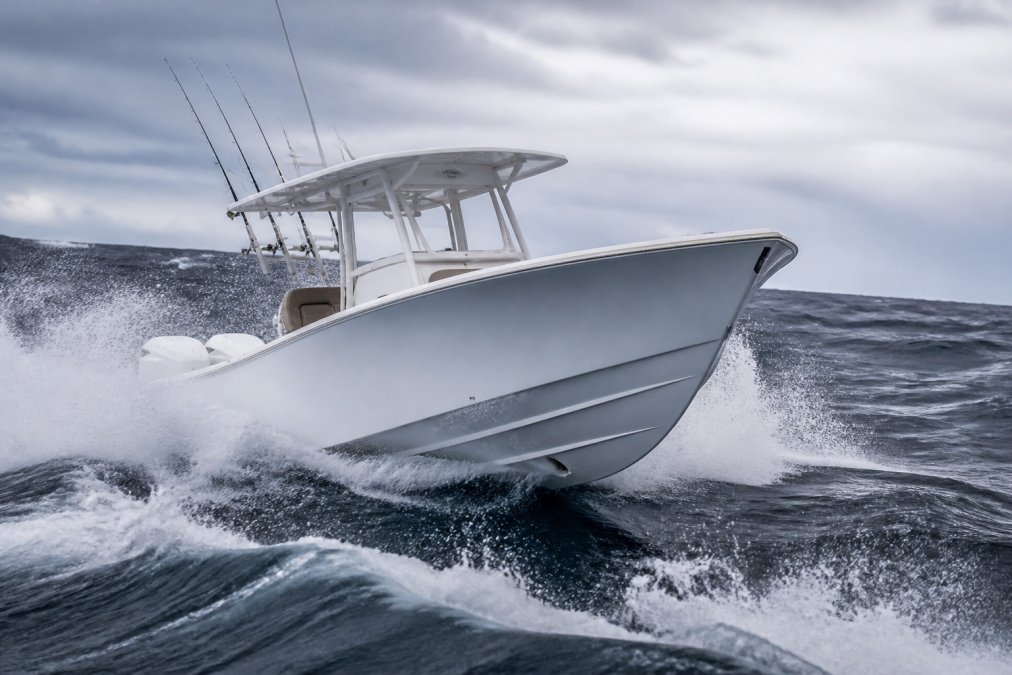
The 5 top rated center console boat brands for rough water earn that reputation through hull geometry, not marketing copy. At Primo Yachts of Palm Beach, we've brokered center consoles since 2009, and the boats that hold value and keep owners safe offshore share measurable traits: deadrise at the transom, bow flare, stringer system integrity, and how the hull behaves when the wind picks up to 20 knots.
This evaluation weighs five criteria that matter in real offshore conditions: deadrise angle and entry sharpness, construction method (hand-laid versus vacuum-bagged), stability at rest in a beam sea, cockpit drainage, and long-term durability. We also flag the trade-offs most listicles skip, including fuel burn, resale value, and how each hull tows.
| Brand | Hull Signature | Rough-Water Strength | Best For |
|---|---|---|---|
| Regulator Marine | Deep-V, 24-degree transom | Soft entry, dry ride | Serious offshore anglers |
| Contender Boats | High-speed hull geometry | Speed in chop | Tournament fishermen |
| Boston Whaler | Unibond foam core | Unsinkable stability | Safety-first families |
| Yellowfin Yachts | Stepped hull | Efficiency plus comfort | Performance owners |
| Everglades Boats | RAMCAP construction | Flotation and luxury | Fishing plus cruising |
1. Regulator Marine: The Deep-V Standard
Regulator built its name on one idea: a deep-V hull that stays composed when the ocean doesn't. The 24-degree transom deadrise and sharp entry let the bow knife through steep chop instead of slamming, which is why the brand shows up on so many short lists for offshore capability.
Pros: Exceptional structural integrity and strong resale value. Cons: The premium construction carries a higher price, and the ride is drier than it is fast.
2. Contender Boats: Speed and Tournament Durability
Contender targets the angler who runs 60 miles offshore before sunrise. Hand-laid fiberglass and high-speed hull geometry deliver a boat that eats up distance in rough seas, and the semi-custom deck layouts let owners build a fishing platform around their exact spread.
Pros: Superior handling at speed and highly customizable cockpits. Cons: The minimalist interior means fewer luxury cruising amenities than rivals.
3. Boston Whaler: Unsinkable Construction and Offshore Confidence
Boston Whaler's Unibond foam-injected hull is the closest thing the industry has to a household name for safety. The foam core bonds the inner and outer hull skins into one rigid unit, so the boat stays afloat even if it's cut in half.
That construction makes the Outrage series a serious offshore platform without the white-knuckle reputation. The trade-off is weight, which can cost you a knot or two against specialized tournament hulls.

4. Yellowfin Yachts: Stepped-Hull Efficiency Meets Rough Water Handling
Yellowfin solves a problem most builders ignore: rough water performance and fuel efficiency usually pull in opposite directions. The stepped-hull design breaks the water's grip along the running surface, which reduces drag and lifts the bow, so the boat runs faster on less fuel while the deep forward sections still handle a head sea.
Vacuum-bagged, cored construction keeps the hull light and stiff, and the helm ergonomics are built for long-range runs. Lead times for a custom build run long, so plan ahead.
5. Everglades Boats: RAMCAP Safety and Luxury Fishing
Everglades pairs the patented RAMCAP construction process, which injects high-density foam into the hull, with hydraulic sliding windshields and integrated hardtops. The result is a boat that fishes hard and cruises comfortably, with flotation and safety baked into the structure.
The catch: complex systems mean specialized maintenance. Buyers who want low-fuss ownership should budget for dealer service.
Best Offshore Center Console Boats Under 30 Feet
The best offshore center console boats under 30 feet balance beam width, draft, and fuel capacity against the realities of towing and storage. Southport Boats stands out here with a wide-beam design that produces excellent lateral stability and a dry ride in choppy conditions.
Cape Horn Boats takes the opposite approach: heavy-duty, foam-filled, self-bailing hulls built for ruggedness over luxury. Both are smart choices for anglers who want offshore capability without a 35-foot footprint.
| Model Type | Beam Width | Standout Trait | Best For |
|---|---|---|---|
| Southport wide-beam | Wide | Lateral stability | Families and anglers |
| Cape Horn deep-water | Large profile | Rugged simplicity | No-nonsense fishermen |
| Onslow Bay custom | Varies | Lightweight strength | Semi-custom buyers |
Center Console Hull Design for Rough Water
Center console hull design for rough water comes down to four measurable variables: deadrise angle, deadrise transition (also called variable deadrise), bow flare, and stringer grid rigidity. Understanding how they interact is the difference between a boat that merely survives a chop and one that runs comfortably through it.
Deadrise angle. Deadrise is the angle between the hull bottom and horizontal, measured at the transom. A 24-degree transom deadrise is the deep-V benchmark for offshore hulls; 20 to 22 degrees is a moderate-V compromise; anything under 18 degrees is a bay or flats hull that will pound in a head sea. More deadrise produces a softer entry and a drier ride, but it also increases wetted surface, which raises fuel burn and causes more roll at rest in a beam sea.
Variable deadrise. Most modern offshore hulls are not a constant angle from bow to stern. A sharp 60-degree-or-steeper entry at the bow transitions to 22 to 24 degrees at the transom. The sharp entry slices through steep chop; the flatter aft section provides lift and stability. The rate of that transition, how quickly the angle changes along the running surface, determines whether the hull carries its bow or falls off plane in a following sea.
Bow flare. Flare is the outward angle of the topsides above the waterline. Generous flare throws spray outward and down, away from the cockpit, which is what actually produces a "dry ride." Flare also adds reserve buoyancy forward, helping the bow rise rather than bury when running down-sea. Too much flare, however, catches wind and makes docking and slow-speed maneuvering harder.
Stringer grid rigidity. The stringer system is the longitudinal and transverse grid bonded into the hull. It determines whether the boat stays rigid after years of pounding. Hand-laid, fully tabbed stringers with foam or plywood cores and bonded bulkheads resist flex; minimally tabbed stringers in a thin hull will crack at the chine and delaminate over time. This is the single most overlooked variable in rough-water capability, because it does not show up on a spec sheet.
Lifting strakes and chine flats. Strakes add planing surface and deflect water down and out, improving lift and reducing spray. Chine flats, the horizontal surface at the hull-to-deck joint, add stability at rest and knock down spray. Their placement relative to the center of gravity affects whether the hull runs bow-high or bow-flat.
| Deadrise at Transom | Ride Character | Roll at Rest | Fuel Burn | Typical Use |
|---|---|---|---|---|
| 24°+ | Softest, driest | Most roll | Highest | Open ocean, long runs |
| 20-22° | Balanced | Moderate | Moderate | Coastal offshore |
| 18-20° | Firmer | Less roll | Lower | Nearshore, bays |
| Under 18° | Pounds in chop | Least roll | Lowest | Inshore, lakes |
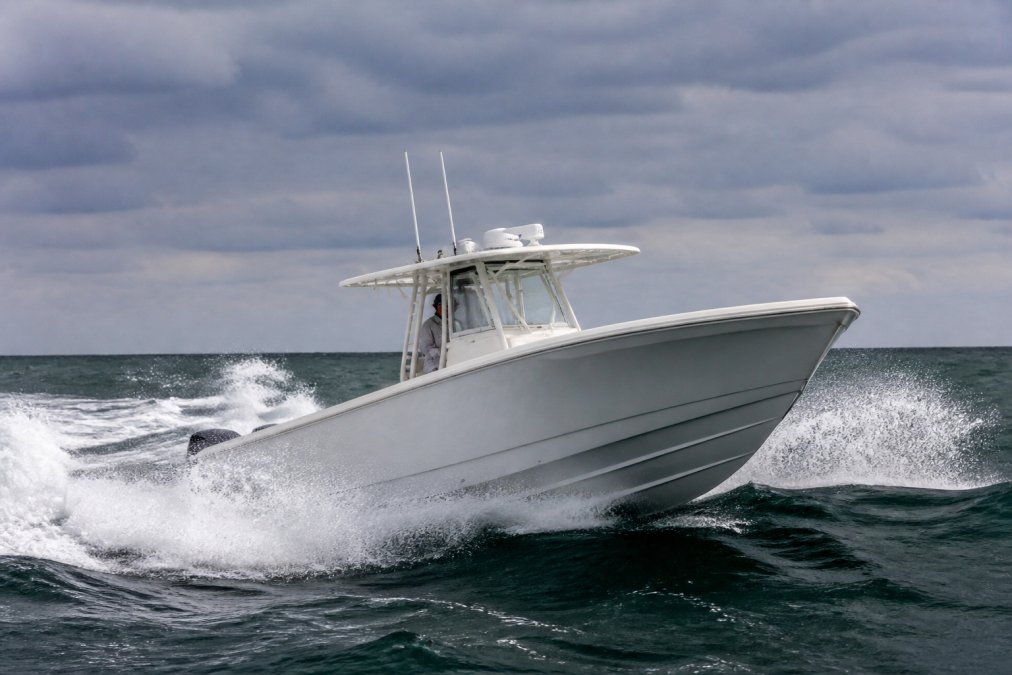
The fuel-burn trade-off most guides skip. Deep-V hulls burn more fuel in rough water than in calm water, and the gap widens with deadrise. A 24-degree hull running into a 3-foot head sea at cruise may burn 20 to 30 percent more fuel than the same hull running in flat conditions, because the sharper entry pushes more water aside and the hull spends more time at higher trim angles. Stepped hulls, like those used by Yellowfin, mitigate this by introducing a ventilated step that reduces wetted surface at speed. If your typical run is 50 miles each way, that fuel penalty is a real cost per trip, not a rounding error.
Towing and beam. A 24-degree deep-V in the 28- to 32-foot range typically carries an 8-foot-6-inch to 9-foot-6-inch beam and a dry weight north of 7,000 pounds. That combination often exceeds the towing capacity of a half-ton pickup once you add fuel, gear, and a trailer. Buyers who plan to trailer should verify beam limits in their state and confirm their tow vehicle's rated capacity before falling in love with a hull.
How to Choose an Offshore Fishing Boat
Choosing an offshore fishing boat starts with honest answers about where you fish and how far you run. Buyers who mostly fish nearshore don't need 24 degrees of deadrise; buyers who run 50 miles out do. The questions below are the ones that actually eliminate hulls from a shortlist.
Run distance and fuel capacity. A common rule of thumb is to carry enough fuel for your round-trip run plus a one-third reserve. A 50-mile run each way at a typical offshore cruise of 30 to 35 mph in a 30-foot center console will burn roughly 1.5 to 2.0 miles per gallon in moderate seas, so a 100-mile round trip consumes 50 to 65 gallons before reserve. That means a 200-gallon tank is comfortable; a 150-gallon tank is tight once you add trolling time. Deep-V hulls burn more in rough water, so build the reserve around your worst-conditions burn, not your best.
Head sea versus beam sea. Beam seas reward beam width and stability; head seas reward deadrise and entry sharpness. If you routinely run into a head sea, prioritize deadrise and bow flare. If you cross open water in a beam sea, prioritize beam width and a lower center of gravity. No single hull is best at both, so be honest about which condition dominates your fishing.
Trailerability and towing. Rough-water boats are heavy. A 30-foot deep-V center console on a trailer can exceed 10,000 pounds fully loaded. Most half-ton pickups top out around 9,000 to 11,000 pounds of tow rating depending on configuration, and that rating drops with passengers, gear, and tongue weight (nhtsa.gov). Verify your tow vehicle's actual rated capacity, check your state's beam limit for trailerable boats (commonly 8 feet 6 inches without a permit), and confirm your ramp and storage can handle the loaded weight.
Fishing platform versus cruising boat. The two pull in different directions. A pure fishing platform prioritizes cockpit space, rod storage, livewell capacity, and a clean transom. A cruising boat that fishes adds seating, a head, and amenities that eat into fishing space. Decide which one you actually use more.
Used market value and depreciation. Brands with strong resale tend to be the ones with proven hull integrity, because used buyers know which hulls hold up after years of offshore pounding. Well-regarded offshore center consoles typically depreciate more slowly than niche builders, and a hull with documented service history and no structural repairs commands a premium. When shopping used, look for stress cracks at the chine and transom, soft spots in the deck, and evidence of prior stringer or transom work. Those are the fingerprints of a rough-water life.
Ergonomics for long-range offshore travel. This is the angle most buyers overlook. A helm that's comfortable for a 20-minute bay run becomes punishing on a four-hour offshore run. Look for adjustable helm seating with bolsters, reachable controls, vibration-dampening helm pads, and a console layout that keeps electronics visible without forcing you to look down. Fatigue compounds: a captain who is fighting the wheel and squinting at gauges at hour three makes worse decisions at hour five. Ergonomic details are not luxury, they are safety equipment on a long run.
Frequently Asked Questions
What makes a center console boat good for rough water?
A center console boats rough water capability comes down to hull geometry and build quality. Deadrise angle determines how softly the hull enters waves, with 24-26 degrees being ideal for offshore conditions. Lifting strakes and bow flare push spray away from the cockpit. Construction matters too: hand-laid fiberglass, vacuum-bagged cored hulls, and foam-filled stringer systems add rigidity without excess weight. Brands like Regulator and Southport prioritize these traits, which is why they perform well when seas build.
Which hull design is best for offshore fishing in rough seas?
Deep-V hulls with a continuous deadrise of 24 degrees or more deliver the softest ride in head seas. Stepped-hull designs, used by Yellowfin and similar builders, reduce drag and improve fuel efficiency at speed but can feel looser in following seas. For pure rough water handling, a deep-V with lifting strakes and trim tabs gives the best combination of wave piercing and stability. The right choice depends on whether you prioritize comfort in chop or speed across calm water.
Are larger center consoles safer in heavy chop?
Larger center consoles generally handle heavy chop better because greater beam width and displacement provide more stability. A 34-foot hull with a 10-foot beam resists rolling more effectively than a 28-footer. However, size alone does not guarantee safety. Hull integrity, gunwale height, and cockpit drainage matter just as much. A well-built 30-foot boat with a deep-V hull and self-bailing deck can outperform a poorly designed 36-footer in rough conditions.
What is the minimum size center console for offshore use?
Most captains consider 28 feet the practical minimum for offshore fishing in the Atlantic or Gulf. At that length, you get enough beam width for stability, fuel capacity for range, and freeboard to keep waves out of the cockpit. Boats under 30 feet can fish offshore on calm days, but they limit your window of safe operation. If you plan to run 40 or more miles out regularly, a 32 to 36 foot center console gives more margin for changing conditions.
How do I evaluate the ride quality of a center console boat?
Sea trial the boat in conditions you actually fish. Pay attention to how the hull enters waves, whether it pounds or slices, and how much spray reaches the helm. Test at different speeds and trim settings. Check for hull slap at rest, which indicates a flat running surface. Ask about the stringer system and core materials. A boat that feels dry and planted in two to three foot chop will handle bigger seas with more confidence.