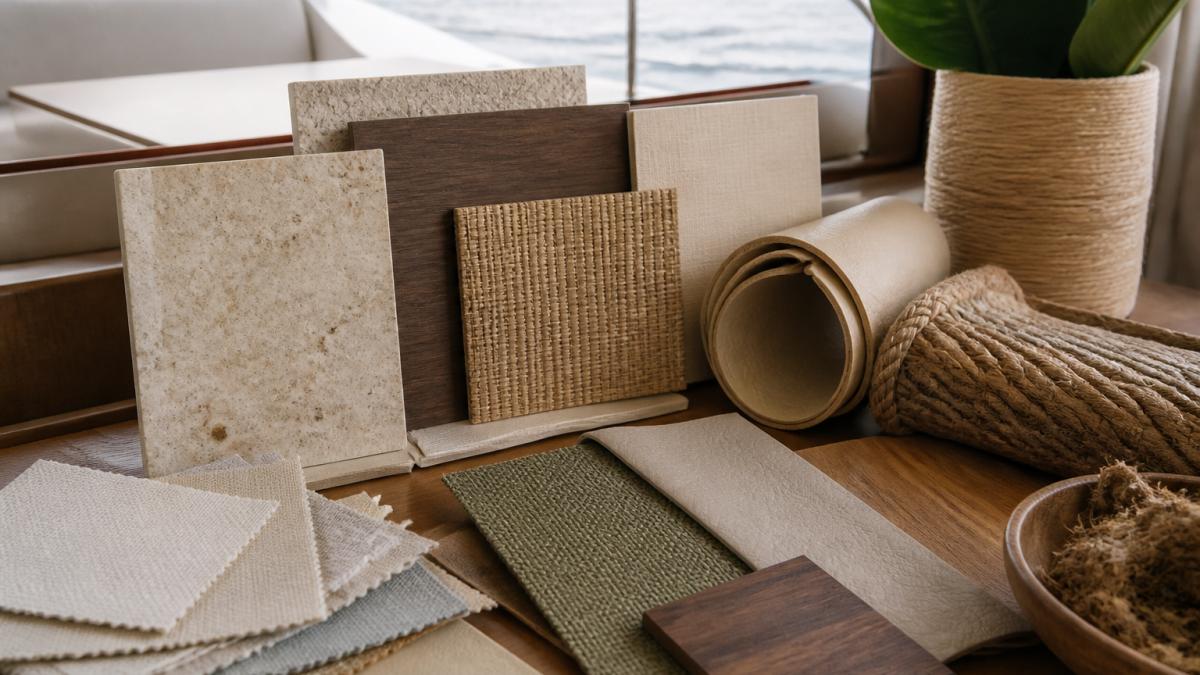
 ultimate-guide
Sustainable Materials for Luxury Yacht Interiors
Table of Contents
- The Shift Toward Sustainable Yachting
- Premium Eco-Friendly Marine Upholstery Fabrics
- Reclaimed and Recycled Materials in Interior Design
- Non-Toxic Finishes and Marine-Grade Performance
- Benefits of Sustainable Yacht Refits
- Luxury Yacht Interior Design Trends 2026
- Lifecycle Assessment and Supply Chain Transparency
- Regulatory Compliance and Fire Safety Standards
- Frequently Asked Questions
Last Updated: October 3, 2026
The Shift Toward Sustainable Yachting
Luxury yacht owners are rethinking what premium means. The conversation has shifted from pure opulence to conscious luxury, where sustainable materials for luxury yacht interiors represent both environmental responsibility and superior performance in marine environments.
Affluent yacht owners increasingly recognize that sustainable materials for luxury yacht interiors deliver measurable advantages: longer service life in salt-air conditions, reduced maintenance cycles, and graceful aging. A reclaimed teak cabin that weathers naturally for decades outperforms a veneered alternative requiring refinishing every few years.
Bespoke craftsmanship combined with environmental awareness has become the marker of true premium ownership. Sustainable procurement is a competitive advantage for refit specialists who understand marine-grade durability standards and can source materials meeting both aesthetic and performance requirements.
Premium Eco-Friendly Marine Upholstery Fabrics
Marine upholstery fabrics now deliver durability comparable to traditional synthetics while incorporating responsible sourcing and non-toxic production methods. The category breaks into two primary approaches: solution-dyed synthetics and natural fiber blends engineered for marine environments.
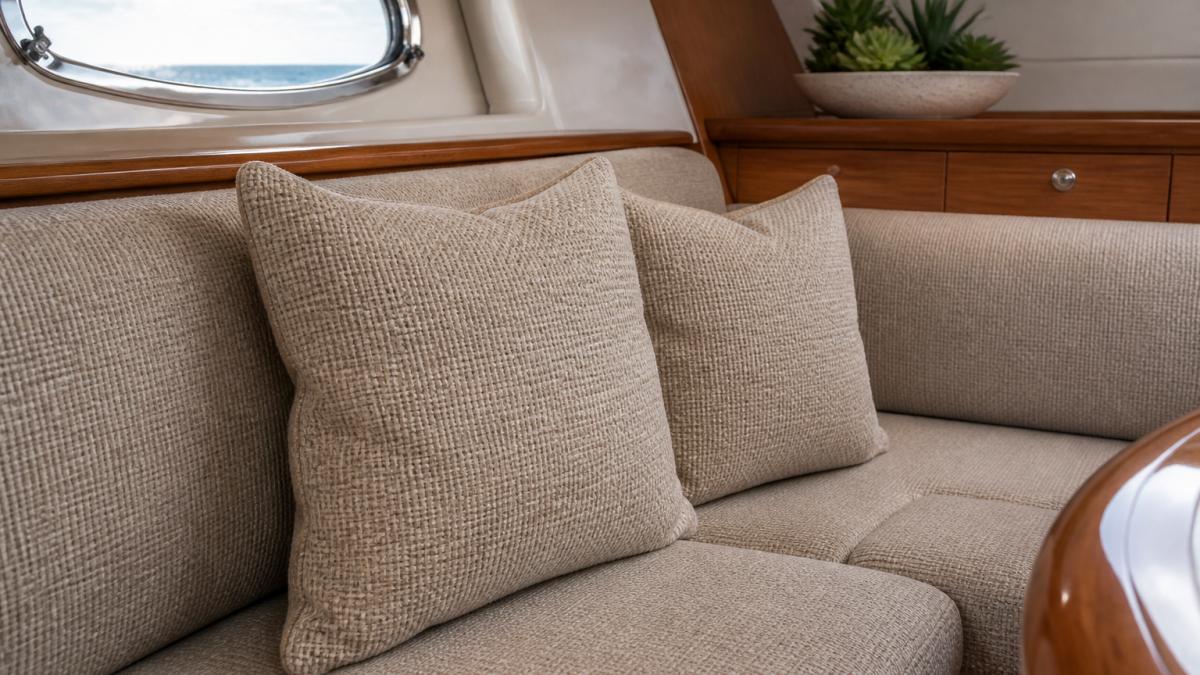
Solution-Dyed Acrylic and High-Performance Textiles
Solution-dyed acrylic integrates color during fiber production rather than applying dyes to finished material. This method reduces water consumption by up to 90% compared to traditional dyeing and eliminates secondary dye-bath waste.
Solution-dyed acrylic resists fading in UV-intense marine environments, maintains color integrity through salt spray exposure, and cleans without staining issues. These textiles feature VOC-free finishes and meet fire safety standards for enclosed marine spaces.
Solution-dyed acrylic fabrics rated for marine use typically carry 5-10 year warranties against fading and wear, reflecting realistic durability in demanding salt-air conditions.
Natural Latex and Organic Linen Options
Organic linen and natural latex appeal to owners prioritizing bio-based materials. Linen's breathability prevents mildew growth in humid marine environments, while natural latex eliminates off-gassing issues common in synthetic foams.
Natural fiber upholstery requires more maintenance than synthetics: organic linen needs regular cleaning to prevent salt accumulation, and natural latex cushions benefit from periodic conditioning.
Reclaimed and Recycled Materials in Interior Design
Reclaimed and recycled materials are now standard in high-end yacht interiors, combining sustainability impact with aesthetic authenticity. Reclaimed teak carries visible history that resonates with owners who understand craftsmanship.
Reclaimed Teak and Renewable Wood Resources
Reclaimed teak sourced from decommissioned structures offers environmental and performance advantages. Teak's natural oil content provides inherent resistance to salt water, rot, and marine boring organisms without requiring additional chemical treatment.
Reclaimed teak carries premium pricing because salvaged teak has undergone decades of seasoning, resulting in superior dimensional stability. It will not warp or expand unpredictably in response to moisture cycling, translating to longevity and reduced refit frequency.
Bamboo and sustainably harvested hardwoods provide cost-effective renewable alternatives. Bamboo's tensile strength exceeds many hardwoods and, when certified sustainable, represents a genuinely renewable resource for marine trim and accents.
Recycled PET and Sustainable Plastics
Recycled PET (polyethylene terephthalate) serves yacht interior components, trim rings, and hardware backing plates. Its saltwater corrosion resistance matches virgin plastic performance while reducing production carbon footprint.
Recycled PET diverts plastic waste from landfills and reduces virgin plastic production demand, representing a concrete sustainability action within the refit budget.
Recycled PET maintains structural integrity in marine environments, resists UV degradation, and meets fire safety classifications for enclosed spaces.
Non-Toxic Finishes and Marine-Grade Performance
Non-toxic finishes have matured to match traditional marine coatings in durability and salt-spray resistance, but achieving both eco-responsibility and maritime fire safety certification remains technically complex.
The Fire Safety Compliance Challenge
SOLAS (Safety of Life at Sea) standards and USCG regulations specify flame-spread ratings (ASTM E84 ≤25), smoke-development limits (≤450), and heat-release criteria that all interior materials must meet. This is where sustainable finishes encounter their greatest obstacle.
Traditional solvent-based marine polyurethanes achieve fire compliance through halogenated flame retardants and antimony compounds. Water-based polyurethane finishes require reformulation to meet fire criteria, demanding higher solid content, extended cure times, and rigorous environmental controls during application.
Water-based polyurethane finishes meeting SOLAS requirements require 7-14 days of controlled humidity (45-55%) and temperature (60-75°F) during cure. In humid marine environments, this demands temporary climate control systems, increasing labor costs and timelines compared to conventional finishes curing in 3-5 days.
Certified Sustainable Finish Systems
Water-based polyurethane finishes have achieved ASTM E84 certification for marine use, but certification is application-dependent. A finish certified for cabin soles may not be certified for overhead surfaces, requiring multiple finish systems within a single refit. Specifications should reference actual ASTM E84 test reports confirming the finish was tested in its exact application configuration.
Non-toxic sealants and adhesives must deliver structural integrity and waterproofing equivalent to conventional alternatives. Polyurethane-based sealants perform reliably in marine environments, but bio-based sealants often lack salt-spray resistance data. Specifications should include salt-spray test results (ASTM B117, minimum 1000 hours) for below-waterline applications.
Maintenance and Repairability Advantages
Water-based polyurethane systems are easier to repair than solvent-based alternatives. Spot repairs can be made without chemical hazards or specialized ventilation, reducing maintenance costs and operational disruption over a 15-20 year ownership cycle.
Water-based finishes resist yellowing from UV exposure better than solvent-based polyurethanes. Certified water-based systems withstand 2000+ hours of salt-spray exposure without substrate corrosion or finish failure.
Refit specifications should explicitly require:
- ASTM E84 test reports (not just product certifications) confirming flame-spread and smoke-development compliance
- Salt-spray test data (ASTM B117) for finishes in high-moisture areas
- Documented cure protocols with environmental monitoring during application
- Repair and maintenance procedures specific to the finish system
This level of specification rigor separates genuine sustainable performance from marketing claims, ensuring that your interior reflects both environmental responsibility and the demanding marine durability standards your vessel requires.
Benefits of Sustainable Yacht Refits
Sustainable yacht refits deliver tangible advantages beyond environmental positioning. The practical benefits accumulate across ownership cycles and directly impact resale value, operating costs, and owner satisfaction.
Sustainable materials engineered for marine environments, reclaimed teak, solution-dyed acrylic, natural latex, outlast conventional alternatives in salt-air exposure. Extended service life reduces refit frequency, allowing owners to avoid complete interior refresh for 15-20 years rather than the typical 8-10 year cycle.
Non-toxic finishes and natural fiber upholstery eliminate chemical off-gassing. Cabins finished with water-based polyurethane and organic linen upholstery feel healthier than conventional alternatives.
Resale value increasingly reflects sustainable specifications. A documented refit using reclaimed materials, eco-conscious upholstery, and non-toxic finishes commands premium pricing and attracts a broader buyer pool.
Luxury Yacht Interior Design Trends 2026
Current design direction emphasizes authenticity and material honesty, favoring visible material character, reclaimed teak's grain patterns, natural linen's texture, recycled materials' subtle imperfections, over perfect uniformity. This shift favors sustainable materials, which often display more visual interest than mass-produced alternatives.
Color palettes have shifted toward warm neutrals and natural tones that complement sustainable materials. Creams, warm grays, and earth tones work harmoniously with reclaimed wood and natural fibers, reducing pressure to specify exotic materials.
Minimalist detailing reflects owner preference for functionality without excessive ornamentation, reducing material waste and simplifying maintenance while showcasing sustainable materials.
Lifecycle Assessment and Supply Chain Transparency
Sophisticated yacht owners increasingly demand lifecycle assessment data and supply chain documentation, yet the yachting industry lacks standardized transparency frameworks. Understanding how to evaluate genuine sustainability claims is essential for owners making six-figure material investment decisions.
Lifecycle Assessment Methodology and What It Reveals
Lifecycle assessment (LCA) quantifies environmental impact across four phases: raw material extraction, manufacturing and transportation, use and maintenance, and end-of-life disposal. Reclaimed teak carries minimal extraction and manufacturing impact but may incur significant transportation carbon if sourced internationally.
Most yacht interior materials lack published LCA data. Owners must request LCA calculations from suppliers, and verification becomes critical.
Legitimate LCA studies follow ISO 14040/14044 methodology and are conducted by independent third parties. A supplier claiming LCA credentials should provide the full LCA report (not just a summary), certification of ISO 14040/14044 compliance, transparency on data sources, and clear definition of the functional unit. Without these elements, LCA claims are marketing assertions.
Certification and Third-Party Verification Standards
Several certification systems provide standardized verification of material sustainability claims:
Forest Stewardship Council (FSC) Certification applies to wood and wood products from forests managed according to environmental, social, and economic standards. FSC Chain of Custody certification documents that material originated from a certified source and maintained integrity through the supply chain. This is the gold standard for hardwood specification.
Global Organic Textile Standard (GOTS) certifies organic fibers and textiles produced without synthetic pesticides, processed without hazardous chemicals, and manufactured under fair labor conditions. Solution-dyed acrylic fabrics cannot be GOTS-certified, but natural linen and cotton upholstery should carry GOTS credentials if organic sourcing is claimed.
Cradle to Cradle (C2C) Certification evaluates material safety, reutilization, renewable energy use, water stewardship, and social responsibility across five categories (Bronze, Silver, Gold, Platinum). This certification is particularly valuable for recycled materials, verifying not just source material but the entire manufacturing process.
Red Flags for Greenwashing in Marine Material Sourcing
Certain claims should trigger skepticism without supporting documentation:
"Eco-friendly" or "sustainable" without certification. These terms have no legal definition. Any material claimed as sustainable should carry third-party certification (FSC, GOTS, C2C, or equivalent). Rigorous verification protocols must extend to the selection of interior surfaces, particularly when integrating eco-friendly flooring solutions into high-traffic marine environments.
Vague sourcing claims. "Responsibly harvested" without naming the specific forest or facility is a red flag. Legitimate suppliers identify geographic origin and provide certification documentation.
Recycled content without end-of-life data. A material made from 50% recycled content may landfill after its service life. Genuine circular-economy materials should have documented recyclability or compostability.
Carbon offset claims without verification. Offsets should be independently verified (Gold Standard or Verified Carbon Standard certification). Without verification, offset claims are unsubstantiated marketing.
Price that seems too low for claimed sustainability. Genuinely sustainable materials carry premium pricing due to certification costs and supply chain transparency. If a material is marketed as sustainable but priced below conventional alternatives, the claims warrant scrutiny.
Building a Verification Checklist for Your Refit
When evaluating material specifications for a yacht interior refit, request the following documentation:
- Certification documents (FSC, GOTS, C2C, or equivalent) for all materials claimed as sustainable
- LCA data showing environmental impact across lifecycle phases
- Supply chain documentation identifying the specific source and any intermediate suppliers
- Third-party audit reports confirming manufacturing practices and labor standards
- End-of-life documentation showing recyclability, compostability, or responsible disposal
- Performance testing data (salt-spray resistance, fire safety certification) confirming sustainability doesn't compromise marine-grade performance
Refit specialists who can provide this documentation distinguish themselves from competitors relying on marketing claims.
Regulatory Compliance and Fire Safety Standards
Sustainable materials for luxury yacht interiors represent genuine evolution in how premium ownership is defined. The convergence of environmental responsibility, superior durability, and refined aesthetics has shifted sustainable specifications from niche preference to competitive standard. When you're evaluating a yacht refit or considering interior upgrades, prioritize specialists who understand both the environmental credentials and the marine-grade performance requirements.
Frequently Asked Questions
What are the most durable sustainable materials for marine interiors?
Solution-dyed acrylic fabrics, natural latex, reclaimed teak, and recycled PET rank among the most durable options for yacht interiors. These materials meet marine-grade durability standards while minimizing environmental impact. Solution-dyed acrylics resist fading and moisture degradation, natural latex provides long-lasting cushioning, reclaimed teak offers proven longevity, and recycled PET delivers structural integrity. Pairing these with VOC-free, non-toxic finishes ensures both performance and responsible sourcing.
How does sustainable interior design impact the resale value of a luxury yacht?
Sustainable yacht refits increasingly appeal to affluent buyers who value environmental awareness and long-term durability. Eco-conscious interiors using high-performance textiles, responsible sourcing practices, and marine-grade materials often command stronger resale interest because they reduce future maintenance costs and align with luxury market trends. Transparent supply chain documentation and certifications for eco-friendly materials can differentiate your vessel in a competitive market.
Are recycled materials suitable for high-traffic areas on a yacht?
Yes, when selected correctly. Recycled PET and solution-dyed acrylic textiles are engineered for high-performance applications and handle heavy use effectively. Recycled materials in galley areas, cabin seating, and circulation spaces perform as well as virgin materials when they meet marine-grade standards. The key is pairing them with proper marine-grade durability testing and non-toxic finishes that prevent degradation from salt spray and UV exposure.
What certifications should I look for in eco-friendly yacht materials?
Look for certifications that verify marine-grade performance, fire safety compliance, and responsible sourcing. Standards such as ASTM International specifications for marine textiles, VOC-free certifications for adhesives and finishes, and third-party lifecycle assessment documentation ensure materials meet both luxury and environmental standards. Certifications for responsible sourcing of reclaimed teak and transparency in supply chains add credibility to sustainability claims.