 ultimate-guide
Negotiating Yacht Purchase Agreements in Florida
Table of Contents
- The Clock Starts at Signing: Why the Contract Sets the Tone
- FYBA Yacht Purchase Agreement Template: Your Starting Point
- Marine Survey Contingencies in Boat Contracts: Your Exit Ramp
- Yacht Purchase Deposit Escrow Process: How Your Money is Protected
- Negotiating 'As-Is' Clauses and Price Adjustments
- International vs. Domestic Florida Closings: Key Differences
- Post-Closing Registration, Titling, and Documentation
- Final Word on Yacht Purchase Negotiations
- Frequently Asked Questions
Last Updated: September 9, 2026
The Clock Starts at Signing: Why the Contract Sets the Tone
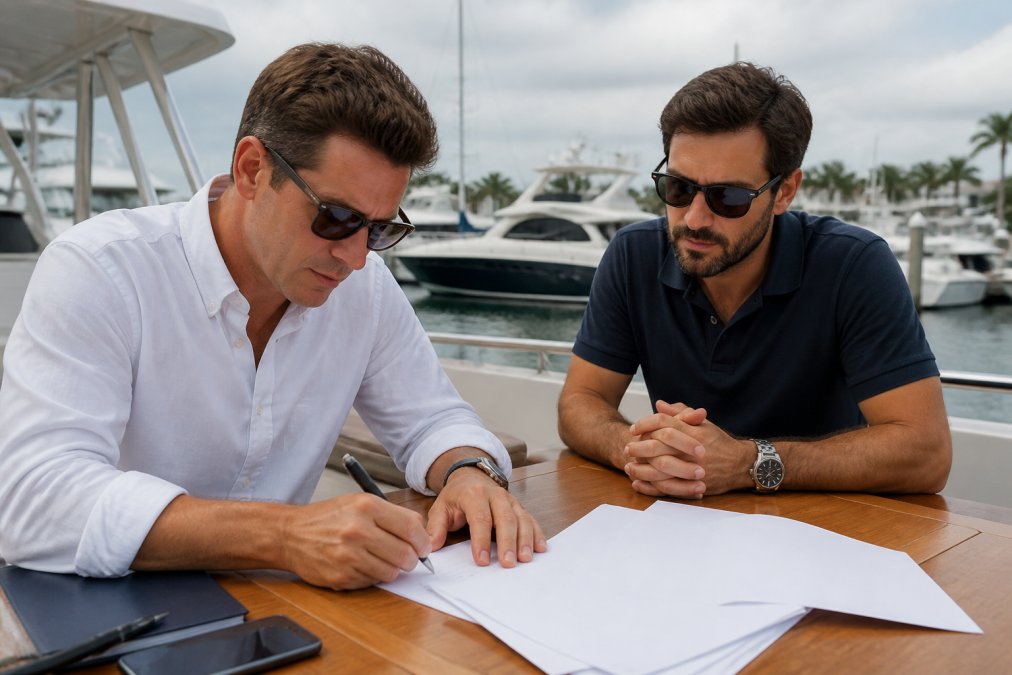
A yacht purchase agreement is the single most important document in a Florida boat transaction, yet many buyers treat it as a formality. Negotiating yacht purchase agreements in Florida starts the moment the deposit check is written, and the terms you accept at signing determine your use for every issue that surfaces later. At Primo Yachts of Palm Beach, we have guided buyers through this process since 2009.
The contract allocates risk, sets inspection deadlines, and defines what happens when a survey reveals problems. A well-structured agreement protects your deposit and gives you clear exit ramps.
FYBA Yacht Purchase Agreement Template: Your Starting Point
Most Florida yacht transactions begin with the Florida Yacht Brokers Association (FYBA) standard purchase agreement, the industry baseline for negotiating yacht purchase agreements in florida. Designed by brokers to be fair to both parties, it remains a starting point rather than a finished document. The blanks you fill in and the addenda you attach are where the real negotiation happens.
The FYBA template gives you a neutral foundation. It addresses the basic allocation of risk, including the buyer's right to a marine survey and sea trial, but the specific parameters of those contingencies are left open. A buyer who simply signs the template without negotiating the details forfeits the protection the form was designed to provide. The Florida Yacht Brokers Association publishes guidance on standard practices for member brokers, which is worth reviewing before you enter negotiations Florida Yacht Brokers Association standard contract guidance.
Marine Survey Contingencies in Boat Contracts: Your Exit Ramp
Marine survey contingencies in boat contracts are your primary protection against inheriting expensive problems. A survey contingency states that the purchase is conditional on a satisfactory pre-purchase inspection by a qualified marine surveyor of your choosing.
The contingency should specify who conducts the survey, when it must occur, and what constitutes grounds for rejection or renegotiation. A common approach requires the survey within ten to fourteen days after contract execution. The clause should also address haul-out costs and establish what happens if the survey reveals conditions affecting the vessel's safety, value, or intended use.
The Negotiation Sequence: What Happens After the Report Lands
The moment your surveyor emails the final report, the clock on your contingency window starts ticking. Most experienced Florida buyers follow a disciplined three-step sequence: review the report with your surveyor to separate critical safety issues from deferred maintenance and cosmetic concerns; obtain written repair estimates from at least two independent marine contractors for significant findings; and schedule a strategy call with your broker to decide whether to request a price reduction, require repairs before closing, or terminate.
Approaching the seller with a survey report alone invites a debate about severity; approaching with itemized contractor estimates shifts the conversation from opinion to documented cost. Present the seller with a summary sheet listing each finding, the estimated repair cost, and a total.
Setting the Repair Allowance Threshold
The most consequential number in your survey contingency is the repair allowance threshold, the dollar amount of survey findings that triggers your right to renegotiate or walk away. Set it too low, and you will negotiate over minor cosmetic issues. Set it too high, and you lose the ability to address significant deficiencies.
A practical approach establishes a threshold covering meaningful mechanical, structural, or safety concerns while excluding normal wear and tear. Many experienced buyers structure the clause so findings exceeding the threshold give them the option to terminate or negotiate a repair allowance or price reduction, tied to written estimates from qualified contractors.
For a typical center console yacht in the $200,000 to $500,000 range, a threshold of $5,000 to $10,000 is common; for larger vessels or those with complex systems, it may be set higher. A $500 threshold on a $400,000 yacht creates constant conflict over trivial findings; a $25,000 threshold effectively waives your right to negotiate for anything short of a major failure.
The 'Cost to Cure' Strategy: Your Strongest Leverage
The most effective negotiation technique after a survey is the cost-to-cure approach. Rather than demanding the seller fix every item, you calculate the total cost to bring the vessel to the condition represented in the listing and purchase agreement. You then present the seller with a clear choice: reduce the purchase price by that amount, complete the repairs before closing with invoices as proof, or release you from the agreement with a full deposit refund.
Most sellers prefer a price reduction because it avoids coordinating repairs and the risk of the buyer rejecting the work quality. A seller who insists on making repairs themselves may be minimizing out-of-pocket costs with cheaper labor or used parts. Your written estimates from established marine contractors provide a credible benchmark for professional-standard repair costs.
Structuring Sea Trial Contingencies
The sea trial contingency is your opportunity to verify the vessel performs as represented under real operating conditions. This clause should specify the trial conditions, including sea state, duration, and who is aboard. During the trial you should verify engine performance, steering response, electronics operation, and overall handling.
Your agreement should state that the sea trial is conducted at the seller's expense for fuel and that a representative of the seller or broker is present. If the vessel fails to perform satisfactorily, your contingency should permit you to terminate or require the seller to remedy deficiencies before closing.
A well-drafted sea trial clause also addresses the weather. Florida's afternoon thunderstorms are a seasonal reality, and your contingency should allow for rescheduling if sea conditions prevent a meaningful evaluation.
Surveyor Selection: Who You Choose Matters
Your choice of surveyor can make or break the negotiation. The FYBA standard agreement gives the buyer the right to select the surveyor, and you should exercise that right deliberately. Look for a surveyor accredited by the Society of Accredited Marine Surveyors (SAMS) or certified by the National Association of Marine Surveyors (NAMS).
Equally important is finding a surveyor who specializes in your vessel type. A surveyor who primarily inspects sailing vessels may miss failure points common to high-performance center console yachts with outboard engines. Ask for references from recent transactions and review sample reports to assess detail and photograph quality.
Yacht Purchase Deposit Escrow Process: How Your Money is Protected
The yacht purchase deposit escrow process protects both parties by placing your funds with a neutral third party until the conditions of the agreement are met. Your deposit is typically held in an escrow account established by the brokerage or an independent closing agent, and it is not released to the seller until closing.
Who Holds the Money: Brokerage vs. Independent Escrow Agent
The first decision is where the deposit is held. In many Florida transactions, the listing brokerage holds it in its trust account. The FYBA requires member brokers to maintain separate trust accounts for client funds, and Florida Statutes impose fiduciary obligations on how those funds are handled. Some buyers prefer an independent escrow agent or title company, particularly for larger deposits.
A brokerage trust account is convenient and familiar to most sellers, which can make your offer more competitive. An independent escrow agent adds a layer of separation some buyers find reassuring. For deposits above $100,000, many experienced buyers choose an independent escrow service or require proof of the brokerage's trust account and professional liability insurance.
Deposit Amounts: What Is Normal in Florida
Deposit amounts in Florida yacht transactions typically range from 5 percent to 10 percent of the purchase price. On a $300,000 center console, a $15,000 to $30,000 deposit is common; on higher-value vessels, the percentage may be lower, with $50,000 to $100,000 typical for yachts in the $1 million range. The deposit demonstrates your seriousness as a buyer and provides the seller with liquidated damages if you default without a contractual basis.
Sellers and their brokers scrutinize the deposit amount as a signal of your commitment. A low deposit may raise questions about your financial readiness; a deposit that is too high exposes you to unnecessary risk if a dispute arises.
The Escrow Instructions: What Must Be Written Down
The escrow instructions should specify the conditions under which the deposit is refunded or forfeited. If you terminate based on a valid survey or sea trial contingency, the deposit is returned in full. If you walk away without a contractual basis, the seller may be entitled to the deposit as liquidated damages.
Your purchase agreement should explicitly state the timeline for deposit release. A common provision requires the escrow agent to return the deposit within three to five business days of receiving written notice of termination. If the parties disagree about release, the escrow agent typically holds the funds until the parties reach a resolution, obtain a court order, or agree to mediation.
Florida's Dispute Resolution Framework
When a deposit dispute arises, Florida law provides several paths forward. The FYBA offers a dispute resolution process for transactions involving member brokers, which can be faster and less expensive than litigation. Many FYBA purchase agreements require mediation before either party can file a lawsuit.
If mediation fails, the parties may proceed to court. Florida courts generally enforce liquidated damages provisions in yacht purchase agreements if the amount is reasonable relative to the seller's actual damages; a deposit of 10 percent of the purchase price is typically considered reasonable.
The Closing Agent's Role in Fund Transfers
The closing agent coordinates the final transfer of funds and execution of closing documents. At closing, the deposit is applied to the purchase price, and the buyer provides the balance, typically via wire transfer. The closing agent verifies that all conditions have been met, confirms the title is clear of liens, and disburses funds to the seller and the brokerage commission.
Wire transfer fraud is a growing concern in Florida yacht transactions. Scammers intercept closing instructions and redirect funds to fraudulent accounts. Reputable closing agents provide wire instructions only through secure channels and confirm them verbally before you transfer funds. Never rely solely on email instructions.
Post-Closing Deposit Release and Final Accounting
After closing, the escrow agent provides a final accounting showing the deposit application, the balance paid, and the disbursement to the seller. Retain copies of all escrow documents, wire confirmations, and the final accounting. If the vessel is U.S. Coast Guard documented, the closing agent will also coordinate the filing of the bill of sale and the documentation transfer with the Coast Guard's National Vessel Documentation Center.
For state-registered vessels, the FLHSMV requires a bill of sale, the original certificate of title, and proof of sales tax payment before issuing a new title. Your closing agent should coordinate these filings, but the responsibility for completing the transfer ultimately rests with you.
Negotiating 'As-Is' Clauses and Price Adjustments
Many Florida yacht listings include an "as-is" clause, but this term is more negotiable than sellers would have you believe. An as-is sale means the buyer accepts the vessel in its current condition, but it does not waive your right to a survey or your ability to negotiate based on findings.
When survey findings reveal significant deficiencies, the as-is clause does not prevent you from seeking a price adjustment. The negotiation shifts from whether the seller is responsible for the defects to what the vessel is worth in its actual condition.
International vs. Domestic Florida Closings: Key Differences
The distinction between international and domestic Florida closings matters more than most buyers expect, particularly regarding documentation and tax treatment. A domestic closing involves a U.S. citizen or resident buyer and a vessel that will remain documented or registered in the United States. An international closing involves a foreign buyer, a foreign-flagged vessel, or a transaction resulting in the vessel leaving U.S. waters.
For international transactions, the closing process often requires additional documentation, including a power of attorney if the buyer is not present, and careful attention to the vessel's flag state requirements. The transfer of title for a U.S. Coast Guard documented vessel follows a different process than a state-registered vessel, and the closing agent must coordinate the appropriate filings U.S. Coast Guard vessel documentation requirements. Domestic closings are generally more straightforward, but they still require a bill of sale, a certificate of title or documentation, and the proper tax filings with the state.
Post-Closing Registration, Titling, and Documentation
The closing is not the end of the process, and buyers who overlook post-closing registration and titling can face delays and penalties. If the vessel is U.S. Coast Guard documented, the closing agent will file the necessary paperwork to transfer the documentation and record the new owner.
For a documented vessel, you will also need to file for a new certificate of documentation and ensure that any preferred ship mortgages are satisfied or transferred. The hull identification number must match across all documents, and a title search should confirm that no liens or encumbrances remain against the vessel. The Florida Department of Highway Safety and Motor Vehicles handles vessel registration and titling, and their requirements are available online Florida vessel registration and titling information. Your yacht broker should coordinate these steps to ensure a clean transfer of title.
Final Word on Yacht Purchase Negotiations
Negotiating yacht purchase agreements in florida rewards preparation and penalizes haste. Buyers who secure the most favorable terms understand that every clause, from the survey contingency to the deposit escrow process, is an opportunity to protect their interests.
At Primo Yachts of Palm Beach, we bring specialist brokerage experience to every transaction. Our focus on premium center console yachts and offshore fishing vessels means we understand the specific survey issues, sea trial expectations, and documentation requirements that matter for these vessels.
Frequently Asked Questions
What are the most critical contingencies to include in a yacht purchase agreement in Florida?
The non-negotiable contingencies are the marine survey and the sea trial. Your survey contingency should specify a clear repair allowance threshold; if the surveyor finds issues exceeding that amount, you can renegotiate or walk away. The sea trial contingency must verify the vessel's performance, including engine checks at cruising speed. Both should have defined deadlines for completion and written notice requirements for requesting repairs or a price adjustment.
How does the FYBA yacht purchase agreement template protect buyers?
The Florida Yacht Brokers Association (FYBA) contract is the industry standard because it balances buyer and seller interests. It clearly defines the deposit escrow process, establishes timelines for the survey and sea trial, and outlines the procedures for requesting repairs. The form's structure makes it harder for a seller to withhold legitimate survey findings. However, you should still have your broker or maritime attorney review the addenda, as sellers often attach their own conditions.
How are deposits handled during the yacht purchase escrow process?
Your deposit is held in a third-party escrow account, often managed by the brokerage or a closing agent. It is not released to the seller until you sign a written release form, typically after the survey and sea trial are acceptable. If you cancel within your contingency periods, the deposit is returned. If you cancel without a valid contingency, you risk deposit forfeiture, which is why documenting every request and approval in writing is critical.
Can I negotiate the price after the marine survey finds problems?
Yes, the survey report gives you real negotiation leverage. If the surveyor finds defects or needed repairs, you can formally request the seller fix them or lower the price to cover the estimated repair allowance. Your broker will present a written request citing the survey findings. The seller can agree, counter, or refuse. If they refuse and the issues exceed your contingency threshold, you can terminate the agreement and recover your escrow deposit.
The yacht purchase agreement is your roadmap to a successful closing, but only if you negotiate it with care. Whether you are buying or selling a premium vessel, the team at Primo Yachts of Palm Beach provides the specialized expertise to protect your interests at every stage. Contact us to discuss your next transaction.